Zeolite in Aquaculture: Benefits, Uses and Limitations
25/10/2026
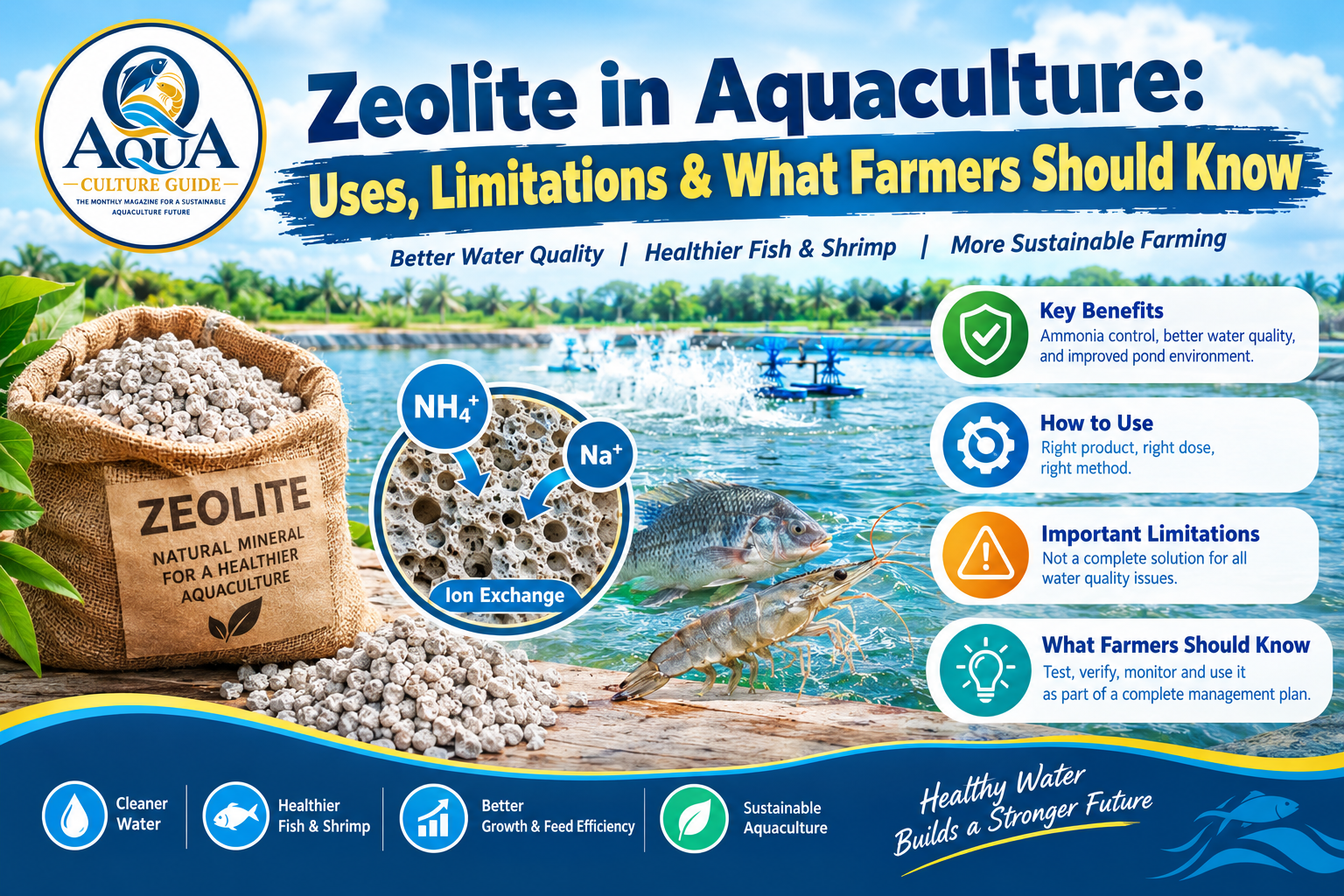
Learn how zeolite is used in aquaculture, its benefits for ammonia management, application precautions, limitations, and practical tips for fish and shrimp farmers.
Introduction
Maintaining good water quality is essential for successful fish and shrimp farming. Ammonia accumulation, excess organic waste, and unstable pond conditions can affect aquatic animal health, feeding, growth, and survival. To manage these challenges, farmers use different water treatment methods, including aeration, biological filtration, water exchange, and selected mineral products.
Zeolite is a naturally occurring or manufactured porous aluminosilicate mineral that can help remove ammonium from water through ion exchange. It is used in some aquaculture systems to support ammonia management, particularly in freshwater environments.
However, zeolite is not a complete solution for every water quality problem. Its performance depends on the mineral type, water chemistry, salinity, ammonia concentration, and application method. A product that performs well in freshwater may be much less effective in brackish or seawater because other dissolved ions compete with ammonium for exchange sites.
What Is Zeolite?
Zeolite is a mineral with a porous crystal structure containing channels and spaces that can hold and exchange certain positively charged ions.
In aquaculture, natural zeolite products commonly contain clinoptilolite, a mineral known for its ability to exchange ammonium ions under suitable conditions.
The main purpose of using zeolite in water management is to help reduce the concentration of ammonium in water. Its effectiveness depends on the product's mineral composition, particle size, water chemistry, and contact time.
How does zeolite work?
Zeolite contains exchange sites that can attract and hold ammonium ions (NH₄⁺). Under suitable conditions, these ions can exchange places with other ions within the mineral structure.
This process is called ion exchange.
For example:
- Fish waste and uneaten feed contribute nitrogenous waste to pond water.
- Microbial processes convert some of this waste into ammonia and ammonium.
- Suitable zeolite may capture part of the ammonium from the water.
- The amount removed depends on the product and surrounding water chemistry.
An important distinction is that zeolite does not automatically eliminate all forms of ammonia, and it does not destroy nitrogen. It temporarily retains ammonium until the exchange sites become occupied or the material is regenerated or removed.
Major Uses of Zeolite in Aquaculture
- Supporting ammonia management
Suitable zeolite can reduce ammonium in some freshwater systems. This may help when ammonia loading is temporarily elevated, but testing and addressing the underlying cause remain essential.
2. Supporting water treatment systems
Selected zeolite products may be used as part of a treatment system or filtration arrangement. Their performance should be evaluated alongside biological filtration, aeration, and routine water quality monitoring.
- Pond management support
Some farmers apply mineral products as part of a broader pond management programme. However, applying zeolite to pond bottoms does not guarantee removal of accumulated sludge or prevent all water quality problems.
- Water treatment in hatcheries and tanks
In suitable freshwater hatchery or tank systems, zeolite may be useful as an additional ammonium-removal medium. Its capacity, replacement schedule, and compatibility with the system must be established before routine use.
Benefits of Zeolite in Fish and Shrimp Farming
When the correct material is used under suitable conditions, zeolite may offer several benefits.
- Ammonium adsorption through ion exchange: Can reduce ammonium concentrations in suitable freshwater systems.
- Additional treatment option: May complement other water quality management measures.
- Potential use in filtration: Some products can be incorporated into appropriate filtration systems.
- Practical handling: Many granular products are relatively easy to store and handle.
- Targeted use: Can be useful when testing confirms that ammonium removal is an appropriate intervention.
These benefits are conditional. Zeolite is not a replacement for good feeding practices, appropriate stocking density, adequate dissolved oxygen, functioning biological filtration, or regular water quality testing.
Important Limitations of Zeolite
This is the most important section for farmers to understand before purchasing or applying zeolite.
Limitation 1: It works differently in freshwater and seawater
Zeolite's ammonium-exchange capacity can be significantly reduced in brackish water and seawater. Sodium, potassium, calcium, magnesium, and other dissolved ions compete for exchange sites.
As a result, a product that works well in freshwater may provide limited ammonia removal in a shrimp pond with high salinity.
Farmer's takeaway: Do not assume that zeolite will control ammonia in shrimp ponds simply because it is advertised for aquaculture. Check product performance under the actual salinity conditions of your farm.
Limitation 2: Its capacity is finite
Zeolite has a limited number of ion-exchange sites. Once those sites become occupied, its ability to capture additional ammonium decreases.
Adding more of the same material without checking the underlying cause may increase costs without solving the problem.
Limitation 3: It does not solve every water quality problem
Zeolite is not a universal treatment for:
- Low dissolved oxygen.
- High nitrite concentrations.
- Unstable pH.
- Low alkalinity.
- Excess sludge and organic waste.
- Bacterial or viral diseases.
- Poor feed management.
Each problem needs a suitable diagnosis and management response.
Limitation 4: Product quality varies
Commercial products differ in mineral composition, purity, particle size, moisture content, and exchange capacity. Some may contain substantial amounts of minerals that contribute little to ammonium removal.
Farmers should purchase from reliable suppliers and request technical specifications rather than relying only on a product's marketing claims.
Limitation 5: Used zeolite can retain nitrogen
After capturing ammonium, zeolite may retain nitrogen within its structure. If the material is regenerated, discarded, or reused improperly, that nitrogen can return to the environment or water system.
Used material should therefore be handled according to its condition, product guidance, and local environmental requirements.
Complete Step-by-Step Guide to Using Zeolite in Aquaculture
There is no single application rate that is suitable for every pond. The appropriate amount depends on the product's verified exchange capacity, the water volume, ammonia concentration, salinity, and the intended treatment method.
Follow these steps before applying any product.
Step 1: Identify the water quality problem
Test the pond water before deciding whether zeolite is necessary.
Check:
- Total ammonia nitrogen (TAN).
- pH and water temperature.
- Dissolved oxygen.
- Nitrite.
- Salinity, particularly in shrimp culture.
- Alkalinity, where relevant.
Remember that TAN includes both NH₃ and NH₄⁺. The more toxic unionised ammonia fraction, NH₃, generally increases as pH and temperature rise.
If aquatic animals are gasping, swimming abnormally, or dying, treat the situation as urgent and seek qualified aquaculture support.
Step 2: Select the correct zeolite product
Before purchasing, confirm:
- The product's mineral type and composition.
- Whether it is intended for aquaculture use.
- Its stated ammonium-exchange capacity and test conditions.
- Whether performance data apply to freshwater, brackish water, or seawater.
- Recommended application method and precautions.
- Whether the product has been tested for relevant contaminants.
Avoid products with unclear composition or unsupported claims of immediate ammonia removal.
Step 3: Confirm whether zeolite is suitable for your farm
For freshwater farms, suitable zeolite may be worth evaluating as a supplementary treatment.
For brackish-water or marine shrimp farms, first establish that the product can remove a meaningful amount of ammonium at the actual salinity of the pond. If reliable evidence is unavailable, prioritise proven water management practices instead of relying on zeolite.
Step 4: Calculate the treatment requirement
Determine the water volume and the ammonia concentration that needs to be managed.
For a rectangular pond:
Water volume (m)3= Length (m) x Width (m) x Average depth (m)
For an irregular pond, use a reasonable estimate of its actual water volume.
The product requirement should be based on verified working capacity under the farm's water conditions, not simply on the amount of ammonia present in the pond.
Ask the supplier or aquaculture specialist to help calculate the application rate. Do not use a general rate from another farm without confirming its suitability.
Step 5: Conduct a small-scale test where possible
Before treating an entire pond, evaluate the product in a controlled water sample or suitable small-scale trial.
- Use representative farm water.
- Follow the product's recommended contact time and handling instructions.
- Compare treated and untreated samples.
- Measure TAN before and after treatment.
- Record salinity, pH, temperature, and other relevant conditions..
Step 6: Apply according to the verified instructions
If the product is suitable and the treatment requirement is established:
- Follow the manufacturer's instructions for the intended use.
- Use the specified particle size and application method.
- Distribute the product evenly where pond application is recommended.
- Avoid creating unnecessary turbidity or disturbing pond-bottom sediment.
- Maintain adequate aeration and normal farm monitoring.
- Do not mix zeolite with other chemicals unless compatibility has been confirmed.
Step 7: Monitor water quality after application
Re-test at an interval appropriate to the product, treatment method, and severity of the problem.
Monitor TAN, pH, temperature, dissolved oxygen, and nitrite as needed. Compare the readings with the initial measurements to determine whether the treatment has produced a meaningful improvement.
If ammonia remains elevated, investigate continued waste loading, feed inputs, stocking density, biological filtration, and other contributing factors.
Step 8: Manage used material and plan follow-up treatment
For filter applications, follow the product-specific guidance for replacement or regeneration. Regeneration should only be performed using a validated procedure, with appropriate handling of the resulting waste.
For pond applications, do not assume the material can be recovered or reused effectively. Record the treatment and subsequent water quality readings so that future decisions are based on actual farm results.
Complete Checklist Before Using Zeolite
Use this checklist before applying zeolite to a fish pond, shrimp pond, hatchery, or filtration system.
Water quality assessment
[ ] Test TAN before application
[ ] Measure pH and temperature
[ ] Check dissolved oxygen
[ ] Test nitrite when appropriate
[ ] Measure salinity in brackish or marine systems
Product selection
[ ] Confirm the zeolite type and composition
[ ] Check verified ammonium-exchange capacity
[ ] Confirm suitability for the farm's salinity
[ ] Review supplier instructions and safety information
[ ] Check product quality and contaminant information
Application planning
[ ] Estimate the actual water volume
[ ] Establish the treatment objective
[ ] Confirm a suitable application rate
[ ] Conduct a small-scale trial where practical
[ ] Check compatibility with other treatments
After application
[ ] Maintain appropriate aeration
[ ] Repeat water quality testing
[ ] Record treatment and follow-up results
[ ] Investigate the cause if ammonia remains high
[ ] Handle used material and waste responsibly
Zeolite vs Other Ammonia Management Methods
Method Main purpose Important consideration
Zeolite Captures ammonium through ion exchange Effectiveness depends on water chemistry and available exchange capacity
Biological filtration Converts ammonia to nitrite and then nitrate Requires a functioning microbial community, oxygen, and suitable water chemistry
Feed management Reduces excess nitrogen entering the system Feeding must match biomass, appetite, and production conditions
Aeration Improves oxygen availability Does not directly remove ammonia, but supports aquatic animals and aerobic biological processes
Water exchange Dilutes pollutants when replacement water is suitable Water quality, biosecurity, availability, and discharge rules must be considered
Solids removal Removes waste and organic matter before further decomposition Requires suitable pond or system design and regular maintenance
The most effective strategy is usually a combination of good husbandry, waste management, suitable biological treatment, and routine monitoring. Zeolite may have a supporting role where its performance is demonstrated.
Common Mistakes Farmers Should Avoid
- Using zeolite without testing water: The real problem may be low oxygen, nitrite, or another water quality issue.
- Ignoring salinity: High concentrations of competing ions can reduce ammonium exchange.
3. Using an unverified dosage: Products differ in composition and working capacity.
4. Expecting instant results: Performance depends on contact time, water chemistry, and product characteristics.
- Ignoring the root cause: Excess feeding, high biomass, and accumulated waste may continue to generate ammonia.
- Replacing biological filtration with zeolite: Ion exchange does not provide the same long-term nitrogen processing as a functioning biofilter.
- Skipping follow-up testing: Without retesting, farmers cannot determine whether treatment was effective.
Conclusion
Zeolite can be a useful supporting material for ammonium management in aquaculture, especially in suitable freshwater applications. However, its effectiveness depends on mineral quality, water chemistry, salinity, and available ion-exchange capacity.
For fish and shrimp farmers, the priority should be to identify the actual water quality problem, select a suitable product, verify its performance, and monitor the results. Zeolite should complement good pond management rather than replace aeration, biological filtration, proper feeding, and routine testing.
The key takeaway: Test first, select the right product, apply according to verified guidance, and measure the results.
Questions & Answers
Q1.What is zeolite used for in aquaculture?
Zeolite is used primarily as an ammonium-exchange material. Under suitable conditions, it can help reduce ammonium concentrations in freshwater ponds, tanks, and selected filtration systems.
Q2.Does zeolite remove ammonia from fish ponds?
Suitable zeolite can capture ammonium, which is part of total ammonia nitrogen. However, the amount removed depends on the product, water chemistry, salinity, and contact time. It should not be assumed to remove all ammonia.
Q3.Is zeolite effective in shrimp farming?
It may be useful in some circumstances, but effectiveness can be limited in brackish and marine water because dissolved salts compete for exchange sites. Farmers should verify performance at their actual salinity before using it.
Q4.Can zeolite control high ammonia in aquaculture?
It may support ammonia management where its exchange capacity is sufficient. High ammonia still requires investigation of feed loading, waste accumulation, pH, temperature, oxygen availability, and biological treatment.
Q5.Does zeolite reduce nitrite?
Zeolite is primarily used for ammonium exchange, not as a direct treatment for nitrite. Nitrite accumulation requires assessment of nitrogen conversion, oxygen availability, biofilter performance, and the farm's overall water chemistry.
Q6.Can zeolite replace a biofilter?
No. Zeolite captures ammonium through ion exchange, while a biological filter supports microbial conversion of ammonia and nitrite. These are different processes.
Related articles
భారతీయ రిజర్వాయర్లలో కేజ్ ఫిష్ ఫార్మింగ్: సాంకేతికత, అనుమతులు మరియు పెట్టుబడి వివరాలు
భారతదేశంలోని రిజర్వాయర్లలో కేజ్ ఫిష్ ఫార్మింగ్ ఎలా ప్రారంభించాలి? అవసరమైన సాంకేతికత, ప్రభుత్వ అనుమతులు, పెట్టుబడి, చేపల జాతులు, మేత నిర్వహణ మరియు లాభనష్టాల గురించి పూర్తి వివరాలు తెలుసుకోండి.
Freshwater Prawn Farming in IndiaFreshwater Prawn Farming in India: రైతులకు పూర్తి సాగు మార్గదర్శిని
భారతదేశంలో మంచినీటి రొయ్యల సాగు ఎలా ప్రారంభించాలి? జెయింట్ ఫ్రెష్వాటర్ ప్రాన్ సీడ్ ఎంపిక, చెరువు తయారీ, స్టాకింగ్, ఆహారం, నీటి నాణ్యత, పెట్టుబడి, మార్కెటింగ్ గురించి పూర్తి వివరాలు తెలుసుకోండి.
Tilapia farming in Indiaభారతదేశంలో తిలాపియా చేపల పెంపకం – మార్కెట్ అవకాశాలు, ప్రభుత్వ నిబంధనలు మరియు ఆధునిక సాగు పద్ధతులు
భారతదేశంలో తిలాపియా చేపల పెంపకం ఎలా చేయాలి? మార్కెట్ అవకాశాలు, ప్రభుత్వ అనుమతులు, చెరువు సాగు, బయోఫ్లాక్, RAS విధానాలు, పిల్లల ఎంపిక, మేత నిర్వహణ మరియు దిగుబడి గురించి పూర్తి సమాచారం.
PCR Testing in Shrimp Hatcheriesరొయ్యల హ్యాచరీల్లో PCR పరీక్షలు: ఫలితాలను రైతులు ఎలా అర్థం చేసుకోవాలి?
WSSV, EHP, AHPND వంటి వ్యాధికారకాలను గుర్తించడంలో PCR పరీక్షల పాత్ర, పరీక్షా నివేదికలను అర్థం చేసుకోవడం, నాణ్యమైన రొయ్య పిల్లలను ఎంపిక చేసుకోవడం గురించి రైతులు తెలుసుకోవాల్సిన పూర్తి సమాచారం.
Explore Aqua Culture Guide
Aqua companies directory
Feed, seed, probiotics & equipment suppliers
Aquaculture calculators
Feed, FCR, stocking & water quality tools
Telugu aqua magazine
Read the latest monthly issue online
All aqua news & articles
Farming, disease control and market updates
List your company free
Get found by farmers across India
Advertise with us
Magazine and website advertising options