
Vannamei Shrimp Pond Alkalinity: Ideal Level & Management
3/10/2026
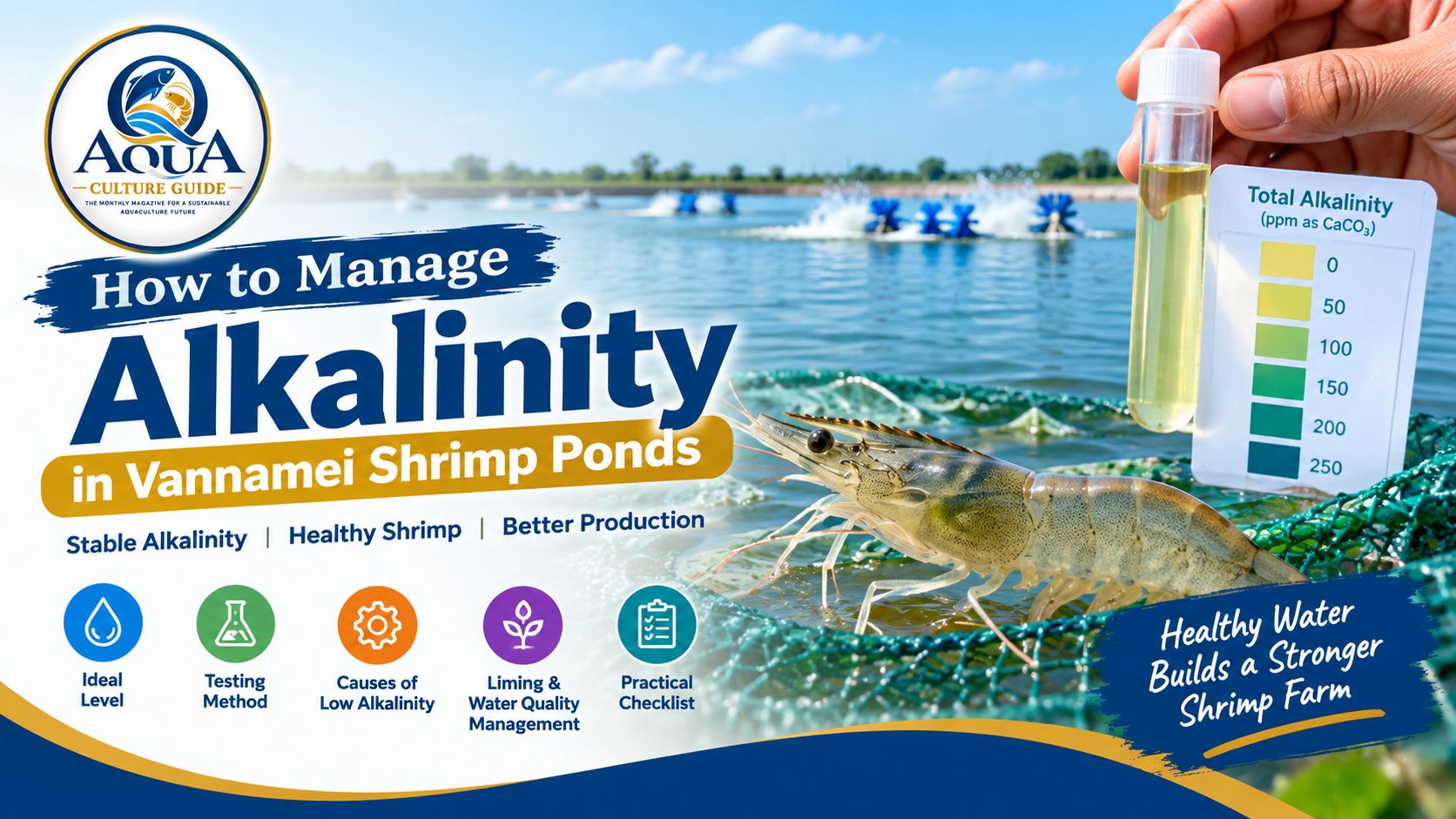
Learn how to manage alkalinity in vannamei shrimp ponds, including the ideal range, testing method, causes of low alkalinity, liming, water quality management and a practical farm checklist.
Vannamei Shrimp Pond Alkalinity: Ideal Level & Management
Alkalinity is an important part of water-quality management in vannamei shrimp farming.
Many farmers focus heavily on pH, ammonia and dissolved oxygen, but alkalinity is closely connected to pH stability and the overall carbonate system of the pond.
In simple terms, alkalinity is the buffering capacity of water. It helps the pond resist sudden changes in pH.
MPEDA currently gives 100–200 ppm as a reference range for total alkalinity in shrimp ponds. CAA's shrimp-farm guideline lists 200 ppm as an optimal reference value.
The important point is:
Do not manage alkalinity by looking at pH alone.
A good farmer should monitor:
Alkalinity + pH + dissolved oxygen + ammonia + temperature + salinity
together.
What Is Alkalinity in a Shrimp Pond?
Alkalinity is the water's ability to neutralize acids and resist changes in pH.
The main contributors to alkalinity in natural waters are carbonate and bicarbonate compounds.
It is commonly reported as:
mg/L as CaCO₃
or simply:
ppm as CaCO₃
For practical shrimp-farm management, when we say:
Total alkalinity = 150 ppm
we generally mean:
150 mg/L as CaCO₃
Why Is Alkalinity Important in Vannamei Farming?
Alkalinity is important because it helps maintain a more stable pH environment.
When alkalinity is too low, pH can become more difficult to stabilize and may show larger daily changes.
MPEDA explains that alkalinity acts as a buffering agent for water and gives 100–200 ppm as its current reference range.
What Is the Ideal Alkalinity for Vannamei Shrimp?
There are slightly different official references.
Source Reference for Total Alkalinity
MPEDA Better Management Practices 100–200 ppm
CAA shrimp-farm guideline 200 ppm
Simple farmer reference
For the Aqua Culture Guide article, you can present:
Target/reference range: 100–200 ppm as CaCO₃
with 200 ppm as the CAA optimal reference.
What Happens When Alkalinity Is Low?
Low alkalinity means the pond has less buffering capacity.
As a result, the water may be more susceptible to pH changes.
A typical pattern may be:
Low alkalinity → weaker buffering → larger pH fluctuation → greater management difficulty
What Causes Low Alkalinity in Shrimp Ponds?
- Heavy Rainfall
Rain can dilute pond water and reduce the concentration of buffering compounds.
MPEDA specifically recommends agricultural lime application after rainfall as part of its water-quality management practices.
- Water Exchange
Water exchange can change alkalinity depending on the chemistry of the incoming water.
If the new water has lower alkalinity than the pond, total alkalinity may decrease.
- Nitrification
Nitrifying bacteria consume alkalinity while converting nitrogen compounds.
This is particularly relevant in systems with significant nitrification activity.
Research summarized in FAO AGRIS confirms that nitrification can contribute to declining alkalinity in biofloc systems
- High Shrimp Biomass
As biomass increases, the biological load on the pond also increases.
More feed and waste can increase microbial activity and nitrogen transformation, which can increase alkalinity demand.
- Low-Alkalinity Source Water
Some water sources naturally have low alkalinity.
This can become more noticeable after repeated water exchange.
- Acidic Soil
Pond soil can influence water chemistry, particularly in ponds with acidic conditions.
Soil testing during pond preparation can therefore help identify potential problems before stocking.
What Causes Alkalinity to Change?
Alkalinity can change because of:
Rainfall → Water exchange → Nitrification → Biological activity → Soil-water interactions → Addition/consumption of carbonate and bicarbonate
This is why alkalinity should be treated as a dynamic water-quality parameter rather than a number that stays constant throughout the crop.
How Is Alkalinity Connected to pH?
This is one of the most important relationships for farmers.
Alkalinity provides buffering.
pH describes the current acid/alkaline condition.
So:
Alkalinity = buffering capacity
pH = current chemical condition
A pond can sometimes have acceptable pH at a particular moment while still having inadequate buffering capacity.
That is why farmers should measure both.
MPEDA recommends maintaining pH around 7.5–8.3 while maintaining total alkalinity around 100–200 ppm.
Alkalinity and Daily pH Fluctuation
During daylight:
Photosynthesis increases → CO₂ decreases → pH rises
At night:
Respiration increases → CO₂ increases → pH falls
Adequate alkalinity helps buffer these changes.
MPEDA recommends limiting the daily pH fluctuation to less than 0.5.
Example
Morning pH = 7.6
Afternoon pH = 8.3
Daily fluctuation:
8.3 − 7.6 = 0.7
This is above the MPEDA reference of less than 0.5.
When this happens, check:
Alkalinity → Plankton → DO → Temperature → Ammonia
Alkalinity and Ammonia
Alkalinity and ammonia are not the same thing, but they are part of the same overall water-quality system.
When ammonia increases, farmers should also check:
pH
Temperature
DO
Alkalinity
Nitrite
CAA specifically requires routine monitoring of alkalinity, total ammonia, unionised ammonia, nitrite and other water-quality parameters in L. vannamei culture
Alkalinity and Dissolved Oxygen
Alkalinity does not directly add oxygen to the pond.
However, the two parameters are connected through the overall biological condition of the pond.
A pond experiencing:
High organic load + high microbial activity + poor oxygen
can have several water-quality problems at the same time.
Therefore, when alkalinity drops unexpectedly, check DO as well.
MPEDA's reference for DO is 4–6 ppm, with early-morning monitoring recommended.
Step-by-Step Guide to Manage Alkalinity
Step 1: Measure Total Alkalinity
Use a reliable alkalinity test kit or laboratory analysis.
Record:
Total alkalinity = _____ ppm
Step 2: Check the Result Again
If the reading is unexpectedly low:
Repeat the test.
Check the test kit condition.
Follow the manufacturer's procedure.
Test a representative pond-water sample.
Consider laboratory confirmation when the decision is important.
Step 3: Check pH
Measure pH along with alkalinity.
Record:
Morning pH = _____
Afternoon pH = _____
MPEDA recommends checking pH at approximately 6 AM and 3 PM
Step 4: Calculate Daily pH Fluctuation
Use:
Afternoon pH − Morning pH
Example:
8.1 − 7.7 = 0.4
This gives you an immediate indication of the pond's daily pH movement.
Step 5: Check Dissolved Oxygen
Check DO, particularly during the early morning.
Record:
DO = _____ ppm
MPEDA recommends measuring DO at around 5–6 AM and gives 4–6 ppm as its reference range.
Step 6: Check Salinity
Salinity affects the overall mineral chemistry of the pond.
Record:
Salinity = _____ ppt
Also check whether salinity has changed recently because of:
Rain
Evaporation
Water exchange
Source-water changes
Step 7: Check Ammonia and Nitrite
When alkalinity becomes unstable, review the nitrogen cycle.
Check:
Total ammonia → Nitrite → DO → Feed → Biomass
Step 8: Check Recent Rainfall
Ask:
Did heavy rain occur recently?
If yes, check:
Alkalinity
pH
Salinity
DO
Temperature
Rainfall can change multiple water parameters at the same time.
Step 9: Review Recent Water Exchange
Look at:
Before exchange alkalinity
versus
After exchange alkalinity
If the incoming water has lower alkalinity, repeated exchanges can reduce pond alkalinity.
Step 10: Review the Feeding Program
Excessive feed can increase organic loading and microbial activity.
Check:
Feed quantity
Feed-tray response
Uneaten feed
Shrimp biomass
Recent feed increases
Step 11: Check Pond-Bottom Condition
Look for:
Black soil
Bad smell
Excess sludge
Uneaten feed
Organic accumulation
Step 12: Identify the Reason Before Correcting
Ask:
Is alkalinity low because of rain?
Is source water low in alkalinity?
Is there heavy water exchange?
Is nitrification consuming alkalinity?
Is the pond operating at high biomass?
Is the test result accurate?
Only after identifying the likely reason should you decide on the correction.
How to Increase Alkalinity in a Shrimp Pond
Different materials can be used to modify water alkalinity, depending on the pond condition and the intended effect.
Common materials used in aquaculture include:
Agricultural limestone (CaCO₃)
Dolomite
Bicarbonate-based materials
The correct material depends on whether the objective is primarily:
Buffering → pH correction → mineral supplementation → soil correction
Agricultural Lime for Buffering
MPEDA's current BMP guidance states that after rainfall and after every water intake/exchange, agricultural lime at 100 kg/ha should be mixed with water and applied throughout the pond as a buffering measure.
Important
This is an MPEDA BMP reference practice, not a universal dose for every pond.
The appropriate application should consider:
Existing alkalinity
Pond pH
Soil condition
Salinity
Water chemistry
Recent rainfall
Culture system
Lime vs Dolomite vs Bicarbonate
Material Common Purpose Important Point
Agricultural lime / CaCO₃ Buffering and alkalinity support Relatively gradual effect
Dolomite Calcium + magnesium supplementation and buffering Useful when mineral balance is also a concern
Bicarbonate Rapid alkalinity adjustment Dose should be calculated from measured water chemistry
Should You Use Quicklime to Increase Alkalinity?
Quicklime (CaO) is chemically different from agricultural lime (CaCO₃) and should not be treated as interchangeable.
Quicklime is much more reactive and can cause rapid pH changes.
MPEDA's pond-preparation guidance uses different lime materials for different purposes and bases soil correction on soil pH.
What If Alkalinity Is Very Low?
When alkalinity is significantly below the farm's target:
Step 1
Confirm the test.
Step 2
Check pH.
Step 3
Check DO.
Step 4
Check salinity.
Step 5
Check ammonia/nitrite.
Step 6
Review rainfall and water exchange.
Step 7
Check the pond bottom.
Step 8
Select an appropriate alkalinity-raising material.
Step 9
Apply according to the product's technical guidance and farm water volume.
Step 10
Retest rather than repeatedly applying material without measurement.
Why You Should Not Increase Alkalinity Too Quickly
The objective is stable water chemistry, not simply achieving a high number as quickly as possible.
Large, poorly calculated additions can change pH and mineral chemistry unnecessarily.
A better approach is:
Test → Calculate → Apply → Wait → Retest
rather than:
Test → Add a large amount → Test later
Can Alkalinity Fall in Biofloc Systems?
Yes.
Research summarized through FAO AGRIS reports that alkalinity and pH can decrease in biofloc systems because autotrophic bacteria involved in nitrification consume inorganic carbon.
This means biofloc farmers may need particularly careful monitoring of:
Alkalinity + pH + DO + biofloc condition + nitrogen compounds
How Often Should You Test Alkalinity?
There is no single frequency appropriate for every farm.
Testing should be more frequent when:
Heavy rainfall occurs
Significant water exchange occurs
The pond is heavily stocked
pH is fluctuating
Nitrification activity is high
Biofloc is being managed
Shrimp are showing unusual behavior
The pond has a history of low alkalinity
For a stable pond, follow your farm's routine monitoring schedule.
The important point is:
Test before making major corrections.
Alkalinity After Heavy Rain
Rain is one of the most common events that can disturb pond water chemistry.
After significant rainfall:
- Check pH.
- Check alkalinity.
- Check salinity.
- Check DO.
- Check temperature.
- Observe shrimp behavior.
Alkalinity After Water Exchange
Before water exchange:
Measure alkalinity
After water exchange:
Measure again
Compare the two results.
If incoming water has significantly different chemistry, repeated exchange may change the pond's alkalinity.
Alkalinity and Shrimp Molting
Mineral balance is important in shrimp farming.
MPEDA notes that low alkalinity in freshwater or low-salinity areas can affect shrimp survival and molting.
However, a molting problem should not automatically be blamed on alkalinity.
Also check:
Calcium
Magnesium
Salinity
Feed quality
Shrimp health
Water temperature
Other water-quality parameters
Alkalinity and Mineral Management
Alkalinity should not be confused with mineral concentration.
For example:
Alkalinity ≠ Calcium
Alkalinity ≠ Magnesium
A pond can have acceptable alkalinity but still have a mineral imbalance.
MPEDA highlights calcium and magnesium as important minerals in vannamei farming and gives a general Ca:Mg ratio reference of 1:3.
Common Signs That Should Trigger an Alkalinity Check
There may be no visible symptom caused by alkalinity alone.
However, consider checking alkalinity when you observe:
Large daily pH fluctuation
Repeated pH instability
pH dropping after rain
Low-salinity water conditions
Frequent water exchange
Changes in biofloc condition
Unexpected changes in nitrogen parameters
Remember that these signs have multiple possible causes.
Complete Step-by-Step Alkalinity Management Routine
Step 1
Measure total alkalinity.
Step 2
Record pH.
Step 3
Check morning and afternoon pH.
Step 4
Calculate the daily pH difference.
Step 5
Check DO.
Step 6
Check ammonia and nitrite.
Step 7
Check salinity and temperature.
Step 8
Review rainfall and water exchange.
Step 9
Inspect pond bottom.
Step 10
Review feed and biomass.
Step 11
Identify the likely cause.
Step 12
Select the appropriate alkalinity-management material.
Step 13
Calculate the application according to actual pond volume and product specification.
Step 14
Apply carefully.
Step 15
Retest alkalinity and pH.
Step 16
Continue monitoring the trend.
Complete Alkalinity Checklist for Farmers
Daily / Routine
☐ Check pH
☐ Check DO
☐ Observe shrimp behaviour
☐ Observe water colour
☐ Record unusual changes
Alkalinity Monitoring
☐ Total alkalinity tested
☐ Result recorded
☐ Test kit checked/calibrated as applicable
☐ Trend compared with previous readings
When Alkalinity Is Low
☐ Retest
☐ Check pH
☐ Check DO
☐ Check salinity
☐ Check ammonia
☐ Check nitrite
☐ Review rainfall
☐ Review water exchange
☐ Check pond bottom
☐ Review feed
☐ Review biomass
☐ Select appropriate corrective material
☐ Calculate dose based on actual water volume
☐ Retest after application
After Rainfall Checklist
☐ pH tested
☐ Alkalinity tested
☐ Salinity tested
☐ DO tested
☐ Temperature checked
☐ Shrimp behaviour observed
☐ Water colour observed
☐ Aerators checked
☐ Recent feed response reviewed
☐ Appropriate buffering action considered
Water Exchange Checklist
Before Exchange
☐ Test pond alkalinity
☐ Test incoming-water alkalinity
☐ Check incoming-water pH
☐ Check salinity
☐ Check disease risk
After Exchange
☐ Retest alkalinity
☐ Retest pH
☐ Check DO
☐ Observe shrimp behaviour
☐ Record results
Quick Reference: Vannamei Pond Water Quality
| Parameter | MPEDA Reference |
|---|---|
| Total alkalinity | 100–200 ppm |
| pH | 7.5–8.3 |
| Daily pH fluctuation | <0.5 |
| DO | 4–6 ppm |
| Temperature | 28–32°C |
| Salinity | 10–25 ppt |
| Transparency | 30–40 cm |
| Water colour | Green or brown |
CAA's separate guideline lists 200 ppm as its optimal total-alkalinity reference and pH of 7.5–8.5.
Common Alkalinity Management Mistakes
- Looking only at pH
A pH reading does not tell you the alkalinity.
- Adding lime without testing
First determine whether alkalinity actually needs correction.
- Using the same dose for every pond
Pond volume and water chemistry differ.
- Ignoring rainfall
Heavy rain can change alkalinity and other water parameters.
- Ignoring incoming-water chemistry
Water exchange can change alkalinity.
- Confusing alkalinity with minerals
Calcium and magnesium are separate measurements.
- Making very large corrections
Rapid changes can disturb pond chemistry.
- Ignoring biofloc/nitrification
These systems can consume alkalinity.
- Not checking pH after correction
Alkalinity and pH should be monitored together.
- Treating symptoms instead of the cause
The reason for falling alkalinity should be investigated.
Simple Alkalinity Management Formula
For farmers, the most important concept is that the amount of material required depends on the pond's water volume and the material's chemical characteristics.
A simple conceptual calculation is:
Required alkalinity increase = Target alkalinity − Current alkalinity
Then:
Required material = Required alkalinity increase × Pond water volume ÷ Material's effective alkalinity contribution
The exact calculation depends on the chemical used and its purity/equivalence.
For that reason, an online Aqua Culture Guide calculator should ask for:
Pond area → Average water depth → Current alkalinity → Target alkalinity → Material selected
and then calculate the required water volume and provide a material-specific calculation, rather than using one generic dose for all products.
Example: Understanding the Calculation
Suppose:
Current alkalinity = 80 ppm
Target = 120 ppm
Required increase:
120 − 80 = 40 ppm
This tells the farmer that the pond needs an increase of 40 mg/L as CaCO₃ equivalent.
The actual quantity of agricultural lime, dolomite or bicarbonate needed cannot be calculated correctly from this information alone. You also need:
Pond water volume
Product type
Product purity/equivalent
Intended rate of response
This is why measuring the pond volume is an important part of alkalinity management.
How to Measure Pond Water Volume
For a simple estimate:
Pond water volume = Surface area × Average water depth
For example:
Surface area = 4,000 m²
Average depth = 1.5 m
Water volume:
4,000 × 1.5 = 6,000 m³
Since:
1 m³ = 1,000 litres
Water volume:
6,000,000 litres
This is an estimate because actual pond depth is not perfectly uniform.
Why Pond Volume Matters
Imagine two ponds:
Pond A: 1 acre × 1.0 m average depth
Pond B: 1 acre × 1.5 m average depth
They have the same surface area but different water volumes.
Best Practice for Alkalinity Management
The most reliable approach is:
Test First
Know the actual alkalinity.
Understand the Cause
Rain? Exchange? Nitrification? Low-alkalinity water?
Choose the Correct Material
Don't treat every water-quality problem with the same product.
Calculate the Requirement
Use actual pond volume.
Apply Carefully
Follow the material's technical instructions.
Retest
Confirm the change.
Monitor the Trend
Make sure alkalinity remains stable.
Conclusion
Alkalinity is the pond's buffering system, and maintaining stable alkalinity can make pH management much easier.
For vannamei shrimp farming, MPEDA gives 100–200 ppm as a reference range for total alkalinity, while CAA lists 200 ppm as an optimal reference in its shrimp-farm guideline.
The best approach is not to add lime whenever pH changes.
Instead:
Test → Understand → Calculate → Apply → Retest → Monitor
Always consider alkalinity together with:
pH + DO + ammonia + nitrite + salinity + temperature + plankton + feeding + biomass
Questions & Answers
Q1.What is the ideal alkalinity for vannamei shrimp?
MPEDA gives 100–200 ppm as its reference range, while the CAA guideline lists 200 ppm as an optimal reference value.
Q2.What happens when alkalinity is low?
Low alkalinity means lower buffering capacity, which can make pH more difficult to stabilize and may contribute to larger daily pH fluctuations.
Q3.How do I increase alkalinity in a shrimp pond?
Depending on the water chemistry, farmers may use materials such as agricultural lime, dolomite or bicarbonate-based products. The appropriate material and quantity should be selected from the measured alkalinity, pond water volume and product characteristics.
Q4.Does agricultural lime increase alkalinity?
Agricultural limestone can contribute to the pond's buffering system and is used in shrimp-farm BMPs. MPEDA recommends agricultural lime at 100 kg/ha after rain and water intake/exchange as a buffering practice.
Q5.Can I use the same lime dose for every pond?
No. Pond volume, soil, water chemistry, salinity and the product itself can differ.
Q6.Does rain reduce alkalinity?
Rainfall can dilute pond water and alter alkalinity, depending on the source water and pond conditions. MPEDA specifically recommends agricultural lime after rainfall as part of its BMP.
Related articles
భారతీయ రిజర్వాయర్లలో కేజ్ ఫిష్ ఫార్మింగ్: సాంకేతికత, అనుమతులు మరియు పెట్టుబడి వివరాలు
భారతదేశంలోని రిజర్వాయర్లలో కేజ్ ఫిష్ ఫార్మింగ్ ఎలా ప్రారంభించాలి? అవసరమైన సాంకేతికత, ప్రభుత్వ అనుమతులు, పెట్టుబడి, చేపల జాతులు, మేత నిర్వహణ మరియు లాభనష్టాల గురించి పూర్తి వివరాలు తెలుసుకోండి.
Freshwater Prawn Farming in IndiaFreshwater Prawn Farming in India: రైతులకు పూర్తి సాగు మార్గదర్శిని
భారతదేశంలో మంచినీటి రొయ్యల సాగు ఎలా ప్రారంభించాలి? జెయింట్ ఫ్రెష్వాటర్ ప్రాన్ సీడ్ ఎంపిక, చెరువు తయారీ, స్టాకింగ్, ఆహారం, నీటి నాణ్యత, పెట్టుబడి, మార్కెటింగ్ గురించి పూర్తి వివరాలు తెలుసుకోండి.
Tilapia farming in Indiaభారతదేశంలో తిలాపియా చేపల పెంపకం – మార్కెట్ అవకాశాలు, ప్రభుత్వ నిబంధనలు మరియు ఆధునిక సాగు పద్ధతులు
భారతదేశంలో తిలాపియా చేపల పెంపకం ఎలా చేయాలి? మార్కెట్ అవకాశాలు, ప్రభుత్వ అనుమతులు, చెరువు సాగు, బయోఫ్లాక్, RAS విధానాలు, పిల్లల ఎంపిక, మేత నిర్వహణ మరియు దిగుబడి గురించి పూర్తి సమాచారం.
PCR Testing in Shrimp Hatcheriesరొయ్యల హ్యాచరీల్లో PCR పరీక్షలు: ఫలితాలను రైతులు ఎలా అర్థం చేసుకోవాలి?
WSSV, EHP, AHPND వంటి వ్యాధికారకాలను గుర్తించడంలో PCR పరీక్షల పాత్ర, పరీక్షా నివేదికలను అర్థం చేసుకోవడం, నాణ్యమైన రొయ్య పిల్లలను ఎంపిక చేసుకోవడం గురించి రైతులు తెలుసుకోవాల్సిన పూర్తి సమాచారం.
Explore Aqua Culture Guide
Aqua companies directory
Feed, seed, probiotics & equipment suppliers
Aquaculture calculators
Feed, FCR, stocking & water quality tools
Telugu aqua magazine
Read the latest monthly issue online
All aqua news & articles
Farming, disease control and market updates
List your company free
Get found by farmers across India
Advertise with us
Magazine and website advertising options