Vannamei Shrimp Farming: From Pond to Harvest
30/9/2026
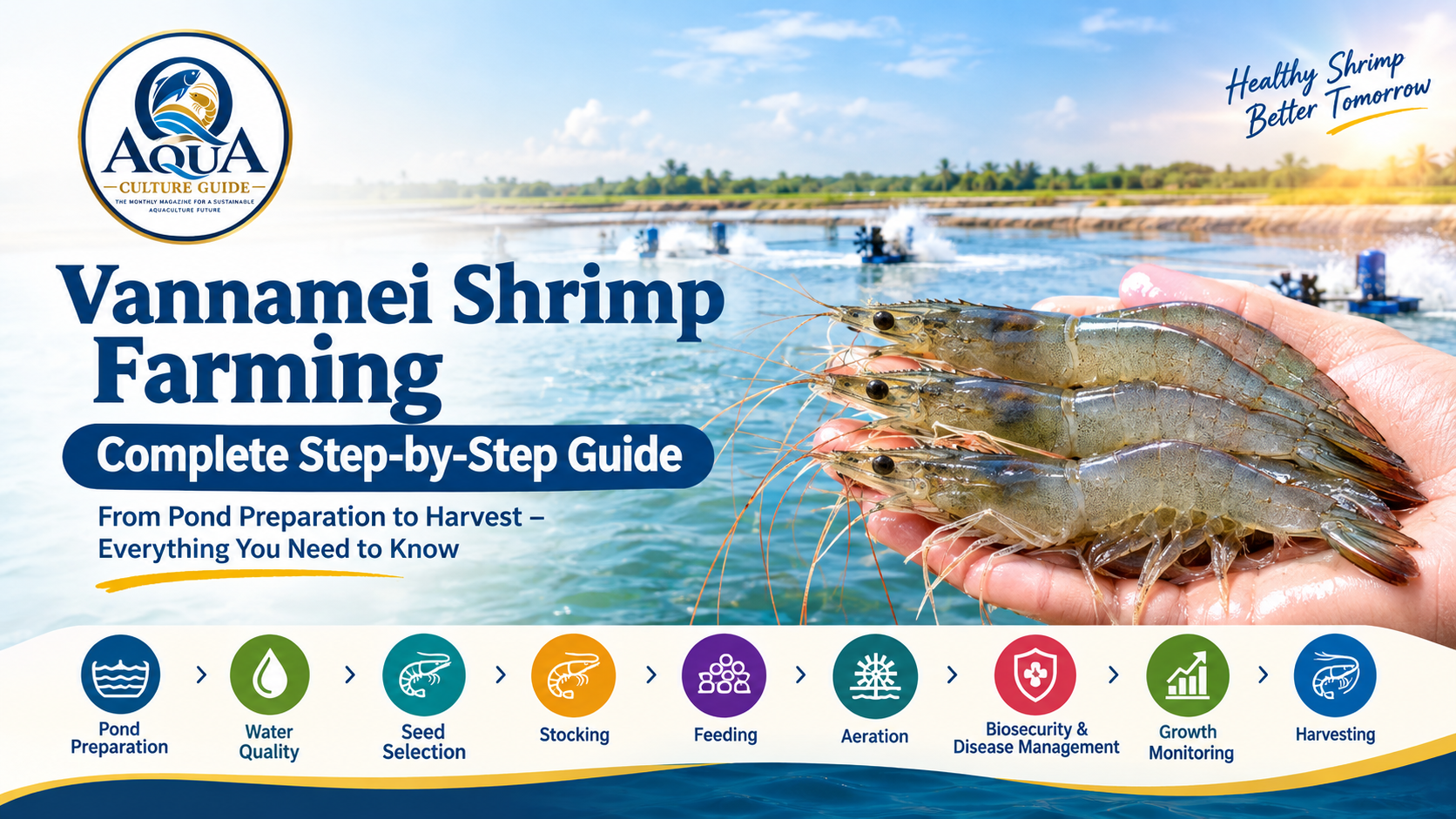
Learn how to start vannamei shrimp farming step by step, including pond preparation, water quality, seed selection, stocking, feeding, biosecurity, disease management and harvesting.
Vannamei Shrimp Farming: Complete Step-by-Step Guide
Vannamei shrimp farming has become one of the most important commercial aquaculture activities in India and many other shrimp-producing countries. The species, scientifically known as Litopenaeus vannamei, is widely cultured because of its growth performance, adaptability and established hatchery and feed infrastructure.
However, successful shrimp farming is not simply about stocking post-larvae and feeding them until harvest. Pond preparation, seed quality, water quality, aeration, feed management, biosecurity, health monitoring and accurate record-keeping must work together.
What Is Vannamei Shrimp?
Vannamei shrimp, or Litopenaeus vannamei, is commonly known as Pacific white shrimp or whiteleg shrimp.
It is a penaeid shrimp species extensively cultivated in Asia and the Americas. Farming systems can range from relatively low-input ponds to highly managed intensive systems.
How Does Vannamei Shrimp Farming Work
A commercial vannamei crop generally follows this sequence:
Site selection → Farm registration/approval → Pond preparation → Water treatment → Seed selection → Acclimation → Stocking → Water-quality management → Feeding → Health monitoring → Sampling → Harvesting → Pond preparation for the next crop
Select a Suitable Farm Site
Before constructing or stocking a shrimp pond, evaluate the farm location carefully.
Important considerations include:
Water availability
A suitable and reliable water source is essential. Water should be assessed for salinity, pH, dissolved oxygen and possible contaminants before the farm is developed or stocked.
Soil quality
Pond soil should be evaluated for texture, organic matter, pH and potential problems such as acid-sulfate conditions or excessive accumulation of organic material.
Drainage
The farm should have an effective drainage system that allows harvesting, controlled discharge and wastewater treatment.
Power supply
Commercial shrimp farms depend heavily on aeration and pumping. A reliable electricity supply and suitable backup power system are therefore important parts of farm planning.
Biosecurity
The layout should allow control of people, vehicles, equipment, animals and incoming water. CAA guidelines include biosecurity measures such as fencing, filtration, bird control and disinfection procedures.
# Understand the Indian Regulatory Requirements
In India, CAA states that persons carrying out coastal aquaculture must register their farms with the Coastal Aquaculture Authority. CAA registration is stated to be valid for five years and renewable.
For L. vannamei, CAA also requires separate permission/approval in accordance with its applicable guidelines. Tested and certified seed should be obtained from authorized hatcheries
Prepare the Shrimp Pond
Pond preparation is one of the most important stages of the entire crop.
Basic pond-preparation sequence
A typical preparation program may include:
Complete harvesting and remove remaining shrimp and waste.
Drain the pond thoroughly.
Dry the pond bottom appropriately.
Remove accumulated sludge where necessary.
Repair pond bunds and inlet/outlet structures.
Eliminate unwanted fish, crabs and other competitors or predators.
Clean and disinfect equipment and farm areas.
Prepare the water-treatment and reservoir system.
Fill the pond with properly treated and filtered water.
Establish suitable water conditions before stocking.
The exact liming, drying and disinfection procedure should be based on the pond soil, previous crop history and advice from a qualified aquaculture professional.
Install Proper Biosecurity
Biosecurity is a system of preventing pathogens from entering, spreading within and leaving the farm.
Useful measures include:
Filter incoming water.
Restrict unnecessary visitors.
Maintain separate equipment for different ponds where practical.
Disinfect equipment between ponds.
Control crabs and other potential carriers.
Prevent birds and other animals from accessing ponds.
Maintain clean farm entrances.
Avoid transferring water or equipment from one pond to another without proper controls.
FAO guidance specifically highlights screening water, selecting healthy post-larvae and restricting the movement of equipment and personnel between ponds as biosecurity measures
Select High-Quality Vannamei Seed
The quality of post-larvae, or PL, can have a major influence on crop performance.
When purchasing seed, farmers should verify:
Hatchery authorization
Seed health certification/testing
Batch information
Age and size of PL
Uniformity
Swimming behavior
Response to stimulation
Physical abnormalities
Transportation conditions
Acclimatize the Post-Larvae
Never release transported post-larvae directly into a pond without proper acclimation.
The water in the transport container and the pond may differ in:
Temperature
Salinity
pH
Dissolved oxygen
Rapid environmental changes can stress the shrimp.
Stock the Pond at a Suitable Density
Stocking density should be selected based on the pond's carrying capacity, aeration capacity, water-management system, farmer expertise and biosecurity, rather than simply trying to maximize the number of shrimp stocked
Stocking-density calculation
The basic formula is:
Total PL required = Pond area × Stocking density
For example, a 1-hectare pond has 10,000 m².
At a stocking density of 40 PL/m²:
10,000 × 40 = 400,000 PL
Actual stocking should be decided based on the farm's production system and applicable regulations.
Manage Shrimp Pond Water Quality
Water quality is the foundation of shrimp health.
Important parameters include:
MPEDA currently provides the following ideal ranges for shrimp farming guidance:
Parameter MPEDA ideal range
Dissolved oxygen: 4–6 ppm
Temperature: 28–32°C
pH: 7.5–8.3
Salinity: 10–25 ppt
Total alkalinity: 100–200 ppm
Total ammonia: 0.5 ppm
Transparency: 30–40 cm
Manage Aeration Properly
Aeration performs several functions:
Adds oxygen to the water
Improves circulation
Helps distribute oxygen throughout the pond
Supports decomposition and waste management
Helps create favorable circulation patterns
As shrimp biomass increases, the oxygen demand of the pond also increases.
Manage Shrimp Feeding
Good feeding involves:
Correct feed size + correct quantity + correct timing + good distribution + regular observation
Farmers should monitor:
Feed consumption
Shrimp growth
Feeding-tray response
Water quality
Shrimp activity
Molting pattern
Feed conversion ratio
Overfeeding can increase organic loading and deteriorate water quality. Underfeeding can reduce growth and increase size variation.
Monitor Shrimp Growth and Biomass
Regular sampling helps the farmer understand how the crop is performing.
Record:
Average body weight
Number of shrimp per kilogram
Estimated survival
Estimated biomass
Feed consumption
Daily mortality
FCR
Example
Suppose:
Estimated shrimp population = 300,000
Average shrimp weight = 20 g
Estimated biomass:
300,000 × 20 g = 6,000,000 g
or
6,000 kg biomass
This biomass estimate helps with aeration, feeding and harvest planning.
Maintain the Pond Bottom
Shrimp spend significant time near the pond bottom, so bottom condition should be monitored regularly.
Warning signs include:
Blackened sediment
Bad smell
Excessive organic accumulation
Excessive benthic algae
Uneaten feed
Localized sludge accumulation
Poor pond-bottom conditions can contribute to deteriorating water quality and stress.
Good circulation, appropriate feeding and regular observation are important parts of bottom management.
Manage Water Exchange Carefully
The decision to exchange water should be based on:
Water quality
Pond-bottom condition
Weather
Plankton condition
Shrimp health
Water availability
Disease situation in surrounding farms
Water should be treated as a management input, not simply as something to replace whenever the pond looks different.
Monitor Shrimp Health Every Day
Daily observation can help identify problems before mortality becomes severe.
Watch for:
Reduced feeding
Weak swimming
Surface swimming
Unusual aggregation
Empty gut
Soft shell
Pale hepatopancreas
Red discoloration
Uneven growth
Sudden mortality
However, visual symptoms alone cannot reliably identify every disease.
Disease Prevention Is Better Than Emergency Treatment
The major principle in modern shrimp farming is prevention and risk reduction.
Disease risk can increase when farms experience:
Poor seed quality
High organic loading
Low dissolved oxygen
Large pH fluctuations
Poor pond-bottom conditions
Weak biosecurity
Contaminated water
Excessive stocking relative to pond capacity
ICAR has highlighted the interaction between water quality, pond-bottom conditions and shrimp health, including the potential effects of fluctuating oxygen and pH, inadequate alkalinity and high organic loading.
Keep Detailed Farm Records
Record-keeping is one of the most underrated parts of shrimp farming.
**A useful farm record should include:
**
Record What to monitor
Seed: Hatchery, PL quantity, batch details
Stock: Date, density and pond
Feed: Daily quantity and brand/batch
Water quality: DO, pH, salinity, temperature, ammonia, nitrite, alkalinity
Health: Mortality and unusual observations
Growth: Weekly/regular sampling
Biomass: Estimated population and weight
Treatments/inputs: Product, dose, date and reason
Harvest: Quantity, size and buyer
Economics: Seed, feed, power, labor, inputs and other costs
lan Harvesting Carefully
Harvesting should be planned rather than treated as the final emergency stage of the crop.
Factors to consider include:
Shrimp size
Growth rate
Survival
Market demand
Farm-gate price
Weather
Pond health
Feed cost
Processor requirements
Partial harvesting may sometimes be considered depending on farm conditions and market requirements.
valuate the Crop After Harvest
The end of the crop is the beginning of the next crop's planning.
Calculate:
Survival rate
Survival % = (Number harvested ÷ Number stocked) × 100
Average body weight
ABW = Total shrimp weight ÷ Number of shrimp
Feed Conversion Ratio
FCR = Total feed used ÷ Total shrimp biomass harvested
Production
Production = Total shrimp harvested
Revenue
Revenue = Harvest quantity × Selling price
Profit
Profit = Total revenue − Total production cost
These calculations help farmers understand whether a crop was successful operationally and financially.
Most Important Factors for Successful Vannamei Shrimp Farming
A successful crop generally depends on a combination of factors rather than one single product or practice.
- Quality seed
Start with tested and certified post-larvae from an authorized hatchery.
- Good pond preparation
A clean and well-prepared pond reduces problems later.
- Stable water quality
Avoid large fluctuations in oxygen, pH, salinity and other critical parameters.
- Adequate aeration
Plan aeration according to biomass and the production system.
5. Feed discipline
Avoid unnecessary feed wastage and continually evaluate feed response.
- Strong biosecurity
Prevent disease entry and movement between ponds.
- Regular monitoring
Measure rather than guess.
- Accurate records
Good records turn a crop into measurable farm data.
9. Timely decisions
Early action can prevent a small water-quality problem from becoming a major crop problem
Vannamei Shrimp Farming: A Practical Daily Checklist
A farmer can use the following as a simple daily routine:
Morning
Check DO, temperature and shrimp activity.
Observe feeding response and any abnormal swimming.
Inspect pond edges and aerators.
Afternoon
Check pH and temperature.
Observe water color and transparency.
Inspect pond condition and equipment.
Evening/Night
Ensure aeration equipment is ready.
Monitor conditions during periods of oxygen-risk.
Check the pond for unusual shrimp behavior.
Every week
Sample shrimp growth.
Review feed consumption and FCR trend.
Inspect pond-bottom condition.
Review water-quality records.
Check pumps, aerators, electrical systems and biosecurity facilities.
Conclusion
Vannamei shrimp farming is a management-intensive business, not simply a stocking-and-feeding activity. The strongest foundation is created before the shrimp enter the pond: suitable site selection, regulatory compliance, pond preparation, certified seed, biosecurity and a clear crop plan.
Once stocking begins, the focus should shift to stable water quality, efficient aeration, disciplined feeding, health monitoring, biomass estimation and accurate records.
Questions & Answers
Q1.Is vannamei shrimp farming profitable?
Profitability depends on many variables, including stocking density, survival, growth rate, feed conversion, input costs, electricity, labor, harvest size and shrimp selling price. A profitable crop cannot be guaranteed simply by choosing vannamei.
Q2.What is the ideal pH for vannamei shrimp?
MPEDA provides an ideal pH range of 7.5–8.3 in its current farmer guidance.
Q3.How much dissolved oxygen should a shrimp pond have?
MPEDA lists 4–6 ppm as an ideal range and emphasizes checking DO during the early-morning period.
Q4.What type of seed should be used?
In India, CAA specifies that tested and certified vannamei seed should be procured from authorized hatcheries.
Q5.What is the most important factor in shrimp farming?
There is no single factor that guarantees success. Seed quality, water quality, aeration, feed management, biosecurity, pond-bottom management and timely monitoring all contribute to crop performance.
Related articles
భారతీయ రిజర్వాయర్లలో కేజ్ ఫిష్ ఫార్మింగ్: సాంకేతికత, అనుమతులు మరియు పెట్టుబడి వివరాలు
భారతదేశంలోని రిజర్వాయర్లలో కేజ్ ఫిష్ ఫార్మింగ్ ఎలా ప్రారంభించాలి? అవసరమైన సాంకేతికత, ప్రభుత్వ అనుమతులు, పెట్టుబడి, చేపల జాతులు, మేత నిర్వహణ మరియు లాభనష్టాల గురించి పూర్తి వివరాలు తెలుసుకోండి.
Freshwater Prawn Farming in IndiaFreshwater Prawn Farming in India: రైతులకు పూర్తి సాగు మార్గదర్శిని
భారతదేశంలో మంచినీటి రొయ్యల సాగు ఎలా ప్రారంభించాలి? జెయింట్ ఫ్రెష్వాటర్ ప్రాన్ సీడ్ ఎంపిక, చెరువు తయారీ, స్టాకింగ్, ఆహారం, నీటి నాణ్యత, పెట్టుబడి, మార్కెటింగ్ గురించి పూర్తి వివరాలు తెలుసుకోండి.
Tilapia farming in Indiaభారతదేశంలో తిలాపియా చేపల పెంపకం – మార్కెట్ అవకాశాలు, ప్రభుత్వ నిబంధనలు మరియు ఆధునిక సాగు పద్ధతులు
భారతదేశంలో తిలాపియా చేపల పెంపకం ఎలా చేయాలి? మార్కెట్ అవకాశాలు, ప్రభుత్వ అనుమతులు, చెరువు సాగు, బయోఫ్లాక్, RAS విధానాలు, పిల్లల ఎంపిక, మేత నిర్వహణ మరియు దిగుబడి గురించి పూర్తి సమాచారం.
PCR Testing in Shrimp Hatcheriesరొయ్యల హ్యాచరీల్లో PCR పరీక్షలు: ఫలితాలను రైతులు ఎలా అర్థం చేసుకోవాలి?
WSSV, EHP, AHPND వంటి వ్యాధికారకాలను గుర్తించడంలో PCR పరీక్షల పాత్ర, పరీక్షా నివేదికలను అర్థం చేసుకోవడం, నాణ్యమైన రొయ్య పిల్లలను ఎంపిక చేసుకోవడం గురించి రైతులు తెలుసుకోవాల్సిన పూర్తి సమాచారం.
Explore Aqua Culture Guide
Aqua companies directory
Feed, seed, probiotics & equipment suppliers
Aquaculture calculators
Feed, FCR, stocking & water quality tools
Telugu aqua magazine
Read the latest monthly issue online
All aqua news & articles
Farming, disease control and market updates
List your company free
Get found by farmers across India
Advertise with us
Magazine and website advertising options