
Vannamei PLs Per Acre: Simple Calculation Guide
30/9/2026
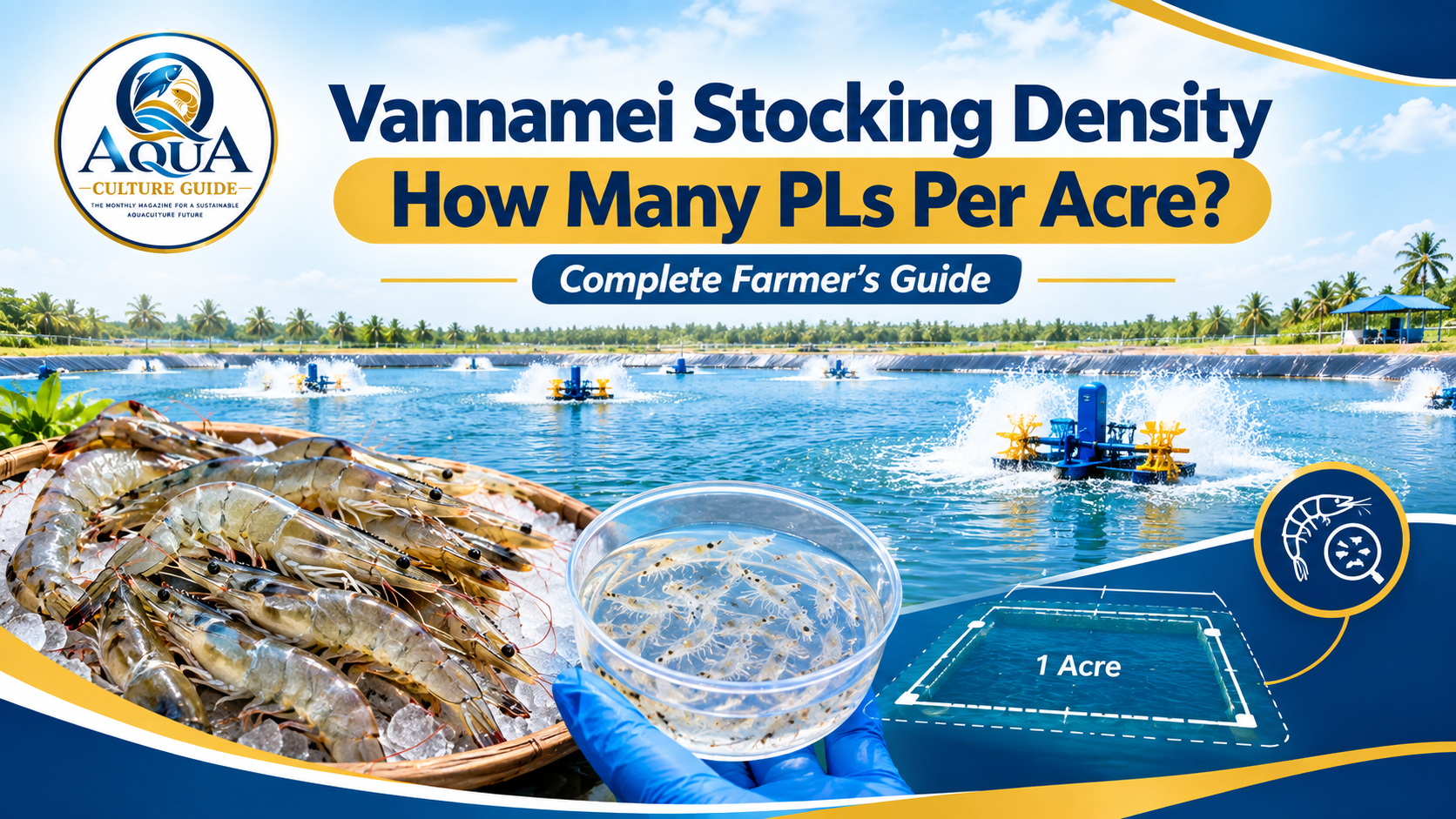
Learn how to calculate vannamei shrimp stocking density per acre, how many PLs to stock at different densities, and how pond capacity, aeration, water quality and biosecurity affect stocking decisions
What Is Vannamei Stocking Density
Vannamei stocking density means the number of shrimp post-larvae stocked in a specific area of pond.
It is normally expressed as:
PLs per square metre (PL/m²)
For example:
20 PL/m²
30 PL/m²
40 PL/m²
50 PL/m²
60 PL/m²
How Many PLs Are There in One Acre?
One acre is approximately:
4,046.86 m²
Therefore:
PLs per acre = Stocking density × 4,046.86
Vannamei PL Requirement Per Acre
| Stocking Density | Approx. PLs per Acre |
|---|---|
| 10 PL/m² | 40,469 PL |
| 20 PL/m² | 80,937 PL |
| 25 PL/m² | 101,172 PL |
| 30 PL/m² | 121,406 PL |
| 35 PL/m² | 141,640 PL |
| 40 PL/m² | 161,874 PL |
| 45 PL/m² | 182,109 PL |
| 50 PL/m² | 202,343 PL |
| 55 PL/m² | 222,577 PL |
| 60 PL/m² | 242,812 PL |
What Is the Maximum Vannamei Stocking Density in India
Under the current CAA guidelines applicable to conventional earthen pond systems, stocking density shall not exceed 60 shrimp/m².
Converted to one acre:
60 × 4,046.86 = approximately 242,812 PLs per acre
So:
Maximum permitted density under this CAA provision
60 PL/m² ≈ 2.43 lakh PLs per acre
This should be understood as a regulatory ceiling, not as a universal recommendation for every farm.
Water Quality Management
Higher stocking density can increase the overall demand placed on the pond.
You need to monitor parameters such as:
Dissolved oxygen
pH
Temperature
Salinity
Alkalinity
Ammonia
Nitrite
Water transparency
Pond-bottom condition
CAA's current vannamei guidance calls for routine monitoring of water-quality parameters including pH, alkalinity, dissolved oxygen, total ammonia, unionized ammonia, nitrite and other indicators.
Pond Depth and Design
Pond design matters.
CAA's current do's and don'ts document states that pond depth should be maintained at not less than 1.5 m in the relevant context.
But depth alone does not determine carrying capacity.
Also consider:
Pond shape
Water circulation
Drainage
Sludge collection
Aerator placement
Inlet and outlet design
Water exchange/management system
Feed Management
More shrimp means more feed demand.
Poor feed management can contribute to:
Feed waste → organic loading → poorer water quality → greater management pressure
Biosecurity
Higher-density farming requires disciplined biosecurity.
CAA guidance includes measures related to disinfection of personnel and implements, and routine monitoring of shrimp health, water quality and bacteria.
Before stocking, make sure:
Inlet water is properly screened.
Equipment is clean.
Pond-to-pond movement is controlled.
Bird and crab control measures are in place.
Sampling equipment is ready.
Workers understand farm hygiene procedures.
Previous Crop Performance
Your previous crop can provide useful information for planning the next one.
Look at:
Survival percentage
Average body weight
FCR
Harvest biomass
Water-quality problems
Oxygen incidents
Disease events
Feed usage
Mortality pattern
Electricity consumption
How to Calculate PLs Per Acre
The formula is simple:
Formula
PLs required = Pond area in m² × Stocking density
For one acre:
PLs required = 4,046.86 × stocking density
Example 1: 30 PL/m²
4,046.86 × 30
= 121,406 PLs per acre
So approximately:
1.21 lakh PLs per acre
Example 2: 40 PL/m²
4,046.86 × 40
= 161,874 PLs
Approximately:
1.62 lakh PLs per acre
Example 3: 50 PL/m²
4,046.86 × 50
= 202,343 PLs
Approximately:
2.02 lakh PLs per acre
Example 4: 60 PL/m²
4,046.86 × 60
= 242,812 PLs
Approximately:
2.43 lakh PLs per acre
Again, 2.43 lakh PLs/acre represents the mathematical equivalent of 60 PL/m², which is the current CAA maximum for conventional earthen pond systems covered by that provision. It should not be treated as a universal farm target.
Stocking Density Table for Farmers
For quick reference:
| Density | Approx. PLs/Acre | PLs in 2 Acres | PLs in 5 Acres |
|---|---|---|---|
| 20 PL/m² | 80,937 | 161,874 | 404,686 |
| 25 PL/m² | 101,172 | 202,343 | 505,858 |
| 30 PL/m² | 121,406 | 242,812 | 607,029 |
| 35 PL/m² | 141,640 | 283,280 | 708,200 |
| 40 PL/m² | 161,874 | 323,749 | 809,372 |
| 45 PL/m² | 182,109 | 364,217 | 910,543 |
| 50 PL/m² | 202,343 | 404,686 | 1,011,715 |
| 55 PL/m² | 222,577 | 445,155 | 1,112,887 |
| 60 PL/m² | 242,812 | 485,623 | 1,214,058 |
What Happens When Stocking Density Increases?
Increasing stocking density does not simply increase production in a straight line.
Higher density can increase:
Total feed requirement
Oxygen demand
Organic loading
Water-quality management requirements
Aeration demand
Monitoring requirements
Biosecurity pressure
Consequences of management failures
Low, Medium and Higher Stocking Density
For educational planning, farmers may think about density in ranges such as:
| Density Range | PL/m² | Approx. PLs/Acre |
|---|---|---|
| Lower | 20 | 80,937 |
| Moderate | 30 | 121,406 |
| Moderate–High | 40 | 161,874 |
| High | 50 | 202,343 |
| CAA maximum for conventional earthen systems | 60 | 242,812 |
Why Overstocking Can Become a Problem
Suppose two farms each have one acre.
Farm A
30 PL/m²
Good aeration
Stable water quality
Strong biosecurity
Regular sampling
Good record-keeping
Farm B
50 PL/m²
Limited aeration
Irregular water-quality testing
Poor circulation
Weak biosecurity
Stocking Density and Expected Biomass
One useful way to think about stocking density is to estimate the eventual biomass.
Basic formula
Estimated biomass (kg) = Number of shrimp × Average harvest weight (g) ÷ 1,000
Suppose:
Stocked = 160,000 PL
Estimated survival = 80%
Harvest weight = 25 g
Estimated number harvested:
160,000 × 80%
= 128,000 shrimp
Estimated biomass:
128,000 × 25 ÷ 1,000
= 3,200 kg
This calculation is only an estimate. Actual biomass depends on survival, growth and sampling accuracy.
Stocking Density and Survival Rate
A high initial PL count does not guarantee a high harvest.
For example:
Stocking
200,000 PL
Survival
80%
Estimated harvested shrimp
200,000 × 0.80
= 160,000 shrimp
If average harvest weight is 25 g:
160,000 × 25 ÷ 1,000
= 4,000 kg
This illustrates why farmers should look beyond the number of PLs stocked and track survival, growth and biomass.
Common Mistakes When Calculating PLs Per Acre
Mistake 1: Using one acre as 4,000 m²
One acre is approximately 4,046.86 m², so using 4,000 m² gives only an approximate result.
For quick farm calculations, rounding can be convenient, but for exact planning use the actual pond area.
Mistake 2: Calculating from total land area
A one-acre property may not contain one acre of actual pond water area.
Always use:
Actual culture water area × PL/m²
Mistake 3: Treating the maximum as the recommended density
The CAA ceiling of 60 shrimp/m² is a regulatory limit for the specified conventional earthen systems, not an instruction that every farm should stock 60 PL/m².
Mistake 4: Ignoring aeration
More shrimp eventually means more biomass and greater oxygen-management requirements.
Mistake 5: Ignoring the previous crop
The previous crop provides valuable data for deciding whether the pond can support the planned density.
Mistake 6: Buying seed before calculating requirements
First determine:
Pond area → stocking density → total PL requirement
Then finalize the seed order.
How to Calculate PLs for Any Pond Size
Use this simple formula:
Step 1
Convert pond area to square metres.
Step 2
Multiply by your planned stocking density.
Example
Pond area = 1.5 acres
Stocking density = 35 PL/m²
1.5 acres = 4,046.86 × 1.5
= 6,070.29 m²
PL requirement:
6,070.29 × 35
= 212,460 PL
Therefore, approximately:
2.12 lakh PLs
Vannamei Stocking Density Calculator Formula
For your Aqua Culture Guide website, this topic is ideal for an interactive calculator.
Calculator inputs
Pond Area: ___ acres
Stocking Density: ___ PL/m²
Calculator output
Total pond area: ___ m²
Required PLs: ___
Approximate PLs in lakhs: ___ lakh
Formula
Required PLs = Pond Area (acres) × 4,046.86 × Stocking Density
This could become one of the useful farmer tools on the Aqua Culture Guide website.
Pre-Stocking Checklist
Before finalizing your PL quantity, review:
☐ Actual pond water area measured
☐ Soil and pond condition assessed
☐ Water source suitable
☐ Water quality stable
☐ Aeration capacity checked
☐ Reservoir prepared
☐ Inlet water screening ready
☐ Biosecurity measures complete
☐ Seed source verified
☐ Feed plan prepared
☐ Emergency power available
☐ Monitoring equipment ready
☐ Applicable CAA requirements checked
☐ Stocking density calculated based on carrying capacity
**Conclusion
**
Vannamei stocking density should be decided based on the farm's carrying capacity—not simply by trying to stock the maximum number of PLs.
For quick reference:
20 PL/m² ≈ 80,937 PL/acre
30 PL/m² ≈ 121,406 PL/acre
40 PL/m² ≈ 161,874 PL/acre
50 PL/m² ≈ 202,343 PL/acre
60 PL/m² ≈ 242,812 PL/acre
In India, the current CAA guidance places a 60 shrimp/m² ceiling on conventional earthen pond systems covered by that provision. MPEDA, meanwhile, emphasizes that stocking density should be planned according to pond carrying capacity.
A good stocking plan connects pond size + seed quality + aeration + water quality + biosecurity + feed management + expected biomass.
Questions & Answers
Q1.How many vannamei PLs can I stock per acre
It depends on your selected stocking density. At 30 PL/m², one acre requires approximately 121,406 PLs. At 40 PL/m², it requires approximately 161,874 PLs. At 60 PL/m², it is approximately 242,812 PLs. For conventional earthen pond systems covered by the current CAA provision, the stocking-density ceiling is 60 shrimp/m²
Q2.What is 60 PL/m² in PLs per acre
Approximately: 60 × 4,046.86 = 242,812 PLs/acre or approximately 2.43 lakh PLs per acre
Q3.Is 60 PL/m² suitable for every farm
No. It is the stated CAA upper limit for the relevant conventional earthen pond systems, while MPEDA recommends determining stocking density according to pond carrying capacity
Q4.How do I calculate PL requirement for 2 acres?
Use: 2 × 4,046.86 × stocking density For 40 PL/m²: 2 × 4,046.86 × 40 = 323,749 PLs
Q5.Should stocking density be based on total land area
No. Use the actual culture-water area of the pond.
Q6.Does higher stocking density always mean higher profit
Not necessarily. Higher density increases the biological and management load on the farm. Profitability depends on survival, growth, FCR, harvest price, input costs, energy use and other farm-specific factors.
Related articles
భారతీయ రిజర్వాయర్లలో కేజ్ ఫిష్ ఫార్మింగ్: సాంకేతికత, అనుమతులు మరియు పెట్టుబడి వివరాలు
భారతదేశంలోని రిజర్వాయర్లలో కేజ్ ఫిష్ ఫార్మింగ్ ఎలా ప్రారంభించాలి? అవసరమైన సాంకేతికత, ప్రభుత్వ అనుమతులు, పెట్టుబడి, చేపల జాతులు, మేత నిర్వహణ మరియు లాభనష్టాల గురించి పూర్తి వివరాలు తెలుసుకోండి.
Freshwater Prawn Farming in IndiaFreshwater Prawn Farming in India: రైతులకు పూర్తి సాగు మార్గదర్శిని
భారతదేశంలో మంచినీటి రొయ్యల సాగు ఎలా ప్రారంభించాలి? జెయింట్ ఫ్రెష్వాటర్ ప్రాన్ సీడ్ ఎంపిక, చెరువు తయారీ, స్టాకింగ్, ఆహారం, నీటి నాణ్యత, పెట్టుబడి, మార్కెటింగ్ గురించి పూర్తి వివరాలు తెలుసుకోండి.
Tilapia farming in Indiaభారతదేశంలో తిలాపియా చేపల పెంపకం – మార్కెట్ అవకాశాలు, ప్రభుత్వ నిబంధనలు మరియు ఆధునిక సాగు పద్ధతులు
భారతదేశంలో తిలాపియా చేపల పెంపకం ఎలా చేయాలి? మార్కెట్ అవకాశాలు, ప్రభుత్వ అనుమతులు, చెరువు సాగు, బయోఫ్లాక్, RAS విధానాలు, పిల్లల ఎంపిక, మేత నిర్వహణ మరియు దిగుబడి గురించి పూర్తి సమాచారం.
PCR Testing in Shrimp Hatcheriesరొయ్యల హ్యాచరీల్లో PCR పరీక్షలు: ఫలితాలను రైతులు ఎలా అర్థం చేసుకోవాలి?
WSSV, EHP, AHPND వంటి వ్యాధికారకాలను గుర్తించడంలో PCR పరీక్షల పాత్ర, పరీక్షా నివేదికలను అర్థం చేసుకోవడం, నాణ్యమైన రొయ్య పిల్లలను ఎంపిక చేసుకోవడం గురించి రైతులు తెలుసుకోవాల్సిన పూర్తి సమాచారం.
Explore Aqua Culture Guide
Aqua companies directory
Feed, seed, probiotics & equipment suppliers
Aquaculture calculators
Feed, FCR, stocking & water quality tools
Telugu aqua magazine
Read the latest monthly issue online
All aqua news & articles
Farming, disease control and market updates
List your company free
Get found by farmers across India
Advertise with us
Magazine and website advertising options