Smart Aquaculture: IoT Sensors and Real-Time Water Quality Monitoring
1/11/2026
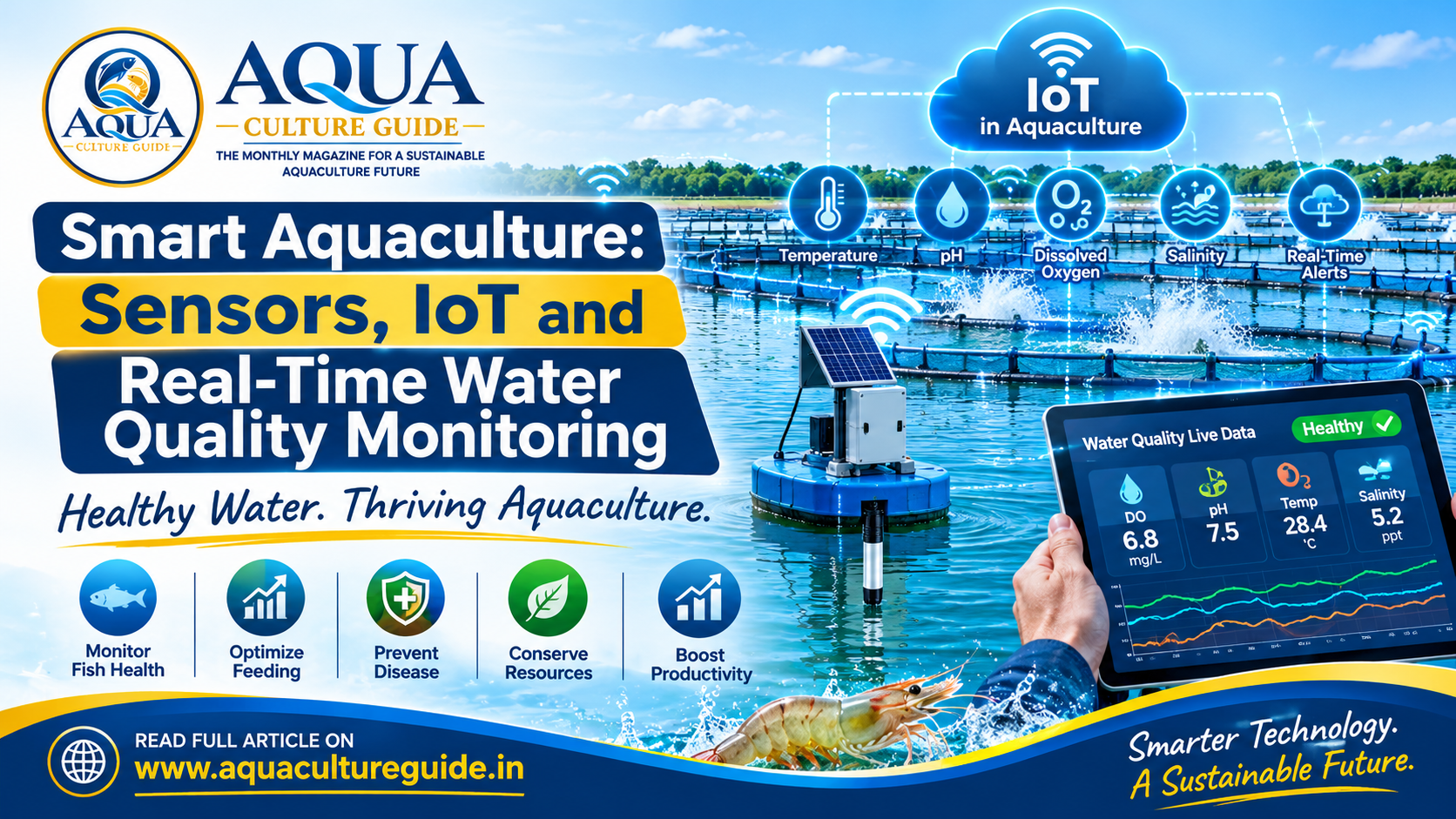
Learn how smart aquaculture uses IoT sensors and real-time water quality monitoring to manage dissolved oxygen, pH, temperature and other important pond parameters.
Introduction
Water quality plays a major role in the success of fish and shrimp farming. Even small changes in dissolved oxygen, temperature, pH and other water parameters can affect animal health, feeding activity, growth and survival.
Traditionally, farmers check water quality using manual testing kits and measuring instruments. Although these methods are useful, they may not always identify sudden changes between testing times.
This is where Smart Aquaculture becomes important.
Smart aquaculture uses modern technologies such as Internet of Things (IoT), water quality sensors, mobile applications and digital monitoring systems to help farmers observe pond conditions more frequently.
With real-time water quality monitoring, farmers can receive information about pond conditions through a mobile phone or computer. Some systems can also send alerts when a parameter reaches a selected warning level.
For example, if dissolved oxygen starts decreasing during the night, a connected monitoring system can send an alert to the farmer. This gives the farmer an opportunity to check the pond and take suitable action.
What Is Smart Aquaculture?
Smart aquaculture is the use of digital technology and connected equipment to improve fish and shrimp farm management.
It combines different technologies to collect, store and analyse farm information.
These technologies include:
IoT-based water quality sensors.
Automatic water monitoring equipment.
Mobile applications.
Internet-connected devices.
Cloud-based data storage.
Automatic feeders and aerators.
Digital farm management software.
Instead of depending only on manual observations, farmers can use these systems to understand changes in pond conditions.
Simple example:
A farmer installs a dissolved oxygen sensor in a shrimp pond. The sensor measures oxygen levels and sends the readings to a connected monitoring device. The farmer can view the readings on a mobile phone and receive an alert if oxygen falls below the selected warning level.
This is one of the basic applications of smart aquaculture.
What Is IoT in Aquaculture?
IoT stands for Internet of Things.
It refers to physical devices such as sensors and equipment that are connected to the internet or a local network so they can collect and share information.
In aquaculture, IoT connects water quality sensors with monitoring systems.
For example:
A sensor measures dissolved oxygen in a pond.
The sensor sends the reading to a connected device.
The device transfers the information to a monitoring platform.
The farmer views the reading through a mobile phone or computer.
The system sends an alert if the reading crosses a preset limit.
This process helps farmers monitor pond conditions without having to visit every pond for every reading.
Important: Some IoT systems can work through local wireless networks and do not require continuous internet access at every sensor. However, remote monitoring and cloud alerts usually need a suitable network connection.
Important Water Quality Parameters to Monitor
Water quality monitoring is essential for maintaining a suitable environment for fish and shrimp.
Smart monitoring systems can measure several important parameters.
A. Dissolved Oxygen (DO)
Dissolved oxygen is the oxygen available in water for aquatic animals.
Low oxygen levels can cause stress, reduced feeding, poor growth and mortality.
Farmers should monitor dissolved oxygen carefully, particularly during the early morning, at night and during periods of high biomass.
An oxygen sensor can provide regular readings and send alerts when oxygen levels approach a selected warning point.
B. Water Temperature
Temperature affects metabolism, feeding activity, growth and oxygen availability.
Sudden temperature changes can create stress in fish and shrimp.
A temperature sensor can record changes throughout the day and help farmers understand daily temperature patterns.
C. pH
pH indicates whether water is acidic, neutral or alkaline.
Sudden pH changes can affect aquatic animal health and the behaviour of other water quality parameters.
A connected pH sensor can help farmers observe changes and identify unusual readings.
D. Salinity
Salinity is especially important in shrimp farming and other systems where animals require suitable salt levels.
Changes in salinity can affect animal performance and water management.
A salinity sensor can help farmers track changes caused by rainfall, evaporation and water exchange.
E. Ammonia
Ammonia can become harmful to aquatic animals, particularly when the toxic unionised form increases.
Its toxicity is influenced by factors such as pH and temperature.
Some monitoring systems offer ammonia sensors, but farmers should check the measurement method, accuracy and maintenance requirements before purchasing.
F. Nitrite
Nitrite can affect the health of fish and shrimp when it reaches harmful levels.
Regular monitoring is important, especially in systems with high feeding rates and organic waste accumulation.
Some farms may use manual test kits or laboratory testing alongside digital monitoring.
G. Water Level
Water level monitoring helps farmers identify unexpected changes in pond or tank water levels.
A water level sensor can provide alerts when water levels rise or fall beyond selected limits.
This can be useful during heavy rainfall, water exchange and water supply problems.
Note: Not every sensor can directly measure every water quality parameter. Farmers should select suitable equipment for each measurement and confirm whether the system provides direct readings or calculated estimates.
How Real-Time Water Quality Monitoring Works
Real-time monitoring systems generally work through five main steps.
Step 1: Data Collection
Sensors are installed in suitable locations in a pond or tank.
They measure parameters such as dissolved oxygen, temperature, pH and salinity.
Step 2: Data Transmission
The sensors send their readings to a connected monitoring device through a suitable communication method.
Depending on the system, this may use Wi-Fi, Bluetooth, LoRaWAN, cellular networks or other communication technologies.
Step 3: Data Processing
The monitoring platform receives and organises the information.
It may display current readings, previous records and changes over time.
Step 4: Alerts and Notifications
Farmers can set warning limits based on their species, farming system and expert recommendations.
If a reading crosses a selected limit, the system can send an alert through a mobile application, message or dashboard.
Step 5: Farmer Action
The farmer checks the reading and confirms the situation using appropriate testing methods.
If action is needed, the farmer can operate aerators, check water supply, adjust farm management or contact an aquaculture technician.
The system provides information, but the final farm decision should consider actual pond conditions.
Benefits of Smart Aquaculture
Using IoT sensors and real-time monitoring can provide several benefits.
Continuous Monitoring
Farmers can observe water quality more frequently instead of depending only on occasional manual testing.
Faster Alerts
The system can notify farmers when important readings change unexpectedly.
Better Oxygen Management
Dissolved oxygen monitoring can help farmers respond more quickly to oxygen-related problems.
Improved Farm Records
Digital systems can store readings and create historical reports.
Better Decision-Making
Farmers can compare water quality changes with feeding, weather, growth and mortality records.
Reduced Manual Monitoring Work
Connected systems can reduce the need for repeated manual readings, although regular physical checks remain necessary.
Improved Farm Planning
Historical data can help farmers understand daily and seasonal water quality patterns.
Support for Multiple Ponds
A central dashboard can help farm managers view readings from several ponds or tanks in one place.
Smart Aquaculture Equipment Farmers Should Know About
Before installing a smart monitoring system, farmers should understand the basic equipment.
- Dissolved Oxygen Sensor
Measures oxygen available in water. It is especially useful for monitoring oxygen changes.
- Temperature Sensor
Records water temperature and helps identify sudden changes.
3. pH Sensor
Measures the acidity or alkalinity of water.
- Salinity Sensor
Measures the salt concentration of water. Check whether the device measures salinity directly or calculates it from conductivity.
- Water Level Sensor
Monitors the water level in ponds, tanks or reservoirs.
- IoT Gateway
Collects information from connected sensors and transfers it to a monitoring platform.
- Data Logger
Stores sensor readings so farmers can review previous measurements.
- Mobile Monitoring Application
Displays sensor readings, alerts and historical reports on a mobile phone.
- Automatic Aerator Controller
Can operate connected aerators based on sensor readings and preset safety rules. It must be installed with suitable safeguards and backup controls.
Complete Checklist Before Installing IoT Sensors on Your Farm
Farmers should check the following points before purchasing or installing a real-time monitoring system.
Farm Requirements
Identify the main water quality problems on your farm.
Decide which parameters need continuous monitoring.
Check the number and size of ponds or tanks.
Consider the type of farming system.
Identify suitable sensor locations.
Decide whether monitoring is needed during the day, night or throughout the day.
Sensor Selection
Select sensors suitable for aquaculture conditions.
Check the measurement range.
Check the accuracy and response time.
Ask how often calibration is required.
Check the sensor's expected service life.
Confirm whether replacement parts are available
Ask about cleaning and maintenance requirements.
Check whether the sensor is suitable for freshwater or saline water.
Connectivity and Power Supply
Check mobile network availability.
Confirm whether Wi-Fi or another network is required.
Ask how far the sensors can communicate with the gateway.
Check the power supply requirements.
Consider battery backup or solar power where suitable.
Confirm what happens during internet or power failure.
Check whether data can be stored locally when the network is unavailable.
Software and Mobile Application
Check whether the system supports Android or iOS.
Confirm that readings are displayed clearly.
Check whether historical reports are available.
Confirm that warning alerts can be customised.
Check whether multiple ponds can be monitored.
Understand any subscription or cloud storage charges.
Ask who can access and manage farm data.
Installation and Maintenance
Install sensors according to manufacturer instructions.
Keep sensors in suitable locations.
Avoid locations where equipment may be damaged.
Clean sensors regularly.
Calibrate sensors according to the manufacturer's schedule.
Compare readings with reliable manual testing equipment.
Keep spare parts where necessary.
Train farm workers to operate the system.
Farm Safety
Keep backup aerators ready.
Maintain emergency oxygen management procedures.
Do not depend entirely on mobile alerts.
Check important readings manually when necessary.
Set alerts based on suitable farm-specific limits.
Prepare an action plan for abnormal readings.
Step-by-Step Guide: How to Start Smart Aquaculture on Your Farm
Farmers can introduce smart aquaculture gradually. A complete automated system is not necessary at the beginning
Step 1: Understand Your Farm's Requirements
First, identify the problems you want to solve.
For example:
Sudden dissolved oxygen changes.
Difficulty checking water quality in multiple ponds.
Unusual pH or temperature changes.
Lack of daily water quality records.
Delayed response to water quality problems.
Choose the most important problem first.
Step 2: Select the Parameters You Want to Monitor
Decide which water quality parameters require frequent monitoring.
For example, a shrimp farm may begin with dissolved oxygen and temperature monitoring.
Other parameters such as pH and salinity can be added based on farm requirements.
Step 3: Choose Suitable Sensors
Compare different sensor models before purchasing.
Check accuracy, measurement range, calibration requirements, maintenance costs and suitability for your water conditions.
Do not select a sensor only because it is inexpensive.
Step 4: Select a Monitoring System
Choose a system that can collect sensor readings and display them through a mobile application or computer dashboard.
Ask the supplier to demonstrate how the readings, alerts and historical reports work.
Confirm whether the system supports your farm's communication and power requirements.
Step 5: Install Sensors in Suitable Locations
Install sensors according to the manufacturer's instructions.
Sensor position is important because water quality may vary between locations and depths.
Avoid placing sensors where they may be damaged by aerators, pumps, nets or other farm activities.
For larger ponds, consider whether one sensor provides enough information to represent the pond.
Step 7: Calibrate and Verify the Sensors
Calibration helps maintain measurement accuracy.
Follow the manufacturer's instructions and use suitable calibration solutions or reference methods.
Compare sensor readings with a reliable manual testing instrument.
If readings differ significantly, investigate the cause before depending on the sensor.
Step 8: Set Warning Limits
Set warning levels based on the cultured species, farming system, animal stage and advice from qualified aquaculture professionals.
For example, the system can be configured to send an alert when dissolved oxygen falls below a farm-approved warning level.
Do not use one fixed limit for every species and farming condition.
Step 9: Monitor Readings Every Day
Check the readings regularly through the mobile application or dashboard.
Pay attention to unusual changes and compare them with previous readings.
Record important events such as rainfall, feeding changes, water exchange and aerator operation.
Step 10: Take Suitable Action
When an alert arrives, first confirm the reading.
If dissolved oxygen is low, check the pond and operate aeration equipment according to your emergency management plan.
If pH or salinity changes unexpectedly, verify the result and identify the possible cause before making adjustments.
Never make major water treatment decisions based only on one unverified sensor reading.
Step 11: Review the System's Performance
After using the system for some time, review whether it is helping your farm.
Check:
Whether alerts are reliable.
Whether sensor readings are accurate.
Whether water quality problems are identified sooner.
Whether monitoring work has become easier.
Whether the system is reducing unnecessary visits.
Whether the investment is providing value.
Step 12: Expand the System Gradually
If the first installation is successful, consider adding more sensors, ponds, automatic feeders or aerator controls.
Expand according to your farm's requirements and budget.
Common Mistakes to Avoid in Real-Time Water Quality Monitoring
Purchasing sensors without checking their accuracy.
Installing sensors in unsuitable locations.
Ignoring calibration and cleaning.
Depending completely on automatic readings.
Setting warning limits without considering species requirements.
Ignoring sensor damage or communication failure.
Failing to maintain backup power.
Ignoring alerts from the monitoring system.
Installing expensive equipment without a clear purpose.
Not training farm workers.
Assuming that one sensor represents the entire pond.
Making water treatment decisions without confirming unusual readings.
What Is the Future of Smart Aquaculture?
Smart aquaculture is expected to become more advanced as digital technology improves.
Some important developments include:
AI-Based Water Quality Prediction: Systems may use historical readings and current conditions to identify possible water quality changes.
Automated Aeration: Connected systems may operate aerators using real-time dissolved oxygen readings and safety controls.
Smart Feeding Systems: Sensors and cameras may help automatic feeders adjust feeding according to animal activity.
Remote Farm Monitoring: Farmers may monitor multiple ponds from a central dashboard, even when they are away from the farm.
Integrated Farm Management: Water quality, feed consumption, growth, health and expenses may be managed through a single digital platform.
Solar-Powered Monitoring: Solar-powered devices may help provide monitoring in farms where regular electricity supply is difficult.
These technologies can improve farm management, but their success will depend on affordability, reliable equipment, maintenance and farmer training.
Conclusion
Smart aquaculture is changing the way farmers monitor and manage fish and shrimp farms. IoT sensors, connected devices and real-time water quality monitoring can help farmers understand pond conditions, receive faster alerts and maintain better farm records.
However, technology alone cannot guarantee successful production. Sensors must be installed correctly, calibrated regularly and checked against reliable testing methods.
Farmers should start with the most important water quality parameters, select suitable equipment and expand gradually.
The future of aquaculture will depend on combining practical farming experience with reliable technology and better farm management.
Questions & Answers
Q1.What is smart aquaculture?
Smart aquaculture is the use of technologies such as IoT sensors, mobile applications, digital monitoring and automation to improve fish and shrimp farm management.
Q2.What is IoT in fish farming?
IoT in fish farming connects sensors and equipment to a monitoring system so farmers can collect and view information such as dissolved oxygen, temperature and pH.
Q3.What is real-time water quality monitoring?
Real-time water quality monitoring means collecting and displaying water quality readings at regular, frequent intervals so farmers can identify changes and respond quickly.
Q4.Which sensors are important for shrimp farming?
Commonly used sensors include dissolved oxygen, temperature, pH and salinity sensors. Other parameters can be monitored using suitable sensors, test kits or laboratory methods.
Q5.Can IoT sensors monitor dissolved oxygen?
Yes. Dissolved oxygen sensors can measure oxygen levels and send readings to a connected monitoring platform.
Q6.Can farmers monitor multiple ponds using one system?
Yes. Suitable monitoring platforms can display readings from multiple ponds. However, each pond needs appropriate sensor coverage to provide useful information.
Q7.Do IoT water quality sensors need internet access?
Not always for local data collection. Some systems use local communication networks, but remote monitoring and cloud-based alerts generally require internet or cellular connectivity.
Q8.Are smart aquaculture systems expensive?
The cost depends on the number of sensors, monitoring platform, connectivity, installation and maintenance. Farmers can start with a few important sensors and expand gradually.
Related articles
భారతీయ రిజర్వాయర్లలో కేజ్ ఫిష్ ఫార్మింగ్: సాంకేతికత, అనుమతులు మరియు పెట్టుబడి వివరాలు
భారతదేశంలోని రిజర్వాయర్లలో కేజ్ ఫిష్ ఫార్మింగ్ ఎలా ప్రారంభించాలి? అవసరమైన సాంకేతికత, ప్రభుత్వ అనుమతులు, పెట్టుబడి, చేపల జాతులు, మేత నిర్వహణ మరియు లాభనష్టాల గురించి పూర్తి వివరాలు తెలుసుకోండి.
Freshwater Prawn Farming in IndiaFreshwater Prawn Farming in India: రైతులకు పూర్తి సాగు మార్గదర్శిని
భారతదేశంలో మంచినీటి రొయ్యల సాగు ఎలా ప్రారంభించాలి? జెయింట్ ఫ్రెష్వాటర్ ప్రాన్ సీడ్ ఎంపిక, చెరువు తయారీ, స్టాకింగ్, ఆహారం, నీటి నాణ్యత, పెట్టుబడి, మార్కెటింగ్ గురించి పూర్తి వివరాలు తెలుసుకోండి.
Tilapia farming in Indiaభారతదేశంలో తిలాపియా చేపల పెంపకం – మార్కెట్ అవకాశాలు, ప్రభుత్వ నిబంధనలు మరియు ఆధునిక సాగు పద్ధతులు
భారతదేశంలో తిలాపియా చేపల పెంపకం ఎలా చేయాలి? మార్కెట్ అవకాశాలు, ప్రభుత్వ అనుమతులు, చెరువు సాగు, బయోఫ్లాక్, RAS విధానాలు, పిల్లల ఎంపిక, మేత నిర్వహణ మరియు దిగుబడి గురించి పూర్తి సమాచారం.
PCR Testing in Shrimp Hatcheriesరొయ్యల హ్యాచరీల్లో PCR పరీక్షలు: ఫలితాలను రైతులు ఎలా అర్థం చేసుకోవాలి?
WSSV, EHP, AHPND వంటి వ్యాధికారకాలను గుర్తించడంలో PCR పరీక్షల పాత్ర, పరీక్షా నివేదికలను అర్థం చేసుకోవడం, నాణ్యమైన రొయ్య పిల్లలను ఎంపిక చేసుకోవడం గురించి రైతులు తెలుసుకోవాల్సిన పూర్తి సమాచారం.
Explore Aqua Culture Guide
Aqua companies directory
Feed, seed, probiotics & equipment suppliers
Aquaculture calculators
Feed, FCR, stocking & water quality tools
Telugu aqua magazine
Read the latest monthly issue online
All aqua news & articles
Farming, disease control and market updates
List your company free
Get found by farmers across India
Advertise with us
Magazine and website advertising options