
Shrimp Harvest Planning: How to Decide the Right Time
12/10/2026
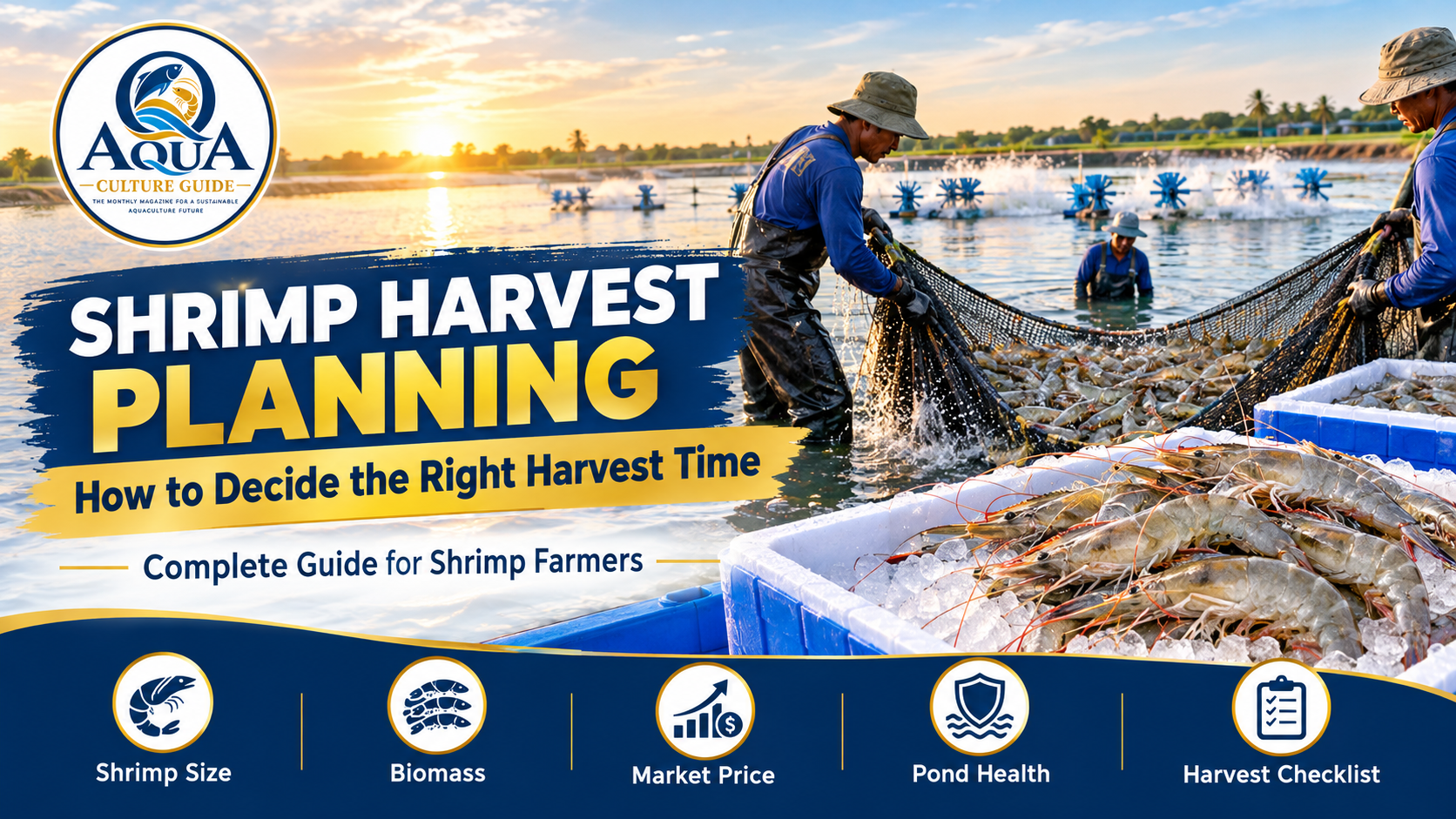
vannamei shrimp, how to check shrimp size and growth, calculate biomass, assess market prices, prepare ponds, and follow a complete pre-harvest checklist.
Shrimp Harvest Planning: How to Decide the Right Harvest Time
Harvesting at the right time is an important decision in vannamei shrimp farming. A farmer may achieve good growth and survival but still lose potential profit by harvesting too early, waiting too long, or failing to coordinate with the buyer and processing plant.
The right harvest time depends on shrimp size, growth rate, survival, pond health, market price, feed cost and the expected return from continuing the crop.
Harvest planning is not simply about waiting until shrimp reach a particular age. Farmers need to evaluate the actual condition of the crop and compare the financial benefits of harvesting now with the risks and costs of waiting.
Why Is Harvest Planning Important?
Proper harvest planning helps farmers:
- Harvest shrimp at the required market size.
- Avoid unnecessary feed and electricity costs.
- Reduce the risk of losses from deteriorating pond conditions.
- Coordinate harvesting with buyers and processing plants.
- Improve shrimp freshness and handling quality.
- Estimate revenue and calculate crop profitability.
- Prepare labor, equipment, ice and transportation in advance.
When Is the Right Time to Harvest Vannamei Shrimp?
There is no single harvest day suitable for every shrimp farm.
The correct timing depends on the following factors.
- Shrimp size
Check whether the shrimp have reached the size required by your buyer or processing plant.
For example, a buyer requiring a particular shrimp count per kilogram may have different requirements from a buyer purchasing larger shrimp.
- Growth rate
Regular sampling helps determine whether shrimp are growing as expected.
If growth has slowed, the farmer should investigate the reason before deciding whether extending the crop will be profitable.
- Survival rate
Estimated survival affects the amount of shrimp available for harvest and the revenue the farmer can expect.
- Pond health
Persistent mortality, poor water quality or declining feeding activity may make waiting riskier.
- Market price
Selling price can change according to shrimp size, buyer demand, processing requirements and market conditions.
- Feed and operating costs
Every extra day adds operating expenses, including feed, electricity, labor and other farm inputs.
The ideal harvest date is the one that balances shrimp growth, farm risk, operating costs and market demand.
Check Shrimp Size Before Deciding
Shrimp size is usually expressed as the number of shrimp in one kilogram.
This is commonly called the count per kilogram or count size.
Shrimp Count per kg Approximate Average Weight
30 count 33.3 g
40 count 25 g
50 count 20 g
60 count 16.7 g
70 count 14.3 g
80 count 12.5 g
100 count 10 g
These values are mathematical estimates based on dividing 1,000 grams by the count per kilogram. Actual shrimp sizes vary within a harvest.
Example
If the buyer requires approximately 40-count shrimp, the average target weight is:
Average Weight= 1000/40=25g
Sample Shrimp Regularly
Sampling helps farmers understand the crop before harvest.
During sampling, check:
- Average body weight (ABW)
- Shrimp count per kilogram
- Size variation
- Feeding response
- General appearance
- Shell and muscle condition
- Signs of abnormal mortality
Use a consistent sampling method and collect shrimp from representative pond locations.
Avoid relying on a single sample from an area where shrimp may be unusually large or small.
Average body weight formula
ABW(g)= Total weight of sampled shrimp(g)/ Number of Shrimp sampled
Example
Suppose 100 shrimp weigh 2,500 grams.
ABW=2500/100=25g
The estimated average count is:
Count/kg=1000/25=40
The sample suggests an average size of approximately 40 shrimp/kg.
Sampling estimates should always be checked against the buyer's required count and the actual variation in shrimp size.
Calculate Shrimp Biomass Before Harvest
Biomass is the estimated total live weight of shrimp in the pond.
It helps farmers estimate how much shrimp may be available and plan labor, transportation, ice and harvesting equipment.
Formula
Estimated biomass (kg)}=Estimated live shrimp population x ABW g/1000
Example
Suppose:
- Estimated surviving shrimp: 150,000
- Average body weight: 25 g
Calculation: 150000x25/1000=3750kg
Estimated standing biomass is 3,750 kg, or 3.75tonnes.
Check Survival and Mortality Trends
Before choosing the harvest date, review recent mortality records.
Ask:
- Is mortality stable or increasing?
- Has feeding reduced unexpectedly?
- Are shrimp showing unusual swimming behavior?
- Are there signs of disease?
- Has water quality deteriorated?
- Is the estimated biomass still reliable?
Daily mortality should be evaluated alongside the overall health of the pond.
If persistent mortality is occurring, consult an aquaculture professional and arrange appropriate diagnostic testing.
Do not assume every mortality event has the same cause, and do not delay an important health assessment simply to reach a larger harvest size
Compare Shrimp Prices Before Fixing the Harvest Date
Market price can significantly influence the harvest decision.
Contact your buyer or processor and confirm:
- Current farm-gate price
- Price by count size
- Minimum quantity required
- Quality specifications
- Expected deductions
- Harvest date and delivery time
- Payment terms
Do not rely only on a general market price. The price offered for your actual shrimp size and quality is what matters.
Practical example
Suppose your estimated harvest is 4,000 kg.
Item Example
Harvest quantity 4,000 kg
Selling price ₹300/kg
Gross revenue ₹12,00,000
This is an illustrative calculation, not a current market quotation.
Gross revenue=Harvest quantityxSelling price
Remember that gross revenue is not profit. Feed, seed, electricity, labor, harvesting, transportation and other operating costs must also be considered.
Decide Whether to Harvest Now or Wait
Waiting may allow shrimp to grow larger, but it also increases feed and operating costs and exposes the crop to additional health and water-quality risks.
Before extending the crop, consider the expected additional profit rather than only the expected increase in body weight.
Calculate the potential benefit of waiting
Estimate:
- Additional harvest weight expected.
- The price likely to be received for the larger size.
- Additional feed required.
- Electricity and labor costs.
- Expected mortality and crop risks.
- Changes in buyer demand.
Simple decision example
Suppose you expect the crop to generate ₹80,000 in additional revenue if you wait several more days.
During that period, you estimate additional feed, power and labor costs of ₹35,000.
The difference before considering additional risk is:
₹80,000-₹35,000=₹45,000
The estimated additional return is ₹45,000 before other costs and risks.
Monitor Water Quality Before Harvest
Water quality remains important until harvesting is complete.
Before harvest, check relevant parameters such as:
- Dissolved oxygen (DO)
- Temperature
- pH
- Salinity
- Alkalinity
- Ammonia
- Nitrite
- Water colour
- Shrimp behavior
Watch especially for
Low oxygen, sudden pH changes, plankton crashes, increasing mortality and reduced feeding.
Check Molting Before Harvest
Molting is the process in which shrimp shed their old shell and develop a new one.
Recently molted shrimp may have soft shells, which can affect handling and quality.
Pre-harvest molting check
- Sample shrimp approximately two days before the planned harvest.
- Examine shell condition carefully.
- Estimate the proportion of newly molted shrimp.
- Discuss the findings with the processor or technical adviser.
- If the proportion is high, consider delaying harvest where pond health and other conditions permit.
Coordinate With the Buyer or Processing Plant
Do this before announcing a final harvest date.
Confirm:
- Harvest date and time
- Quantity expected
- Required count size
- Harvesting method
- Packing arrangements
- Ice requirements
- Transport availability
- Processing plant schedule
- Quality and documentation requirements
Complete Step-by-Step Shrimp Harvest Planning Guide
Step 1: Review Crop Records
Collect your stocking, sampling, feed, mortality and water-quality records.
Review growth trends and estimate the current condition of the crop.
Step 2: Sample Shrimp
Measure average body weight and determine count size.
Check size variation and the proportion of newly molted shrimp.
Step 3: Estimate Biomass
Use the estimated surviving population and average body weight to calculate standing biomass.
Remember that the result is an estimate rather than a guaranteed harvest weight.
Step 4: Check Shrimp Health
Look for abnormal mortality, poor feeding, muscle abnormalities or other signs of health problems.
If a disease is suspected, seek appropriate diagnostic advice.
Step 5: Test Water Quality
Check the key parameters and compare them with previous readings.
Look for worsening trends that could make further culture risky.
Step 6: Contact the Buyer
Confirm acceptable count sizes, price, quantity, quality requirements and the processing schedule.
Step 7: Compare the Economics
Estimate gross revenue from harvesting now and compare it with the likely additional returns and costs of waiting.
Step 8: Select a Provisional Harvest Date
Choose a date based on shrimp size, health, pond conditions, market demand and buyer availability.
Step 9: Conduct the Pre-Harvest Check
Approximately two days before harvest, check molting and review shrimp health.
MPEDA recommends delaying harvest by a day or two if newly molted shrimp exceed 10%, where appropriate.
Step 10: Finalize Harvest Logistics
Arrange labor, nets, pumps, insulated containers, clean water, ice, weighing equipment and transportation.
Step 11: Follow the Pre-Harvest Feeding Plan
MPEDA recommends stopping feeding six hours before harvesting to help empty the gut and maintain quality. Confirm this with your processor and adapt it to the actual harvest schedule and farm instructions.
Step 12: Harvest at a Suitable Time
MPEDA recommends completing draining and harvesting within approximately 6–8 hours, during the cooler period between 6 PM and 6 AM, and avoiding harvest and packing during the hottest part of the day.
Step 13: Handle Shrimp Carefully
Avoid unnecessary delays, rough handling and contamination.
Wash and chill shrimp according to food-safety procedures and processor instructions.
Step 14: Transport Promptly
Use clean, insulated containers and maintain appropriate chilling during transport.
Step 15: Calculate Actual Production and Profit
Record the actual harvested quantity, count size, selling price, deductions and costs.
Compare actual results with your original estimate to improve the next crop's harvest plan.
Preparing the Pond Before Harvest
The preparation process will depend on the farm design and planned harvesting method.
Check:
- Outlet gates and drainage structures
- Pumps and backup power
- Harvest nets and bag nets
- Pond access and safety
- Labor availability
- Transport access
- Clean water for washing
- Insulated tubs or crates
Pre-Harvest Water Exchange: What Should Farmers Know?
MPEDA's Better Management Practices describe exchanging approximately 20% of pond water one week before the planned harvest, followed by agricultural lime application of 100–200 kg/ha after water exchange. The guidance also advises against water exchange or reducing water level during the final two to three days before harvest.
These are specific practices from MPEDA's guidance, not instructions that must be applied blindly to every pond.
Before any water exchange or lime application, consider:
- Existing water quality
- Source-water quality
- Disease risk
- Salinity difference
- Pond-bottom condition
- Current regulations and technical advice
Avoid unnecessary water exchange where it could introduce risk or destabilize the pond.
Harvesting Time and Weather
Harvesting during cooler hours can help reduce heat-related quality deterioration and make handling easier.
MPEDA recommends harvesting during the night or early morning window specified in its BMP and avoiding harvesting and packing at the hottest time of the day.
Farmers should also check the local weather forecast and prepare for rain, extreme heat, unsafe access or power interruptions.
The planned timing must allow sufficient workers, chilling capacity and transportation to be ready before the harvest begins.
Post-Harvest Handling: Protect Shrimp Quality
Harvesting is only one part of the process. Post-harvest handling directly affects the quality of shrimp reaching the buyer.
Follow these practices
Use clean water. Wash harvested shrimp appropriately and prevent contamination.
Chill promptly. Arrange sufficient good-quality ice before harvest.
Use insulated containers. Keep shrimp protected from heat and contamination.
Separate lots when required. MPEDA recommends keeping hand-picked shrimp separate from bag-net harvested shrimp in the procedure it describes.
Avoid unapproved chemical use. MPEDA advises against adding chemicals during washing or chill-killing without the processor's knowledge. Follow current food-safety requirements and the processor's approved procedure.
Transport without delay. Arrange prompt movement to the processing plant.
Calculate Harvest Revenue and Profit
At harvest, record the actual results rather than relying entirely on estimates.
Gross revenue
Gross revenue=Harvest quantity (kg)xSelling price per kg
Feed cost
Feed cost}=Total feed used (kg)xFeed price per kg
Total production cost
Include:
- Seed
- Feed
- Electricity and fuel
- Labor
- Water management
- Farm inputs
- Harvesting
- Ice and packing
- Transportation
- Other relevant expenses
Approximate crop profit
Profit=total revenue-Total crop cost
Complete Shrimp Harvest Planning Checklist
Use this checklist before fixing your final harvest date.
A. Shrimp Growth and Health
☐ Recent shrimp sampling completed
☐ Average body weight recorded
☐ Count per kilogram estimated
☐ Size variation assessed
☐ Survival and mortality records reviewed
☐ Shrimp health checked
☐ Feeding response evaluated
☐ Newly molted shrimp assessed
B. Water Quality
☐ Dissolved oxygen checked
☐ pH checked
☐ Temperature checked
☐ Salinity checked
☐ Alkalinity checked
☐ Ammonia checked
☐ Nitrite checked where appropriate
☐ Recent water-quality trends reviewed
C. Market and Economics
☐ Buyer contacted
☐ Required count size confirmed
☐ Current price confirmed
☐ Expected quantity estimated
☐ Early harvest versus delayed harvest compared
☐ Additional feed cost estimated
☐ Electricity and labor costs estimated
☐ Expected gross revenue calculated
D. Harvest Preparation
☐ Harvest date and time fixed
☐ Processing plant informed
☐ Labor arranged
☐ Nets and harvesting equipment checked
☐ Pumps and drainage system checked
☐ Backup power available
☐ Clean water arranged
☐ Ice supply confirmed
☐ Insulated tubs/crates available
☐ Weighing equipment ready
☐ Transportation confirmed
E. Final Pre-Harvest Inspection
☐ Shrimp health reviewed
☐ Molting checked
☐ Feeding schedule confirmed
☐ Water exchange decision reviewed
☐ Weather checked
☐ Pond access and safety checked
☐ Processing plant reconfirmed
☐ Farm records prepared
F. Post-Harvest
☐ Actual harvest quantity recorded
☐ Count size recorded
☐ Buyer and sale price recorded
☐ Shrimp chilled promptly
☐ Packing and transport records maintained
☐ Feed use finalized
☐ Crop costs updated
☐ Profit calculated
☐ Lessons recorded for the next crop
Shrimp Harvest Planning Timeline
Timing Main Activities
1–2 weeks before harvest Review sampling, growth, health, biomass, price and buyer requirements. Plan harvesting equipment and labor.
Around 1 week before harvest Finalize the harvest plan and assess whether water management or other preparation is required. Follow farm-specific technical advice.
2 days before harvest Check molting and shrimp health. Review weather, water conditions and logistics.
1 day before harvest Confirm buyer, workers, ice, equipment, transport and processor schedule.
Harvest day Follow the agreed feeding plan, harvest carefully, chill quickly, weigh and dispatch promptly.
After harvest Reconcile production and costs, document the crop outcome and plan pond preparation.
Common Shrimp Harvest Planning Mistakes
- Harvesting without checking shrimp size
The crop may not meet the buyer's required count.
- Waiting only for a target weight
Shrimp growth must be compared with feed cost, market price and pond-health risks.
- Ignoring increasing mortality
Continuing the crop can become more expensive or risky if health problems are developing.
- Failing to contact the buyer early
Unplanned harvesting may cause delays in processing and chilling.
- Ignoring molting
Harvesting a high proportion of newly molted shrimp can affect handling quality.
- Harvesting during the hottest period
Heat and delays can compromise shrimp freshness.
- Not arranging enough ice
Harvested shrimp need prompt chilling and appropriate handling.
- Using rough or unsuitable equipment
Poor handling can damage shrimp and reduce product quality.
- Extending the crop without calculating additional costs
More growth does not necessarily mean more profit.
- Failing to maintain records
Without accurate harvest and cost records, it becomes harder to improve the next crop.
Conclusion
The right shrimp harvest time is the point at which shrimp size, market demand, pond health and farm economics come together.
Farmers should not decide the harvest date based only on culture age or average body weight.
Instead, use a consistent process:
Sample shrimp → Calculate biomass → Check health → Monitor water quality → Confirm buyer requirements → Compare the economics of waiting → Prepare equipment and ice → Harvest carefully → Record the actual results.
Questions & Answers
Q1.How do I know when vannamei shrimp are ready for harvest?
Check average body weight, count per kilogram, size variation, growth trend, survival, pond health and buyer requirements. No single culture day or body weight is correct for every farm.
Q2.How often should shrimp be sampled before harvest?
Sampling frequency depends on the crop stage and farm conditions. Regular sampling becomes particularly important when the harvest decision is approaching because it helps track growth, count size and estimated biomass.
Q3.Should I harvest when the shrimp reach the target size?
Target size is important, but also consider price, feed cost, health, survival, mortality trends and the economics of waiting.
Q4.Should feeding be stopped before harvest?
MPEDA recommends stopping feeding six hours before harvesting as part of its Better Management Practices. Confirm the plan with the processor and adjust it to the actual harvest schedule and farm requirements.
Q5.What is the best time of day to harvest shrimp?
MPEDA recommends the cooler hours between 6 PM and 6 AM for the procedure described in its guidance and advises avoiding harvesting and packing during the hottest part of the day.
Q6.Should I delay harvest during molting?
MPEDA recommends avoiding harvest during molting and advises checking shrimp two days before harvest. If newly molted shrimp exceed 10%, its guidance recommends considering a delay of one or two days where conditions permit.
Related articles
భారతీయ రిజర్వాయర్లలో కేజ్ ఫిష్ ఫార్మింగ్: సాంకేతికత, అనుమతులు మరియు పెట్టుబడి వివరాలు
భారతదేశంలోని రిజర్వాయర్లలో కేజ్ ఫిష్ ఫార్మింగ్ ఎలా ప్రారంభించాలి? అవసరమైన సాంకేతికత, ప్రభుత్వ అనుమతులు, పెట్టుబడి, చేపల జాతులు, మేత నిర్వహణ మరియు లాభనష్టాల గురించి పూర్తి వివరాలు తెలుసుకోండి.
Freshwater Prawn Farming in IndiaFreshwater Prawn Farming in India: రైతులకు పూర్తి సాగు మార్గదర్శిని
భారతదేశంలో మంచినీటి రొయ్యల సాగు ఎలా ప్రారంభించాలి? జెయింట్ ఫ్రెష్వాటర్ ప్రాన్ సీడ్ ఎంపిక, చెరువు తయారీ, స్టాకింగ్, ఆహారం, నీటి నాణ్యత, పెట్టుబడి, మార్కెటింగ్ గురించి పూర్తి వివరాలు తెలుసుకోండి.
Tilapia farming in Indiaభారతదేశంలో తిలాపియా చేపల పెంపకం – మార్కెట్ అవకాశాలు, ప్రభుత్వ నిబంధనలు మరియు ఆధునిక సాగు పద్ధతులు
భారతదేశంలో తిలాపియా చేపల పెంపకం ఎలా చేయాలి? మార్కెట్ అవకాశాలు, ప్రభుత్వ అనుమతులు, చెరువు సాగు, బయోఫ్లాక్, RAS విధానాలు, పిల్లల ఎంపిక, మేత నిర్వహణ మరియు దిగుబడి గురించి పూర్తి సమాచారం.
PCR Testing in Shrimp Hatcheriesరొయ్యల హ్యాచరీల్లో PCR పరీక్షలు: ఫలితాలను రైతులు ఎలా అర్థం చేసుకోవాలి?
WSSV, EHP, AHPND వంటి వ్యాధికారకాలను గుర్తించడంలో PCR పరీక్షల పాత్ర, పరీక్షా నివేదికలను అర్థం చేసుకోవడం, నాణ్యమైన రొయ్య పిల్లలను ఎంపిక చేసుకోవడం గురించి రైతులు తెలుసుకోవాల్సిన పూర్తి సమాచారం.
Explore Aqua Culture Guide
Aqua companies directory
Feed, seed, probiotics & equipment suppliers
Aquaculture calculators
Feed, FCR, stocking & water quality tools
Telugu aqua magazine
Read the latest monthly issue online
All aqua news & articles
Farming, disease control and market updates
List your company free
Get found by farmers across India
Advertise with us
Magazine and website advertising options