
Shrimp Farming Cost per Acre: Complete Expense Breakdown
30/10/2026
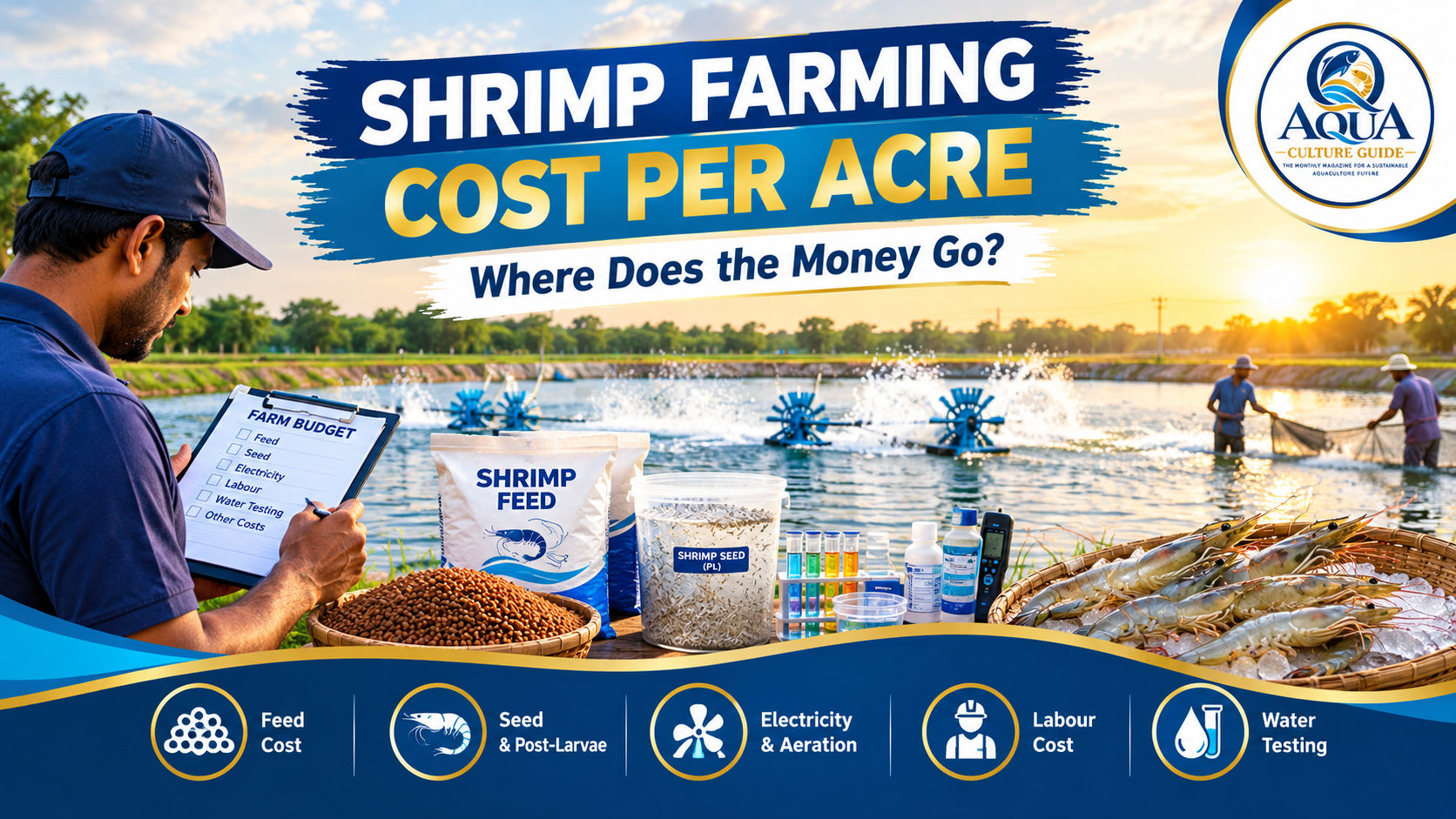
Understand shrimp farming cost per acre, including pond preparation, seed, feed, labour, electricity, probiotics and other expenses. Learn how to prepare a farm budget and calculate profitability.
Introduction
Shrimp farming can offer good business opportunities, but profitability depends on much more than production and market price. Every crop involves several expenses, starting from pond preparation and seed purchase to feed, electricity, labour, water management, harvesting and transportation.
For farmers, understanding the shrimp farming cost per acre is important before starting a new crop. A farm may achieve good production but still generate low returns if feed expenses, electricity costs, seed quality or other operating expenses are not properly managed.
Many farmers calculate their investment by considering only major expenses such as seed and feed. However, smaller expenses—including testing, pond preparation, minerals, probiotics, equipment maintenance and harvesting charges—can add significantly to the total cost.
The actual cost of shrimp farming per acre is not the same for every farm. It depends on the culture system, stocking density, crop duration, feed conversion ratio (FCR), survival rate, electricity tariff, labour availability, input prices and harvesting size.
Understanding the Two Main Types of Shrimp Farming Costs
Before calculating the cost per acre, farmers should separate expenses into two categories.
A. Initial investment or capital cost
These are expenses for setting up the farm or improving its infrastructure. They may continue to provide value across several crop cycles.
Examples include:
- Pond excavation and construction.
- Pond lining, where required.
- Inlet and outlet structures.
- Water pumps and pipelines.
- Paddlewheel aerators and electrical installations.
- Generator or backup power supply.
- Feed storage and worker facilities.
- Biosecurity equipment and fencing.
These costs should not be charged entirely to one crop if the equipment or infrastructure will be used for several years. Instead, farmers can account for depreciation and maintenance over its useful life.
B. Operating cost per crop
These are the expenses directly involved in running a crop.
Examples include:
- Pond preparation.
- Shrimp seed (post-larvae).
- Feed.
- Electricity and diesel.
- Probiotics, minerals and other permitted inputs.
- Labour.
- Water testing and laboratory charges.
- Repairs and maintenance.
- Harvesting, packing and transportation.
- Interest on working capital.
Important: When comparing two farms, make sure both are calculating costs on the same basis—per acre per crop, per acre per year, or total farm investment. Mixing these figures can lead to incorrect profit estimates.
Shrimp Farming Cost per Acre: Where Does the Money Go?
The following are the main expense categories farmers should include in an acre-wise budget.
1. Pond preparation
Pond preparation is the first major activity before stocking.
It may include:
- Removing accumulated sludge where necessary.
- Drying the pond bottom.
- Repairing pond bunds.
- Cleaning inlet and outlet structures.
- Applying suitable soil or water conditioners based on test results.
- Filling and preparing water.
- Disinfection where appropriate and permitted.
- Checking screens, pumps and aerators.
The cost depends on pond condition, soil characteristics, water source and the work required before each crop.
- Shrimp seed (PL) cost
Seed quality and stocking decisions directly influence the crop's financial risk.
The seed budget depends on:
- Number of post-larvae stocked.
- Price per thousand PL.
- Hatchery and transport charges.
- Seed quality and health-screening requirements.
- Stocking density.
- Acclimation and stocking arrangements.
Farmers should source suitable, healthy seed from approved or appropriately registered hatcheries and check relevant health documentation. The cheapest seed is not necessarily the most economical choice if quality or survival is poor.
- Shrimp feed cost
Feed is usually the largest operating expense in shrimp farming. MPEDA's better-management guidance identifies feed as accounting for approximately 50–60% of operating costs in the farming context it discusses. Actual shares vary with the culture system and farm performance.
Feed expenses depend on:
- Total biomass produced.
- Feed price and quality.
- Feeding duration.
- Feed conversion ratio (FCR).
- Shrimp growth and survival.
- Feed wastage.
- Feeding management.
For example, poor feed-tray monitoring or excessive feeding can increase costs while adding uneaten feed and organic waste to the pond.
Farmers should monitor feeding trays, sample shrimp regularly and adjust feeding according to actual consumption, growth, health and water conditions.
- Electricity and diesel expenses
Aerators, pumps and backup generators consume energy throughout the crop.
The cost depends on:
- Number and horsepower of aerators.
- Daily operating hours.
- Electricity tariff.
- Pumping requirements.
- Generator use and diesel price.
- Stocking density and biomass.
- Culture system.
Energy consumption can rise significantly in intensive and biofloc systems because of their aeration and water-management requirements. A 2025 study of shrimp farms in Tamil Nadu also identified electricity as a major energy input, with consumption increasing as culture intensity increased
- Probiotics, minerals and water-management inputs
Farmers may spend money on products such as:
- Pond-water probiotics.
- Feed probiotics.
- Mineral supplements.
- Alkalinity-management products.
- Approved water treatments.
- Soil and pond-bottom conditioners.
- Other permitted farm inputs.
These expenses should be based on actual requirements, product quality and proper application. Applying more products does not automatically improve production or profitability.
- Labour expenses
Labour is needed for daily pond management and farm operations.
Common responsibilities include:
- Feeding and feed-tray monitoring.
- Checking water quality.
- Operating aerators and pumps.
- Sampling shrimp.
- Pond cleaning and maintenance.
- Recordkeeping.
- Harvest preparation.
Labour expenses depend on the number of workers, wages, crop duration, farm size and whether the farm uses permanent or temporary staff.
- Water testing and laboratory expenses
Regular testing helps farmers identify problems before they become costly.
Possible expenses include:
- pH and dissolved oxygen testing.
- Ammonia and nitrite testing.
- Alkalinity and hardness testing.
- Salinity testing.
- Mineral analysis where required.
- Shrimp health and disease-related laboratory tests.
- Seed health screening.
The frequency and type of testing should match the farm's risk and management needs.
- Repairs and maintenance
Farmers should budget for maintenance instead of waiting for equipment to fail.
Examples include:
- Aerator servicing.
- Pump and motor repairs.
- Electrical maintenance.
- Generator servicing.
- Pipeline repairs.
- Net and screen replacement.
- Pond bund maintenance.
Unexpected equipment failure can affect both expenses and animal survival, especially when backup aeration is unavailable.
- Harvesting, packing and transportation
Harvest-related expenses may include:
- Labour for harvesting.
- Harvest nets and equipment.
- Ice and packing materials.
- Loading and unloading.
- Transportation to the buyer or processing facility.
- Handling or service charges, where applicable.
These costs can vary according to harvest quantity, distance, buyer arrangements and market requirements.
- Finance, rent and other expenses
Do not forget the expenses that are easy to overlook:
- Pond lease or land rent.
- Interest on working capital.
- Loan interest.
- Insurance premiums, if applicable.
- Depreciation of equipment.
- Administrative expenses.
- Communication and transport.
- Miscellaneous farm expenses.
A realistic budget should include these costs even when no direct cash payment is made during a particular crop.
Example: How to Prepare an Acre-Wise Shrimp Farming Budget
There is no single fixed shrimp farming cost per acre in India. A conventional semi-intensive pond, a high-density farm and a biofloc operation can have very different investment and operating requirements.
Research on shrimp farms in Tamil Nadu also shows that feed, electricity, seed, labour and other inputs all contribute to production costs, with their shares varying by farm and production system.
Wiley Online Library+1
Rather than treating an online estimate as a guaranteed market rate, farmers should prepare a budget using their own supplier quotations and farm records.
Sample operating budget worksheet
Enter your actual expected expenses. The table is a planning template, not a fixed cost estimate.
Expense category Your estimated cost (₹/acre/crop)
Pond preparation ₹ ______
Seed and stocking ₹ ______
Feed ₹ ______
Electricity and diesel ₹ ______
Probiotics, minerals and other inputs ₹ ______
Labour ₹ ______
Water testing and laboratory ₹ ______
Repairs and maintenance ₹ ______
Harvesting and transportation ₹ ______
Rent and finance costs ₹ ______
Other expenses ₹ ______
Total operating cost ₹ ______
Keep capital investment separate. If you include depreciation, interest on fixed capital or annual rent, clearly identify how you have allocated those expenses to each crop.
How to calculate the total cost
Total operating cost=All crop expenses
For example, if your farm spends ₹8,00,000 on all operating expenses for one acre during a crop, its operating cost is ₹8,00,000 per acre for that crop. This is an illustration of the calculation, not a typical or recommended investment figure.
Calculate cost per kilogram of shrimp
Cost per kg =Total crop cost / Total harvested shrimp (kg)
If total crop cost is ₹8,00,000 and harvested production is 2,000 kg:
₹800000\2000=₹400kg
This means the calculated production cost is ₹400 per kg, based on the expenses included in the example.
How Feed, FCR and Survival Affect the Cost
Three important factors have a major influence on shrimp farming economics.
A. Feed Conversion Ratio (FCR)
FCR measures how much feed is used to produce a unit of shrimp biomass gain.
FCR=Total feed used (kg)\Shrimp biomass gain (kg)
For example:
- Feed used: 2,400 kg
- Biomass gain: 2,000 kg
- FCR: 1.2
A higher FCR generally means more feed is required for each kilogram of biomass produced, increasing feed cost.
However, FCR should be interpreted alongside survival, harvest biomass, feed quality and crop conditions. A single number does not tell the whole story.
B. Survival rate
Survival rate is the percentage of stocked shrimp that remain alive at harvest.
Survival (\%)=Number harvested / Number stocked x 100
For example:
- Number stocked: 100,000 PL
- Number harvested: 75,000 shrimp
- Survival rate: 75%
Poor survival can reduce harvest quantity while many operating expenses remain unchanged.
Harvest size and selling price
The selling price depends on shrimp size, quality, market demand, buyer requirements and prevailing market conditions.
A farmer harvesting larger shrimp may receive a different price per kilogram from a farmer harvesting smaller shrimp. However, keeping shrimp longer to achieve a larger size also means additional feed, electricity, labour and disease-risk exposure.
The best harvest decision should consider expected additional revenue against the extra cost and risk of continuing the crop.
How to Calculate Revenue, Profit and Break-Even Price
Step 1: Calculate gross revenue
Gross revenue= Harvest quantity\Average selling price
Example:
- Harvest quantity: 2,000 kg
- Average selling price: ₹450/kg
Gross revenue:
2000x₹450=₹900000
Step 2: Calculate net operating result
Operating profit=Gross revenue-Total operating cost
Using the illustrative figures above:
- Gross revenue: ₹9,00,000
- Operating cost: ₹8,00,000
- Operating surplus: ₹1,00,000
This is before any costs excluded from the operating budget, such as certain capital charges, depreciation, taxes or other financing expenses. Include those costs to calculate a fuller net profit.
Step 3: Calculate the break-even selling price
Break-even price per kg= Total cost \ Harvest quantity
If total cost is ₹8,00,000 and production is 2,000 kg, the break-even price is ₹400/kg.
This means the average selling price must be above ₹400/kg to cover the costs included in that calculation.
Step 4: Prepare a low-price scenario
Farmers should not prepare a budget using only the most optimistic selling price.
Calculate expected returns under at least three situations:
- Good scenario: Better survival, suitable growth and favourable market price.
- Normal scenario: Production and price based on realistic farm records.
- Difficult scenario: Lower survival, higher FCR, additional expenses or reduced selling price.
This helps farmers understand whether they can manage a crop if conditions become unfavourable.
Where Can Farmers Control Shrimp Farming Costs?
Cost reduction should not mean cutting essential farm management practices. The aim is to reduce waste and improve efficiency without increasing production risk.
Expense area Practical cost-control approach
Feed Use feeding trays, sample shrimp regularly and adjust feeding based on consumption
Seed Choose healthy, traceable seed and avoid stocking decisions based only on low price
Electricity Maintain aerators and pumps, monitor operating hours and plan energy use carefully
Probiotics and minerals Select products based on actual needs, quality and label instructions
Labour Train workers and maintain clear daily work records
Water testing Use a planned testing schedule and reliable methods
Repairs Perform preventive maintenance and keep essential spare parts
Harvesting Plan harvesting and buyer arrangements in advance
Finance Prepare cash-flow estimates and understand interest and repayment obligations
Step-by-Step Guide: How to Prepare a Shrimp Farming Budget Before Stocking
Step 1: Measure the actual culture area
Confirm the usable pond area rather than calculating expenses from the total land area. A farm may include reservoirs, canals, roads, sheds and other spaces that are not part of the culture pond.
Step 2: Review previous crop records
If you have farmed before, collect information about:
- Seed quantity and cost.
- Total feed used.
- FCR.
- Survival rate.
- Harvest size and quantity.
- Electricity and diesel usage.
- Labour expenses.
- Total input costs.
- Selling price and buyer deductions.
Previous crop records are often more useful than generic estimates because they reflect your own farm conditions.
Step 3: Collect current supplier quotations
Ask suppliers for current prices of seed, feed, minerals, probiotics, water treatments and other necessary inputs.
Compare product specifications and quality, not just prices.
Step 4: Estimate stocking and production
Prepare a realistic production estimate using the proposed stocking density, expected survival and target harvest size.
Do not assume that higher stocking density will automatically produce higher profit. Higher biomass may require more feed, aeration, energy and management.
Step 5: Estimate feed requirements
Prepare an initial feed budget using expected production and a realistic FCR based on the farming system and previous crop performance.
Keep monitoring feed consumption and revise the estimate during the crop.
Step 6: Estimate energy and labour expenses
Calculate expected aerator operating hours, pump usage, generator requirements, electricity charges, diesel consumption and worker wages.
Include backup power arrangements where required for the farm's risk conditions.
Step 7: Add other operating expenses
Include pond preparation, testing, minerals, probiotics, maintenance, harvesting, transport, rent and finance costs.
Small expenses should not be ignored simply because they are paid in cash or purchased frequently.
Step 8: Keep a contingency reserve
Set aside a suitable financial buffer for unexpected repairs, emergency water management, additional testing or other crop requirements.
The amount should reflect the farm's risk, available working capital and previous experience. Do not use the entire budget for seed and feed purchases.
Step 9: Calculate break-even production and price
Estimate the minimum production and selling price needed to cover the costs. Check whether the farm can remain financially viable under a lower-price or lower-survival scenario.
Step 10: Review the budget before stocking
Discuss the final budget with the farm manager, technical adviser and finance provider where appropriate. Stock only when the farm has a realistic operating plan and sufficient working capital for the crop.
Complete Checklist: Shrimp Farming Cost per Acre
Use this checklist before stocking and throughout the crop to make sure important expenses are included in your budget.
A. Farm infrastructure and preparation
[ ] Confirmed actual culture area per acre
[ ] Checked pond bunds, inlet and outlet structures
[ ] Estimated pond preparation expenses
[ ] Checked pumps, aerators and electrical installations
[ ] Planned backup power and biosecurity arrangements
B. Seed and stocking
[ ] Collected seed quotations from reliable hatcheries
[ ] Checked seed quality and relevant health documentation
[ ] Estimated stocking quantity and seed cost
[ ] Included seed transport and acclimation expenses
[ ] Prepared a realistic survival and production estimate
C. Feed and farm inputs
[ ] Collected current feed prices
[ ] Estimated feed requirement and FCR
[ ] Planned feed-tray and shrimp-sampling activities
[ ] Budgeted probiotics, minerals and water treatments
[ ] Checked product quality, dosage and suitability
D. Daily operating expenses
[ ] Estimated electricity and diesel expenses
[ ] Included labour and worker facilities
[ ] Budgeted water testing and laboratory charges
[ ] Included repairs and equipment maintenance
[ ] Planned water management and pond-bottom management
E. Harvest and financial planning
[ ] Estimated harvesting and packing expenses
[ ] Included transport and buyer-related charges
[ ] Calculated total cost per crop
[ ] Calculated cost per kilogram
[ ] Estimated gross revenue and break-even price
[ ] Prepared good, normal and difficult crop scenarios
[ ] Kept a contingency reserve for unexpected expenses
F. Crop recordkeeping
[ ] Recorded daily feed usage
[ ] Recorded electricity and aerator operating hours
[ ] Recorded water-quality readings
[ ] Recorded product applications and expenses
[ ] Recorded weekly shrimp growth and health
[ ] Recorded harvest quantity, size, survival and FCR
[ ] Calculated final crop profit or loss
Common Financial Mistakes in Shrimp Farming
- Calculating only seed and feed expenses
Other expenses such as electricity, labour, pond preparation, testing, maintenance and harvesting also affect profitability.
2.Ignoring capital investment
Pond construction, aerators, pumps and generators require investment. Their cost should be considered over their useful life.
- Assuming a fixed production per acre
Production varies with stocking density, survival, growth, water quality, farm management and culture system.
- Choosing seed only by price
Poor-quality seed can increase production risk. Evaluate hatchery credibility and relevant health information.
5. Ignoring FCR
Feed is a major operating expense. Poor feeding management can increase the cost of producing each kilogram of shrimp.
- Spending too much on unnecessary products
Do not apply every available probiotic, mineral or water treatment. Use products according to the farm's requirements and reliable instructions.
- Not maintaining daily records
Without records, farmers may not know where money is being spent or which management decisions are affecting production costs.
- Calculating profit without market deductions
Consider buyer deductions, transport, handling, commission and other applicable charges when calculating the actual amount received.
- Not preparing for price changes
Shrimp market prices can change during the crop. A financial plan should include a lower-price scenario.
Conclusion
Shrimp farming profitability is not decided by harvest quantity alone. It depends on how efficiently farmers manage every expense throughout the crop.
Feed, seed, electricity, labour, pond preparation, water management, harvesting and finance costs all contribute to the final production cost. Even small expenses can make a difference when they accumulate over a complete crop cycle.
Before stocking, prepare an acre-wise budget, estimate realistic production, calculate the break-even price and maintain sufficient working capital. During the crop, record expenses, monitor FCR and survival, and make decisions based on actual farm performance.
Successful shrimp farming is not just about producing more shrimp. It is about producing shrimp efficiently, controlling unnecessary expenses and making informed financial decisions.
Questions & Answers
Q1.How much does shrimp farming cost per acre in India?
There is no fixed cost per acre. It depends on the culture system, stocking density, seed and feed prices, electricity, labour, crop duration and farm infrastructure. Farmers should prepare a crop-specific budget using current local quotations.
Q2.What is the biggest expense in shrimp farming?
Feed is generally the largest operating expense. MPEDA's better-management guidance indicates that feed can account for around 50–60% of operating costs in the farming context it describes. The actual percentage varies between farms and production systems.
Q3.How much does shrimp seed cost per acre?
Seed cost depends on the number of PL stocked, price per thousand, hatchery, transport and stocking density. Calculate it using the current supplier quotation and planned stocking quantity.
Q4.How can farmers reduce shrimp farming costs?
Farmers can improve feed management, avoid unnecessary product applications, maintain equipment, monitor electricity use, select suitable seed and maintain regular farm records. Essential biosecurity and water-quality management should not be compromised to save money.
Q5.How does FCR affect shrimp farming profit?
A higher FCR generally means more feed is required to produce the same biomass. Since feed is a major expense, improving feed utilisation can help reduce production cost per kilogram.
Q6.What is the difference between capital cost and operating cost?
Capital cost covers long-term infrastructure such as ponds, pumps and aerators. Operating cost covers crop-related expenses such as seed, feed, electricity, labour and other inputs.
Related articles
భారతీయ రిజర్వాయర్లలో కేజ్ ఫిష్ ఫార్మింగ్: సాంకేతికత, అనుమతులు మరియు పెట్టుబడి వివరాలు
భారతదేశంలోని రిజర్వాయర్లలో కేజ్ ఫిష్ ఫార్మింగ్ ఎలా ప్రారంభించాలి? అవసరమైన సాంకేతికత, ప్రభుత్వ అనుమతులు, పెట్టుబడి, చేపల జాతులు, మేత నిర్వహణ మరియు లాభనష్టాల గురించి పూర్తి వివరాలు తెలుసుకోండి.
Freshwater Prawn Farming in IndiaFreshwater Prawn Farming in India: రైతులకు పూర్తి సాగు మార్గదర్శిని
భారతదేశంలో మంచినీటి రొయ్యల సాగు ఎలా ప్రారంభించాలి? జెయింట్ ఫ్రెష్వాటర్ ప్రాన్ సీడ్ ఎంపిక, చెరువు తయారీ, స్టాకింగ్, ఆహారం, నీటి నాణ్యత, పెట్టుబడి, మార్కెటింగ్ గురించి పూర్తి వివరాలు తెలుసుకోండి.
Tilapia farming in Indiaభారతదేశంలో తిలాపియా చేపల పెంపకం – మార్కెట్ అవకాశాలు, ప్రభుత్వ నిబంధనలు మరియు ఆధునిక సాగు పద్ధతులు
భారతదేశంలో తిలాపియా చేపల పెంపకం ఎలా చేయాలి? మార్కెట్ అవకాశాలు, ప్రభుత్వ అనుమతులు, చెరువు సాగు, బయోఫ్లాక్, RAS విధానాలు, పిల్లల ఎంపిక, మేత నిర్వహణ మరియు దిగుబడి గురించి పూర్తి సమాచారం.
PCR Testing in Shrimp Hatcheriesరొయ్యల హ్యాచరీల్లో PCR పరీక్షలు: ఫలితాలను రైతులు ఎలా అర్థం చేసుకోవాలి?
WSSV, EHP, AHPND వంటి వ్యాధికారకాలను గుర్తించడంలో PCR పరీక్షల పాత్ర, పరీక్షా నివేదికలను అర్థం చేసుకోవడం, నాణ్యమైన రొయ్య పిల్లలను ఎంపిక చేసుకోవడం గురించి రైతులు తెలుసుకోవాల్సిన పూర్తి సమాచారం.
Explore Aqua Culture Guide
Aqua companies directory
Feed, seed, probiotics & equipment suppliers
Aquaculture calculators
Feed, FCR, stocking & water quality tools
Telugu aqua magazine
Read the latest monthly issue online
All aqua news & articles
Farming, disease control and market updates
List your company free
Get found by farmers across India
Advertise with us
Magazine and website advertising options