
Shrimp Farming Break-Even Analysis: Simple Practical Example
30/10/2026
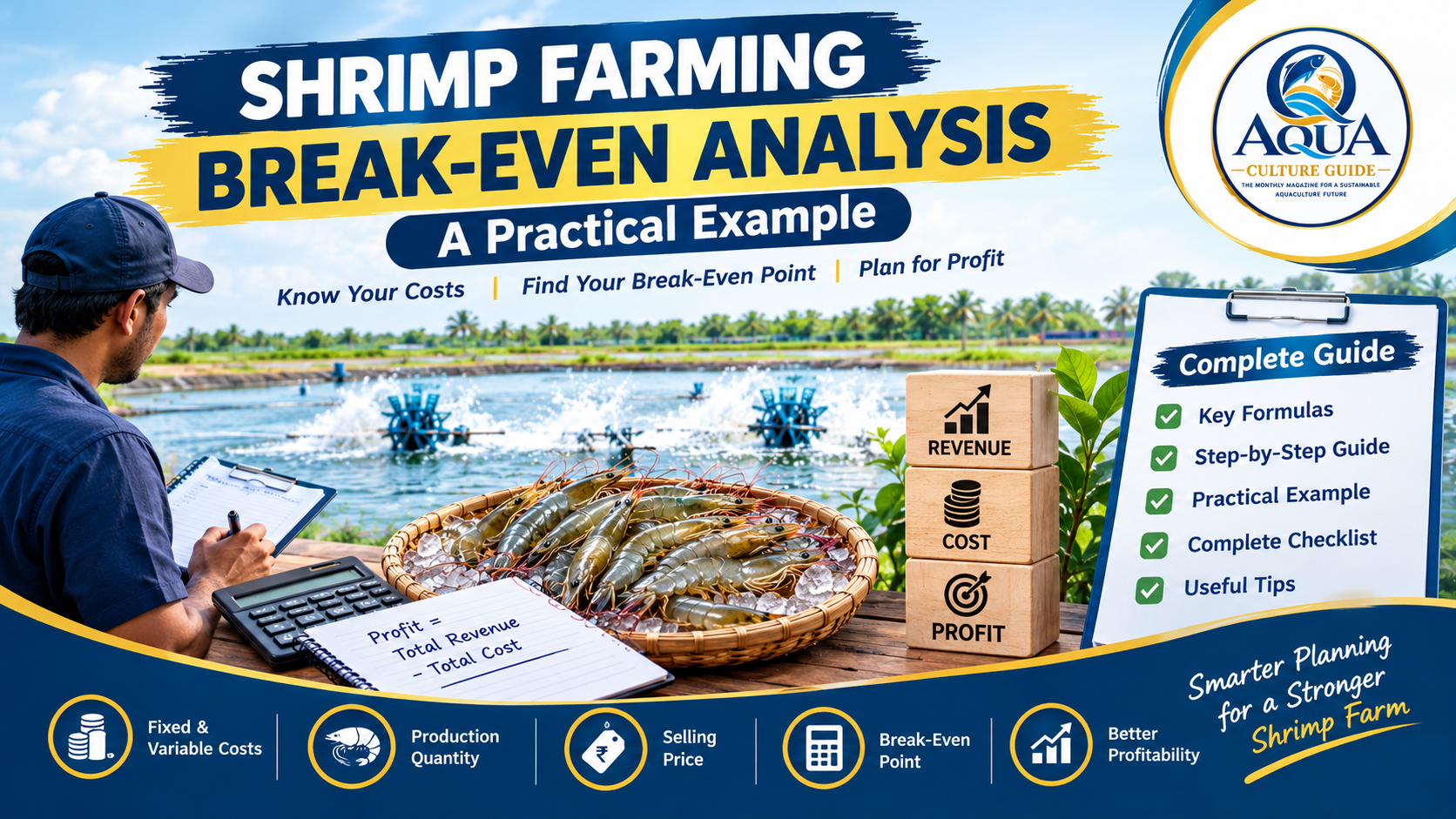
Learn how to calculate the break-even point in shrimp farming with a practical example. Understand fixed costs, variable costs, selling price, production quantity and farm profitability.
Introduction
Shrimp farming involves several expenses, including seed, feed, electricity, labour, probiotics, minerals, pond preparation and harvesting. Even when a farmer gets a good harvest, changes in production costs or market prices can affect the final profit.
One important calculation that helps farmers understand financial risk is break-even analysis.
Break-even analysis tells farmers how much shrimp they need to produce and sell, or what selling price they need to receive, to cover their farming costs. At this point, the farm neither makes a profit nor suffers a loss.
In this article, we explain shrimp farming break-even analysis using a simple practical example. We also cover fixed costs, variable costs, break-even production, break-even selling price and a complete checklist that farmers can use to review their crop economics.
What Is Break-Even Analysis in Shrimp Farming?
Break-even analysis is a method used to calculate the minimum production or sales required to cover the total costs of a shrimp farming crop.
At the break-even point:
Total revenue equals total cost.
The farmer does not make a profit.
The farmer does not suffer a loss.
Simple example:
Total farming cost: ₹8,00,000
Total sales income: ₹8,00,000
Profit or loss: ₹0
This means the farmer has recovered the money spent on the crop, but has not earned a profit.
Understand Fixed Costs and Variable Costs
Before calculating the break-even point, farmers need to separate expenses into two categories.
A. Fixed Costs
Fixed costs are expenses that generally do not change directly with the quantity of shrimp produced during a crop.
Examples include:
Pond rent or lease charges.
Equipment depreciation.
Interest on farm loans.
Fixed salaries, where applicable.
Allocated infrastructure maintenance costs.
Some of these expenses may change between crops or over time, but they are treated as fixed for the particular calculation period.
B. Variable Costs
Variable costs change with production or farming activity.
Examples include:
Shrimp seed (PL).
Feed.
Probiotics and minerals.
Electricity and diesel used for production.
Additional labour.
Harvesting and packing expenses.
Transportation and sales-related charges.
For a simple break-even calculation, variable expenses are converted into a cost per kilogram of shrimp produced and sold.
Important: Classify each expense consistently. Do not count the same expense in both fixed and variable costs.
Important Formulas for Shrimp Farming Break-Even Analysis
Farmers should understand three basic calculations.
A. Break-Even Quantity
This tells farmers how many kilograms of shrimp they must sell to cover their costs.
Break-Even Quantity (kg) = Fixed Costs ÷ (Selling Price per kg − Variable Cost per kg)
B. Break-Even Selling Price
This tells farmers the minimum average selling price required to cover the total cost at a particular production quantity.
Break-Even Selling Price per kg = Total Cost ÷ Total Quantity Sold
C. Profit or Loss
Profit or Loss = Total Revenue − Total Cost
These calculations help farmers understand how production quantity, selling price and expenses affect the financial result.
Practical Example: Break-Even Analysis for a One-Acre Shrimp Farm
Let's understand the calculation using a hypothetical one-acre shrimp farm.
Farm Details
Particulars Amount
Farm area- 1 acre
Expected production-2,500 kg
Average selling price- ₹400/kg
Fixed costs- ₹1,50,000
Variable cost per kg- ₹250
Step 1: Calculate Total Variable Cost
Expected production = 2,500 kg
Variable cost per kg = ₹250
Total variable cost:
2,500 × ₹250 = ₹6,25,000
Step 2: Calculate Total Cost
Fixed costs = ₹1,50,000
Variable costs = ₹6,25,000
Total cost: ₹1,50,000 + ₹6,25,000 = ₹7,75,000
Step 3: Calculate Total Revenue
Expected production = 2,500 kg
Selling price = ₹400/kg
Total revenue:
2,500 × ₹400 = ₹10,00,000
Step 4: Calculate Expected Profit
Total revenue = ₹10,00,000
Total cost = ₹7,75,000
Expected profit: ₹10,00,000 − ₹7,75,000 = ₹2,25,000
This is the expected profit under the assumptions in this example.
Calculate the Break-Even Quantity
Now let's find out how many kilograms the farmer must sell to cover the costs.
Given:
Fixed costs = ₹1,50,000
Selling price = ₹400/kg
Variable cost = ₹250/kg
Contribution per kg:
₹400 − ₹250 = ₹150
Break-even quantity:
₹1,50,000 ÷ ₹150 = 1,000 kg
Result: The farmer must sell approximately 1,000 kg of shrimp to cover the fixed and variable costs under these assumptions.
Below 1,000 kg: the farm makes a loss.
At 1,000 kg: the farm reaches break-even.
Above 1,000 kg: the farm earns an operating profit, provided the assumed price and costs remain unchanged.
Calculate the Break-Even Selling Price
Farmers should also understand the minimum selling price required to cover the total cost.
From our example:
Total cost = ₹7,75,000
Expected production = 2,500 kg
Break-even selling price:
₹7,75,000 ÷ 2,500 = ₹310/kg
This means the farmer needs an average selling price of ₹310 per kg to cover the costs included in this example.
If the average selling price is above ₹310/kg, the farm generates a surplus. If it is below ₹310/kg, the farm makes a loss.
How Selling Price Changes Affect Profit
Shrimp market prices can change depending on size, quality, buyer demand and market conditions.
Let's see how different selling prices affect the farm's financial result.
Assumptions:
Harvested quantity: 2,500 kg
Total cost: ₹7,75,000
Simple explanation:
- At ₹280/kg, the farmer loses ₹75,000.
- At ₹300/kg, the farmer loses ₹25,000.
- At ₹310/kg, the farmer recovers all expenses.
- At ₹350/kg, the farmer earns ₹1,00,000 profit.
- At ₹400/kg, the farmer earns ₹2,25,000 profit.
Key point: ₹310 per kg is the break-even selling price in this example. Below this price, the farmer makes a loss; above it, the farmer makes a profit.
How Production Quantity Affects Profit
Production quantity also affects the final result.
Assumptions:
Fixed costs: ₹1,50,000
Variable cost: ₹250/kg
Selling price: ₹400/kg
Assume the selling price is ₹400 per kg, fixed costs are ₹1,50,000, and variable costs are ₹250 per kg.
- If the farmer harvests 800 kg, they lose ₹30,000.
- At 1,000 kg, they recover all their expenses.
- At 1,500 kg, they earn ₹75,000.
- At 2,000 kg, they earn ₹1,50,000.
- At 2,500 kg, they earn ₹2,25,000.
Key point: In this example, the farmer needs to harvest and sell at least 1,000 kg to cover the costs. This is the break-even production level.
The example assumes that variable cost per kilogram and selling price remain constant as production changes. In a real farm, these values may change with survival, FCR, harvest size, market price and operating conditions.
Factors That Can Change the Break-Even Point
Several farm and market conditions can increase or decrease the break-even quantity.
- Feed Cost
Feed is a major expense in shrimp farming. An increase in feed price or poor feed conversion can increase the production cost.
- Survival Rate
Low survival can reduce the total harvest quantity. When fewer kilograms are harvested, the fixed costs are spread across less production.
3. FCR
A higher FCR means more feed is used to produce the same amount of shrimp biomass. This can increase variable cost per kilogram.
- Electricity and Diesel
Aeration and water pumping require energy. Higher energy expenses can increase production costs.
- Shrimp Market Price
A lower selling price reduces the contribution earned from each kilogram and increases the quantity needed to break even.
- Disease and Crop Losses
Disease problems, mortality and early harvesting can reduce production and make it harder to recover the farming investment.
7. Harvest Size
Different shrimp sizes may receive different prices. Farmers should calculate the actual average selling price from all harvest lots rather than assuming one price for the entire crop.
Complete Shrimp Farming Break-Even Checklist
Use this checklist before starting a crop and again after harvesting.
Farm and Production Details
Record total pond area.
Record pond preparation date.
Record stocking date.
Record total PL stocked.
Record stocking density.
Monitor survival estimates.
Record average body weight.
Record total harvested quantity.
Record all partial harvests.
Fixed Cost Records
Record pond rent or lease charges.
Calculate equipment depreciation.
Record loan interest.
Record fixed salaries, where applicable.
Allocate infrastructure-related expenses.
Variable Cost Records
Record shrimp seed expenses.
Record feed purchases and actual feed usage.
Record electricity and diesel costs.
Record probiotics and mineral expenses.
Record water treatment expenses.
Record labour expenses that vary with production.
Record laboratory and water testing costs.
Record harvesting and packing expenses.
Record transportation and sales charges.
Revenue Records
Record total shrimp sold.
Record the selling price for each harvest lot.
Record buyer deductions and commissions.
Calculate total sales revenue.
Check payments received and outstanding amounts.
Break-Even Calculation
Calculate total fixed costs.
Calculate total variable costs.
Calculate variable cost per kg.
Record the expected selling price per kg.
Calculate contribution per kg.
Calculate break-even quantity.
Calculate break-even selling price.
Compare expected production with break-even quantity.
Calculate expected profit or loss.
Prepare a budget for the next crop.
Step-by-Step Guide to Perform Break-Even Analysis
Farmers can follow these steps to calculate the break-even point for their own ponds.
Step 1: Collect farm expense records
Gather all bills and records related to seed, feed, electricity, diesel, labour, probiotics, minerals and other farming expenses.
Step 2: Separate fixed and variable costs
Identify expenses that remain relatively fixed for the crop and expenses that change with production.
Step 3: Calculate variable cost per kg
Divide the total variable cost by the expected or actual production quantity, using a consistent production basis.
Step 4: Decide the expected selling price
Use a realistic price based on shrimp size, quality, buyer quotations and market conditions. Do not depend only on the highest available market price.
Step 5: Calculate contribution per kg
Subtract variable cost per kilogram from selling price per kilogram.
Step 6: Calculate break-even quantity
Divide total fixed costs by contribution per kilogram.
Step 7: Calculate break-even selling price
Divide total costs by expected harvested quantity.
Step 8: Compare break-even quantity with expected production
Check whether the expected harvest is comfortably above the break-even quantity. Consider possible production and price risks.
Step 9: Calculate expected profit or loss
Estimate total revenue and subtract all costs included in the calculation.
Step 10: Review the results before the next crop
Identify the biggest expenses and prepare a realistic farm budget. Update the calculations whenever feed prices, energy costs or expected selling prices change.
Common Mistakes Farmers Should Avoid
Mixing fixed costs and variable costs.
Forgetting electricity, diesel and labour expenses.
Using an unrealistic shrimp selling price.
Ignoring partial harvest quantities.
Calculating break-even using estimated production without considering crop risks.
Forgetting interest, rent or depreciation when calculating full economic costs.
Counting the same expense twice.
Assuming feed cost and other variable costs remain constant at every production level.
Ignoring buyer deductions and transportation charges.
Treating break-even production as a guaranteed harvest target.
Conclusion
Break-even analysis is a useful financial tool for shrimp farmers. It helps them understand how much shrimp they need to sell and what price they need to receive to cover their farming expenses.
By separating fixed and variable costs, calculating production cost per kilogram and monitoring market prices, farmers can make better financial decisions before and after stocking.
Remember: A good shrimp harvest is important, but knowing your break-even point is equally important for running a financially sustainable farm.
Questions & Answers
Q1.What is the break-even point in shrimp farming?
It is the production quantity or sales level at which total revenue equals total cost. At this point, the farmer neither makes a profit nor suffers a loss.
Q2.How do you calculate the break-even quantity in shrimp farming?
Divide fixed costs by the difference between selling price per kilogram and variable cost per kilogram
Q3.What is the break-even selling price?
It is the average price per kilogram required to cover the total costs at a particular production quantity.
Q4.Why is break-even analysis important for shrimp farmers?
It helps farmers understand the minimum production or selling price needed to recover farming expenses and assess financial risks.
Q5.Does a higher shrimp selling price reduce the break-even quantity?
Yes. When variable cost remains unchanged, a higher selling price increases contribution per kilogram and reduces the quantity needed to break even.
Q6.Does a higher feed cost affect break-even analysis?
Yes. Higher feed costs can increase variable cost per kilogram, reduce contribution and increase the break-even quantity.
Q7.Is break-even analysis the same as profit calculation?
No. Break-even analysis identifies the point where revenue covers costs. Profit calculation measures the amount earned after deducting costs from revenue.
Related articles
భారతీయ రిజర్వాయర్లలో కేజ్ ఫిష్ ఫార్మింగ్: సాంకేతికత, అనుమతులు మరియు పెట్టుబడి వివరాలు
భారతదేశంలోని రిజర్వాయర్లలో కేజ్ ఫిష్ ఫార్మింగ్ ఎలా ప్రారంభించాలి? అవసరమైన సాంకేతికత, ప్రభుత్వ అనుమతులు, పెట్టుబడి, చేపల జాతులు, మేత నిర్వహణ మరియు లాభనష్టాల గురించి పూర్తి వివరాలు తెలుసుకోండి.
Freshwater Prawn Farming in IndiaFreshwater Prawn Farming in India: రైతులకు పూర్తి సాగు మార్గదర్శిని
భారతదేశంలో మంచినీటి రొయ్యల సాగు ఎలా ప్రారంభించాలి? జెయింట్ ఫ్రెష్వాటర్ ప్రాన్ సీడ్ ఎంపిక, చెరువు తయారీ, స్టాకింగ్, ఆహారం, నీటి నాణ్యత, పెట్టుబడి, మార్కెటింగ్ గురించి పూర్తి వివరాలు తెలుసుకోండి.
Tilapia farming in Indiaభారతదేశంలో తిలాపియా చేపల పెంపకం – మార్కెట్ అవకాశాలు, ప్రభుత్వ నిబంధనలు మరియు ఆధునిక సాగు పద్ధతులు
భారతదేశంలో తిలాపియా చేపల పెంపకం ఎలా చేయాలి? మార్కెట్ అవకాశాలు, ప్రభుత్వ అనుమతులు, చెరువు సాగు, బయోఫ్లాక్, RAS విధానాలు, పిల్లల ఎంపిక, మేత నిర్వహణ మరియు దిగుబడి గురించి పూర్తి సమాచారం.
PCR Testing in Shrimp Hatcheriesరొయ్యల హ్యాచరీల్లో PCR పరీక్షలు: ఫలితాలను రైతులు ఎలా అర్థం చేసుకోవాలి?
WSSV, EHP, AHPND వంటి వ్యాధికారకాలను గుర్తించడంలో PCR పరీక్షల పాత్ర, పరీక్షా నివేదికలను అర్థం చేసుకోవడం, నాణ్యమైన రొయ్య పిల్లలను ఎంపిక చేసుకోవడం గురించి రైతులు తెలుసుకోవాల్సిన పూర్తి సమాచారం.
Explore Aqua Culture Guide
Aqua companies directory
Feed, seed, probiotics & equipment suppliers
Aquaculture calculators
Feed, FCR, stocking & water quality tools
Telugu aqua magazine
Read the latest monthly issue online
All aqua news & articles
Farming, disease control and market updates
List your company free
Get found by farmers across India
Advertise with us
Magazine and website advertising options