
Shrimp Farm-Gate Price vs Export Price: How the Value Chain Works
31/10/2026
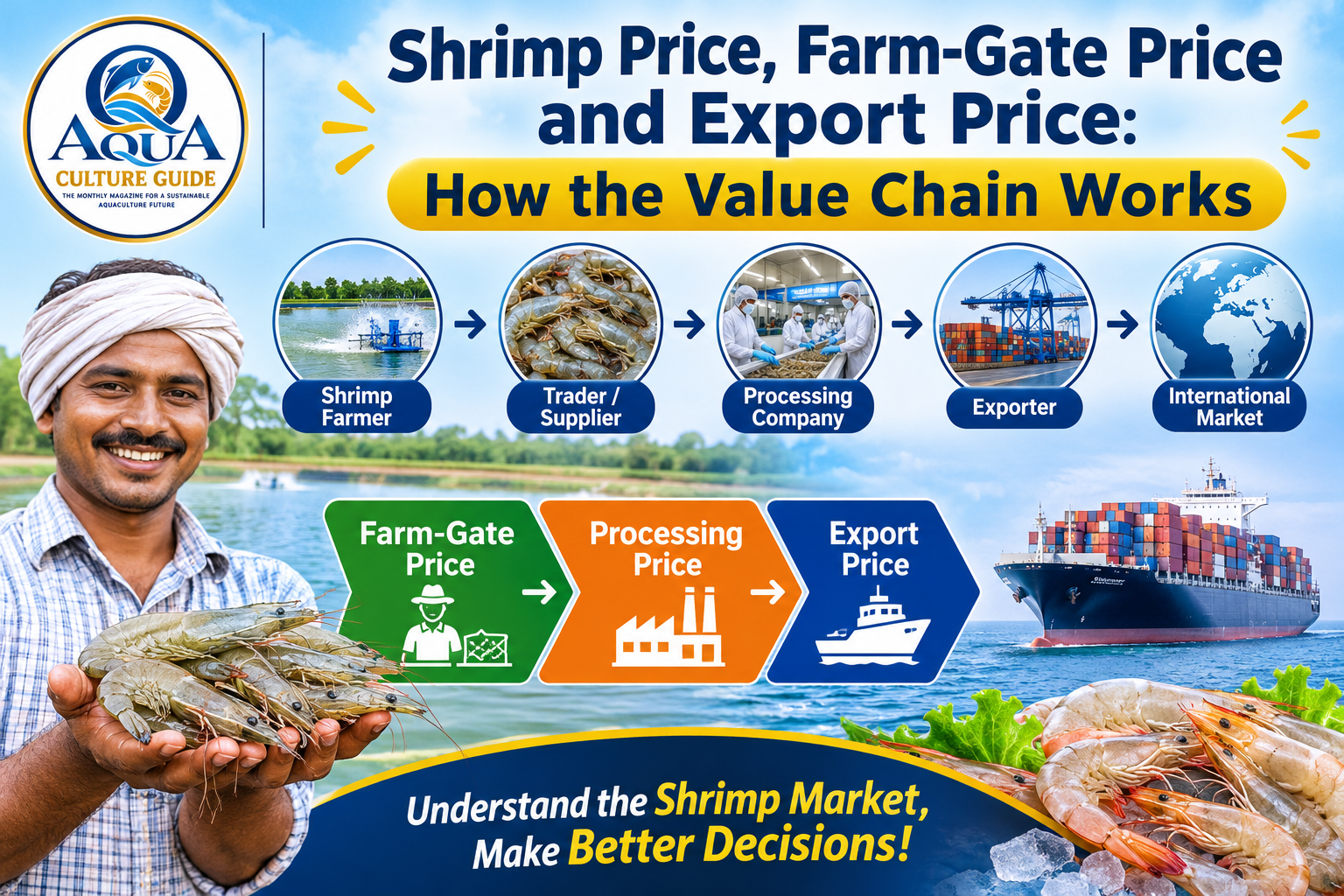
Understand shrimp farm-gate prices, processing prices and export prices. Learn how shrimp moves from farms to international markets, what affects prices and how farmers can understand the value chain.
Introduction
Shrimp farming is an important business that connects farmers, traders, processing companies and international buyers. But have you ever wondered why the price a farmer receives for shrimp is different from the price at which shrimp is exported to another country?
The reason is that shrimp passes through several stages before reaching international customers. At each stage, activities such as buying, transportation, grading, processing, freezing, packaging, storage and shipping add costs and value.
Three important prices are commonly discussed in the shrimp industry:
Farm-gate price: The price paid to the farmer for harvested shrimp.
Processing or selling price: The price associated with shrimp after it is purchased, handled or processed.
Export price: The price at which shrimp products are sold to overseas buyers.
Understanding these prices helps farmers learn how the shrimp market works, why prices change and how different businesses earn money along the supply chain.
What Is the Shrimp Value Chain?
The shrimp value chain means all the steps involved in moving shrimp from the farm to the final customer.
It usually includes:
Shrimp farmer.
Local trader or commission agent.
Collector or supplier.
Processing company.
Exporter.
International importer or distributor.
Retailer, restaurant or final customer.
Not every shipment follows exactly the same route. Some processing companies purchase directly from farmers, while others buy through traders or suppliers.
Simple explanation: The farmer produces shrimp, the buyer purchases it, the processing company prepares it, and the exporter sends the finished product to international markets.
What Is Farm-Gate Price?
Farm-gate price is the amount a farmer receives when selling harvested shrimp at the farm or through a farm-level buyer.
It is usually quoted in rupees per kilogram.
For example:
Shrimp harvested: 1,000 kg
Farm-gate price: ₹400 per kg
Total sale value:
1,000 × ₹400 = ₹4,00,000
This is the farmer's sales revenue before deducting farming expenses.
What Affects Farm-Gate Price?
Several factors influence the price offered to farmers:
- Shrimp Size
Shrimp are commonly sold according to size or count. Different sizes can receive different prices depending on buyer demand and market conditions.
- Shrimp Quality
Freshness, appearance, shell condition, meat quality and handling can influence the buyer's offer.
- Market Demand
When demand from processing companies and exporters is strong, farm-gate prices may improve. When demand is weak, prices may fall.
- Export Orders
Demand from overseas customers can influence the buying activity of processors and exporters.
- Harvest Quantity
Large quantities may attract different buying arrangements depending on the buyer's requirements and available processing capacity.
- Season and Supply
The availability of shrimp from different farming regions can influence market prices.
- Rejections and Deductions
Quality issues, size differences, damaged shrimp or other buyer conditions may result in deductions from the expected payment.
What Is Processing Price?
After shrimp are purchased from farmers, they may be transported to a processing plant.
At the processing plant, shrimp can undergo several activities, including:
Receiving and weighing.
Quality inspection.
Washing and cleaning.
Sorting and grading.
Head removal or peeling, depending on the product.
Deveining, where required.
Freezing.
Packaging and labelling.
Cold storage.
These activities involve labour, machinery, electricity, water, packaging materials, quality checks and other operating expenses.
The value of shrimp may change after processing because the product is now prepared in a particular form and specification.
Important: Processing does not automatically mean that the company earns a profit. The company must also pay for raw shrimp, processing, packaging, storage, transport, quality control and other business expenses.
What Is Export Price?
Export price is the price at which a shrimp product is sold to an overseas buyer.
It depends on several factors, such as:
Product type.
Shrimp size and grade.
Processing method.
Product quality.
Packaging requirements.
Country of destination.
Buyer demand.
International competition.
Shipping and delivery terms.
Currency exchange rates.
For example, a whole frozen shrimp product and a peeled, deveined and individually quick-frozen product may have different selling prices.
Important: Export price is not directly comparable with farm-gate price unless both prices refer to the same quantity basis, product form, grade, currency and delivery terms.
How Shrimp Moves from Farm to Export Market
Let's understand the value chain step by step.
Step 1: Shrimp Farmer Produces the Crop
The farmer prepares the pond, stocks quality PL, manages feed, maintains water quality and grows shrimp until harvest.
The farmer's main expenses include seed, feed, electricity, labour, farm inputs and harvesting.
Step 2: Shrimp Is Harvested and Sold
After harvest, the shrimp is weighed, checked for quality and sold to a buyer.
The farmer receives a farm-gate price based on factors such as size, quality and market demand.
Step 3: Trader or Supplier Collects Shrimp
A trader or supplier may collect shrimp from one or more farms and arrange transportation to a processing plant.
Costs may include:
Purchase price.
Ice and handling.
Labour.
Transportation.
Loading and unloading.
Quality-related losses, where applicable.
Some processing companies purchase directly from farmers, so this stage may not always involve a separate trader.
Step 4: Processing Company Prepares the Product
The processing company inspects, cleans, grades, processes, freezes and packs the shrimp according to buyer specifications.
Different products require different processing steps. For example, head-on shrimp and peeled shrimp do not have the same finished weight.
Step 5: Exporter Sells to an International Buyer
The exporter negotiates the price, product specifications, quantity, delivery terms and payment conditions with an overseas buyer.
The shipment is prepared with the required documentation and food-safety compliance.
Step 6: Product Reaches the Overseas Market
The imported shrimp may be sold to wholesalers, distributors, supermarkets, restaurants or other businesses before reaching consumers.
Simple Example: Understanding Farm-Gate Price and Export Price
Let's take a simple example to understand why the prices are different.
A farmer sells 1,000 kg of raw shrimp at ₹400 per kg.
Farmer's sales value: 1,000 × ₹400 = ₹4,00,000.
The shrimp is transported to a processing plant.
The company sorts, processes, freezes and packs the product.
The finished product is sold to an overseas buyer.
The export invoice may show a different price because it refers to a processed product and may include processing, packaging and other costs.
For example, if the finished product is sold at an export price of ₹650 per kg, that does not mean the company earns ₹250 profit on every kilogram.
Why? Because the company may have incurred additional costs, and processing may reduce the final product weight.
Remember: Farm-gate price and export price are not the same type of price. Always check whether the quantity refers to raw shrimp or finished processed product.
Why Export Price Is Usually Different from Farm-Gate Price
There are several reasons for the difference.
- Processing Expenses
Cleaning, grading, peeling, freezing and packing require labour, equipment and electricity.
- Weight Difference
Some processing methods remove the head, shell or other parts. Therefore, the finished product weight may be lower than the original raw shrimp weight.
- Packaging and Storage
Export products require suitable packaging and temperature-controlled storage.
- Transportation and Shipping
Shrimp must be transported under suitable conditions. International shipments may involve freight, insurance and port-related charges.
- Quality and Food Safety
Export markets may require specific testing, traceability, hygiene and documentation.
- Business and Financial Costs
Companies may have expenses related to staff, finance, administration, insurance, compliance and currency transactions.
- Export Delivery Terms
The export price can be quoted under different delivery terms. For example, an FOB price and a CIF price do not include exactly the same transportation and insurance responsibilities.
What Should Farmers Understand About Shrimp Market Prices?
Farmers should not judge their selling price only by looking at an export price reported in the news.
Before comparing prices, check:
Is the price for raw shrimp or processed shrimp?
Is it for the same shrimp size?
Is it for the same product form?
Is it a farm-gate price or an export invoice price?
Does it include freight and insurance?
What currency is being used?
What date does the price refer to?
Are there any quality deductions?
This helps farmers avoid incorrect comparisons.
How Farmers Can Understand the Shrimp Value Chain Better
Farmers can improve their market understanding by following these simple practices.
- Check Local Farm-Gate Prices
Ask multiple buyers for current prices before finalising a sale.
- Understand Shrimp Size and Count
Learn how different sizes are graded and how they affect the price offered.
- Maintain Harvest Records
Record harvested quantity, size, buyer, price and deductions for every harvest lot.
- Understand Quality Requirements
Follow good harvesting, handling, icing and transportation practices to protect shrimp quality.
5. Build Buyer Relationships
Maintain contact with reliable buyers and understand their payment and quality requirements.
- Follow Market Updates
Monitor domestic buying prices, export demand and industry news.
- Compare the Correct Prices
Compare farm-gate prices with other farm-gate prices, and export prices with export prices for similar products and delivery terms.
Complete Checklist: Understanding Shrimp Price and the Value Chain
Use this checklist when selling shrimp or reviewing market information.
Farm-Gate Price Checklist
Check the current local buying price.
Ask more than one buyer for a quotation.
Record shrimp size or count.
Check shrimp freshness and quality.
Confirm the weighing method.
Understand possible quality deductions.
Confirm transport and ice arrangements.
Check payment terms.
Record the final price per kg.
Keep the sale receipt or transaction record.
Processing and Export Price Checklist
Identify whether the product is raw or processed.
Check the product form.
Check the shrimp size and grade.
Understand processing and weight loss.
Consider packaging and freezing costs.
Check storage and transportation expenses.
Understand export delivery terms.
Check the destination market.
Check the currency and price date.
Compare prices on the same product and weight basis.
Farmer Business Checklist
Record total harvest quantity.
Record each harvest lot separately.
Record the selling price for each lot.
Calculate total sales revenue.
Calculate total farming expenses.
Calculate production cost per kg.
Calculate profit or loss.
Compare prices between buyers.
Review market trends before the next crop.
Maintain records for every crop.
Step-by-Step Guide: How to Follow Shrimp Prices from Farm to Export
Step 1: Start with the local farm-gate price
Find out the current price offered by buyers in your farming area.
Step 2: Check shrimp size
Confirm the count or size category for which the price is being quoted.
Step 3: Ask how the shrimp will be handled
Understand who is responsible for harvesting, icing, loading and transportation.
Step 4: Record the quantity sold
Write down the exact weight of each harvest lot.
Step 5: Record the price and deductions
Note the agreed price per kg and any deductions made by the buyer.
Step 6: Understand the processing stage
Learn whether the shrimp is sold as whole shrimp, headless shrimp, peeled shrimp or another product.
Step 7: Check the export product price
When looking at export prices, identify the product form, size, destination and delivery terms.
Step 8: Understand the additional costs
Consider processing, packaging, freezing, storage, transport, shipping and other expenses.
Step 9: Compare prices correctly
Do not directly subtract the farm-gate price from the export price and call the difference profit. First account for processing yield, costs and product differences.
Step 10: Use the information for better farm decisions
Review your selling records and production costs to understand whether your crop is financially successful.
Common Mistakes When Comparing Shrimp Prices
Comparing raw shrimp price with processed shrimp price.
Assuming the difference between farm-gate and export price is company profit.
Ignoring weight loss during processing.
Comparing different shrimp sizes.
Ignoring packaging, freezing and transportation expenses.
Forgetting export delivery terms.
Looking at old market prices without checking the date.
Ignoring quality deductions.
Not recording the actual price received by the farmer.
Making farm decisions based only on export market news.
Conclusion
Shrimp moves through several stages before reaching international customers. The farmer receives the farm-gate price, while traders, processors and exporters handle different activities that add costs and value to the product.
Understanding the difference between farm-gate price, processing price and export price helps farmers understand the shrimp market more clearly.
Farmers should focus on production costs, shrimp quality, size, buyer quotations and actual selling prices rather than comparing export prices directly with farm income.
Remember: Understanding the value chain helps farmers make better selling decisions and understand where their shrimp goes after harvest.
Questions & Answers
Q1.What is farm-gate price in shrimp farming?
Farm-gate price is the amount paid to a farmer for harvested shrimp at the farm or through a farm-level buyer. It is generally quoted per kilogram.
Q2.What is shrimp export price?
Shrimp export price is the price at which shrimp products are sold to overseas buyers. It depends on product form, size, quality, destination and delivery terms.
Q3.Why is export price higher than farm-gate price?
Export prices may include the value of processing, grading, freezing, packaging and other services. They may also refer to a different product weight or form.
Q4.Does the difference between farm-gate price and export price represent profit?
No. The difference also covers processing, weight loss, packaging, storage, transport, shipping, finance and other business expenses.
Q5.Who buys shrimp from farmers?
Shrimp may be purchased by local traders, suppliers, collectors or processing companies. Some processors also buy directly from farmers.
Q6.Why does shrimp size affect the farm-gate price?
Different shrimp sizes have different buyer demand and processing requirements. Therefore, the price may vary between size categories.
Q7.What is shrimp processing yield?
Processing yield is the percentage of finished product weight obtained from the original raw shrimp weight after processing.
Q8.What is the difference between FOB and CIF export prices?
FOB generally refers to a price that includes delivery of the goods on board the vessel at the named port of shipment. CIF generally includes cost, insurance and freight to the named destination port. The exact responsibilities depend on the agreed Incoterms and contract.
Related articles
భారతీయ రిజర్వాయర్లలో కేజ్ ఫిష్ ఫార్మింగ్: సాంకేతికత, అనుమతులు మరియు పెట్టుబడి వివరాలు
భారతదేశంలోని రిజర్వాయర్లలో కేజ్ ఫిష్ ఫార్మింగ్ ఎలా ప్రారంభించాలి? అవసరమైన సాంకేతికత, ప్రభుత్వ అనుమతులు, పెట్టుబడి, చేపల జాతులు, మేత నిర్వహణ మరియు లాభనష్టాల గురించి పూర్తి వివరాలు తెలుసుకోండి.
Freshwater Prawn Farming in IndiaFreshwater Prawn Farming in India: రైతులకు పూర్తి సాగు మార్గదర్శిని
భారతదేశంలో మంచినీటి రొయ్యల సాగు ఎలా ప్రారంభించాలి? జెయింట్ ఫ్రెష్వాటర్ ప్రాన్ సీడ్ ఎంపిక, చెరువు తయారీ, స్టాకింగ్, ఆహారం, నీటి నాణ్యత, పెట్టుబడి, మార్కెటింగ్ గురించి పూర్తి వివరాలు తెలుసుకోండి.
Tilapia farming in Indiaభారతదేశంలో తిలాపియా చేపల పెంపకం – మార్కెట్ అవకాశాలు, ప్రభుత్వ నిబంధనలు మరియు ఆధునిక సాగు పద్ధతులు
భారతదేశంలో తిలాపియా చేపల పెంపకం ఎలా చేయాలి? మార్కెట్ అవకాశాలు, ప్రభుత్వ అనుమతులు, చెరువు సాగు, బయోఫ్లాక్, RAS విధానాలు, పిల్లల ఎంపిక, మేత నిర్వహణ మరియు దిగుబడి గురించి పూర్తి సమాచారం.
PCR Testing in Shrimp Hatcheriesరొయ్యల హ్యాచరీల్లో PCR పరీక్షలు: ఫలితాలను రైతులు ఎలా అర్థం చేసుకోవాలి?
WSSV, EHP, AHPND వంటి వ్యాధికారకాలను గుర్తించడంలో PCR పరీక్షల పాత్ర, పరీక్షా నివేదికలను అర్థం చేసుకోవడం, నాణ్యమైన రొయ్య పిల్లలను ఎంపిక చేసుకోవడం గురించి రైతులు తెలుసుకోవాల్సిన పూర్తి సమాచారం.
Explore Aqua Culture Guide
Aqua companies directory
Feed, seed, probiotics & equipment suppliers
Aquaculture calculators
Feed, FCR, stocking & water quality tools
Telugu aqua magazine
Read the latest monthly issue online
All aqua news & articles
Farming, disease control and market updates
List your company free
Get found by farmers across India
Advertise with us
Magazine and website advertising options