
Shrimp Disease Diagnosis: Complete Guide for Farmers | When to Send Samples to a Lab
7/10/2026
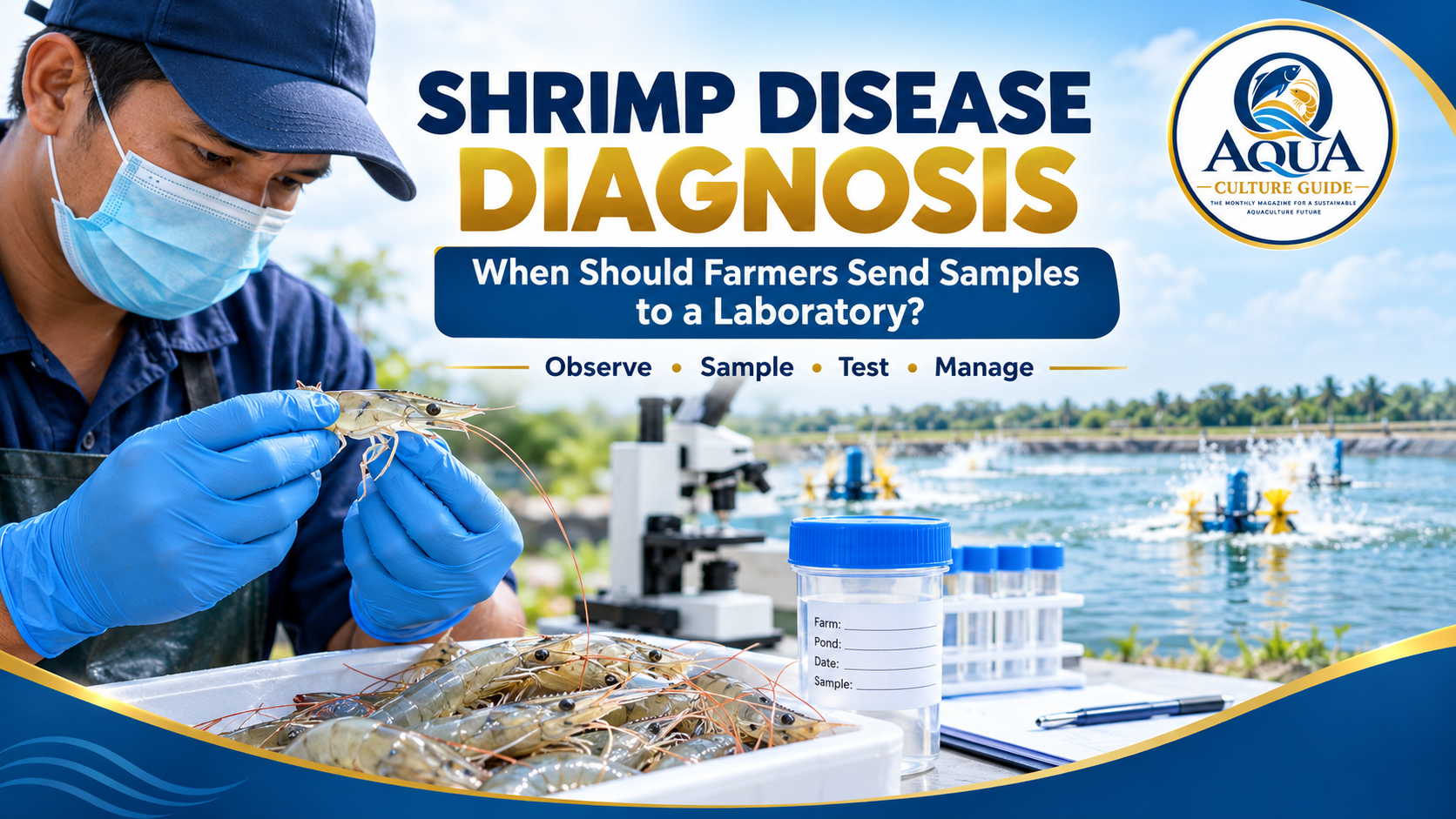
shrimp farmers should send samples to a laboratory, how to collect and pack shrimp samples, what tests may be required, and a complete checklist for early disease diagnosis.
Shrimp Disease Diagnosis: When Should Farmers Send Samples to a Laboratory?
Disease problems can develop quickly in shrimp farming. A sudden reduction in feeding, unusual swimming behavior or unexpected mortality may be caused by poor water quality, bacterial infections, viral diseases, parasites or other environmental problems.
The challenge is that many shrimp diseases can show similar symptoms.
For this reason, farmers should not always try to identify a disease based only on what they see in the pond.
Laboratory diagnosis can help identify the possible cause and guide appropriate farm management decisions.
This guide explains when to send shrimp samples to a laboratory, how to collect samples correctly, what information to provide and what farmers should do after receiving the results.
Why Is Laboratory Diagnosis Important in Shrimp Farming?
A shrimp farmer may observe:
Reduced feed consumption
Weak shrimp
Empty gut
Slow growth
Abnormal swimming
Soft shell
Color changes
Lesions
Sudden mortality
But these signs alone may not tell you exactly what is happening.
For example, reduced feeding can result from:
Disease + low dissolved oxygen + poor water quality + temperature changes + stress + feed problems
Therefore, laboratory testing can provide additional evidence when the cause is unclear.
The basic principle is:
Observe → Record → Sample → Test → Interpret → Take Action
When Should Farmers Send Shrimp Samples to a Laboratory?
Farmers should consider laboratory testing when there is an unusual or unexplained change in shrimp health or pond performance.
- Sudden Increase in Mortality
This is one of the strongest reasons to investigate immediately.
If mortality suddenly increases:
☐ Observe the affected pond
☐ Check water quality
☐ Check feeding behavior
☐ Collect appropriate shrimp samples
☐ Contact a qualified laboratory or aquatic animal-health professional
Do not wait for mortality to become severe before investigating.
2. Sudden Drop in Feed Consumption
A sudden reduction in feed intake can be an early warning sign.
Check:
Dissolved oxygen
Temperature
pH
Salinity
Ammonia
Nitrite
Weather conditions
Recent management changes
If water-quality conditions appear acceptable but feeding continues to decline, laboratory investigation may be appropriate.
3. Unusual Shrimp Behavior
Send samples for investigation when you observe unusual behavior such as:
Swimming near pond edges
Swimming at the surface
Weak swimming
Abnormal swimming patterns
Reduced response to feed
Unusual aggregation
Shrimp becoming inactive
These signs are not specific to one disease, so laboratory diagnosis may help determine the cause.
4. Physical Abnormalities
Farmers should investigate when they observe unusual physical changes such as:
Abnormal coloration
Lesions
Muscle abnormalities
Empty gut
Unusual hepatopancreas appearance
Shell abnormalities
Poor body condition
Unusual pigmentation
Take clear photographs and collect appropriate samples when necessary
5. Poor Growth or Uneven Growth
Laboratory testing is not required for every case of slow growth.
First check:
Feed quality
Feed management
Stocking density
Water quality
Temperature
Dissolved oxygen
Disease history
6. Repeated Problems in the Same Pond
If the same pond repeatedly experiences:
Mortality
Poor growth
Reduced feeding
Disease-like symptoms
Poor survival
farmers should consider a more detailed investigation.
Repeated problems may indicate an underlying issue involving pond conditions, biosecurity, seed health, water source or pathogens.
7. Before Major Management Decisions
Laboratory diagnosis can also be useful before making major disease-related decisions.
For example:
Do not automatically assume that every mortality problem is Vibrio.
A laboratory investigation may help distinguish between:
Bacterial problems
Viral diseases
Parasitic conditions
Environmental stress
Nutritional problems
Other causes
This can help farmers avoid unnecessary treatments.
Complete Step-by-Step Guide: How to Send Shrimp Samples to a Laboratory
Step 1: Observe the Problem
Before collecting samples, carefully observe the pond.
Record:
Date
Pond number
Stocking date
Shrimp age
Estimated biomass
Mortality
Feed consumption
Recent water exchange
Weather conditions
Recent treatments or product applications
Step 2: Check Water Quality First
Disease symptoms can sometimes be caused or worsened by environmental conditions.
Check, where relevant:
☐ Dissolved oxygen
☐ Temperature
☐ pH
☐ Salinity
☐ Alkalinity
☐ Ammonia
☐ Nitrite
☐ Water color
☐ Transparency
☐ Pond-bottom condition
Record the results.
Do not send a shrimp sample to the laboratory without recording the pond's environmental conditions whenever possible.
Step 3: Select the Right Shrimp
Sample selection is extremely important.
When possible, collect shrimp showing early or representative signs of the problem, rather than only dead and decomposed shrimp.
Good samples may include:
Weak but still living shrimp
Recently moribund shrimp
Shrimp showing early abnormal signs
Apparently affected shrimp
Representative healthy shrimp for comparison, when requested by the laboratory
Avoid:
❌ Severely decomposed shrimp
❌ Samples that have been sitting in the sun
❌ Damaged samples
❌ Samples contaminated with pond debris
Step 4: Collect Enough Samples
The required number depends on:
Type of suspected disease
Test method
Laboratory requirements
Sample type
Shrimp size
Always contact the laboratory before collecting samples when possible.
The laboratory can tell you:
Number of shrimp required
Whole shrimp or tissue required
Fresh or preserved sample
Container type
Temperature requirements
Transport method
Step 5: Handle Samples Carefully
Incorrect handling can affect test results.
Sample handling checklist
☐ Use clean equipment
☐ Avoid unnecessary handling
☐ Avoid contamination
☐ Keep samples cool as instructed
☐ Use appropriate containers
☐ Label every sample
☐ Follow the laboratory's preservation instructions
Do not freeze samples unless the laboratory specifically recommends freezing.
Different diagnostic tests require different sample-preservation methods.
Step 6: Label Every Sample
Every sample should be clearly identified.
Example:
Farm: ABC Shrimp Farm
Pond: Pond 3
Date: 07 October 2026
Shrimp Age: 55 DOC
Issue: Reduced feeding + mortality
Sample: Moribund shrimp.
Step 7: Complete the Laboratory Submission Form
Provide as much information as possible.
Farm information
☐ Farm name
☐ Location
☐ Contact details
☐ Pond number
Culture information
☐ Species
☐ Stocking date
☐ Stocking density
☐ Current age/DOC
☐ Estimated biomass
Disease information
☐ First date symptoms appeared
☐ Mortality level
☐ Feeding reduction
☐ Main symptoms
☐ Recent treatments
☐ Recent water-quality problems
Environmental information
☐ Temperature
☐ Dissolved oxygen
☐ pH
☐ Salinity
☐ Ammonia
☐ Nitrite
☐ Other relevant observations
Step 8: Transport the Sample Quickly
Time is important.
Samples should reach the laboratory as quickly as practical and according to the laboratory's instructions.
During transportation:
Maintain the recommended temperature.
Prevent overheating.
Avoid direct sunlight.
Prevent leakage.
Keep samples properly identified.
Follow the laboratory's transport instructions.
Step 9: Tell the Laboratory What You Suspect
Don't simply say:
"Shrimp are dying."
Give the laboratory a complete description.
For example:
"Shrimp are 55 DOC. Feeding dropped over the last three days. Mortality increased yesterday. Some shrimp are weak and showing abnormal swimming. Dissolved oxygen and other water-quality measurements are available."
This information gives the diagnostic team useful context.
Step 10: Ask Which Tests Are Appropriate
Depending on the symptoms, the laboratory may recommend different diagnostic methods.
Possible approaches can include:
PCR / Molecular Testing
Used to detect genetic material from specific pathogens.
Bacterial Testing
Can be used when bacterial disease is suspected and may include bacterial culture and identification.
Microscopic Examination
Can help identify certain parasites or other abnormalities.
Histopathology
Examines tissue structure and can provide evidence of disease-related changes.
Other Diagnostic Methods
The appropriate test depends on the suspected problem and the laboratory's capabilities.
The test should be selected based on the clinical and farm situation rather than ordering random tests.
Complete Shrimp Disease Sample-Collection Checklist
Before Sampling
☐ Observe shrimp behavior
☐ Record mortality
☐ Check feeding
☐ Check water quality
☐ Photograph symptoms
☐ Contact laboratory
☐ Confirm sample requirements
During Sampling
☐ Select representative shrimp
☐ Prefer live or freshly moribund shrimp when appropriate
☐ Avoid decomposed specimens
☐ Use clean equipment
☐ Avoid contamination
☐ Collect the required number of samples
Labeling
☐ Farm name
☐ Pond number
☐ Date
☐ Shrimp age
☐ Sample type
☐ Main symptoms
Documentation
☐ Mortality information
☐ Feeding information
☐ Water-quality data
☐ Recent treatments
☐ Recent management changes
☐ Previous disease history
Transportation
☐ Correct container
☐ Correct preservation method
☐ Appropriate temperature
☐ Avoid direct sunlight
☐ Prevent leakage
☐ Send promptly
When NOT to Wait for Laboratory Results
Some situations require immediate farm-management attention while diagnostic testing is underway.
For example, if shrimp mortality is increasing, farmers should not simply wait for a laboratory report before checking:
Dissolved oxygen → Water quality → Aeration → Feeding → Pond condition → Recent management changes
Laboratory testing and immediate farm management should happen in parallel.
Common Mistakes Farmers Should Avoid
Mistake 1: Sending Only Dead Shrimp
Dead shrimp may already be decomposed, making diagnosis difficult.
Mistake 2: Waiting Too Long
Samples collected several days after the first symptoms may not provide the best diagnostic information.
Mistake 3: Sending Unlabeled Samples
Always identify the pond and date.
Mistake 4: Ignoring Water Quality
A disease investigation should also consider environmental conditions.
Mistake 5: Assuming Every Mortality Is Vibrio
Different diseases and environmental problems can produce similar signs.
Mistake 6: Randomly Applying Products
Avoid changing several treatments at the same time without understanding the problem.
Mistake 7: Using Antibiotics Without Diagnosis
Antimicrobial treatment should be based on appropriate professional advice and applicable regulations.
Simple Decision Guide for Farmers
Shrimp look normal + feeding normal + mortality normal
➡ Continue routine monitoring.
Feeding decreases
➡ Check water quality and shrimp behavior.
Feeding decreases + unusual behavior
➡ Increase monitoring and consider diagnostic sampling.
Mortality starts increasing
➡ Check water quality immediately + collect appropriate samples.
Mortality continues or increases rapidly
➡ Send samples to a qualified laboratory and seek professional diagnostic support.
Laboratory confirms a pathogen
➡ Follow the recommended management and biosecurity response.
What Should Farmers Do After Receiving the Laboratory Report?
Receiving a laboratory report is not the final step.
Farmers should:
Understand what was detected.
Discuss the result with a qualified aquatic animal-health professional where appropriate.
Compare the result with pond symptoms.
Review water-quality records.
Review recent farm-management changes.
Strengthen biosecurity.
Monitor affected ponds closely.
Avoid unnecessary treatments.
Keep the report as part of the farm's health records.
Remember:
A laboratory result should be interpreted together with farm observations and environmental information.
Complete Shrimp Disease Diagnosis Checklist
🚨 Early Warning Signs
☐ Sudden mortality
☐ Reduced feeding
☐ Abnormal swimming
☐ Weak shrimp
☐ Empty gut
☐ Poor growth
☐ Abnormal color
☐ Visible lesions
☐ Unusual hepatopancreas appearance
☐ Repeated disease problems
💧 Water Quality
☐ Dissolved oxygen
☐ Temperature
☐ pH
☐ Salinity
☐ Alkalinity
☐ Ammonia
☐ Nitrite
☐ Water appearance
☐ Pond-bottom condition
🔬 Laboratory Sampling
☐ Contact laboratory
☐ Confirm sample requirements
☐ Select appropriate shrimp
☐ Avoid decomposed samples
☐ Use clean equipment
☐ Label samples
☐ Complete submission form
☐ Maintain recommended temperature
☐ Transport promptly
📋 Farm Information
☐ Pond number
☐ Shrimp age/DOC
☐ Stocking density
☐ Feed consumption
☐ Mortality history
☐ Water-quality records
☐ Recent treatments
☐ Recent weather events
☐ Previous disease history
🛡️ After Diagnosis
☐ Review laboratory report
☐ Consult appropriate professional
☐ Review farm conditions
☐ Strengthen biosecurity
☐ Monitor shrimp closely
☐ Record the diagnosis
☐ Avoid unnecessary treatment
☐ Continue water-quality monitoring
conclusion
Early diagnosis can save valuable time in shrimp farming.
Farmers should consider sending samples to a laboratory when they observe unexplained mortality, sudden feeding reduction, unusual shrimp behavior, physical abnormalities, persistent poor growth or repeated disease problems.
The best approach is:
Observe → Check Water Quality → Collect the Right Sample → Send to the Laboratory → Interpret the Result → Take Evidence-Based Action
Laboratory testing should not replace good farm management. Instead, it should work alongside daily observation, water-quality monitoring, biosecurity, proper feeding and good shrimp-health management.
The earlier an unusual problem is investigated, the better the opportunity to identify its cause and respond appropriately.
Questions & Answers
Q1.When should shrimp farmers send samples to a laboratory?
Farmers should consider laboratory testing when they notice sudden mortality, reduced feeding, unusual swimming, physical abnormalities, poor growth, or repeated unexplained health problems.
Q2.Should I send shrimp samples if only a few shrimp are dying?
Yes, especially if the mortality is unusual or increasing. Early investigation can help identify a potential problem before it becomes more serious.
Q3.Which shrimp should be collected for laboratory testing?
Whenever possible, collect live, weak or freshly moribund shrimp showing early symptoms. Severely decomposed shrimp are generally less useful for many diagnostic tests.
Q4.How many shrimp should I send to the laboratory?
The required number depends on the suspected disease and the test being performed. Contact the laboratory before collecting samples and follow its specific instructions.
Q5.What information should farmers provide with the shrimp sample?
Provide the farm and pond number, shrimp age, stocking information, symptoms, mortality history, feeding changes, water-quality results and recent treatments or management changes.
Q6.Can water quality problems look like shrimp disease?
Yes. Poor dissolved oxygen, ammonia, nitrite, temperature changes and other environmental problems can cause stress and symptoms that may resemble disease.
Q7.Can I identify shrimp disease just by looking at the shrimp?
Not reliably. Some diseases have similar visible symptoms. Laboratory testing may be necessary to confirm the cause.
Related articles
భారతీయ రిజర్వాయర్లలో కేజ్ ఫిష్ ఫార్మింగ్: సాంకేతికత, అనుమతులు మరియు పెట్టుబడి వివరాలు
భారతదేశంలోని రిజర్వాయర్లలో కేజ్ ఫిష్ ఫార్మింగ్ ఎలా ప్రారంభించాలి? అవసరమైన సాంకేతికత, ప్రభుత్వ అనుమతులు, పెట్టుబడి, చేపల జాతులు, మేత నిర్వహణ మరియు లాభనష్టాల గురించి పూర్తి వివరాలు తెలుసుకోండి.
Freshwater Prawn Farming in IndiaFreshwater Prawn Farming in India: రైతులకు పూర్తి సాగు మార్గదర్శిని
భారతదేశంలో మంచినీటి రొయ్యల సాగు ఎలా ప్రారంభించాలి? జెయింట్ ఫ్రెష్వాటర్ ప్రాన్ సీడ్ ఎంపిక, చెరువు తయారీ, స్టాకింగ్, ఆహారం, నీటి నాణ్యత, పెట్టుబడి, మార్కెటింగ్ గురించి పూర్తి వివరాలు తెలుసుకోండి.
Tilapia farming in Indiaభారతదేశంలో తిలాపియా చేపల పెంపకం – మార్కెట్ అవకాశాలు, ప్రభుత్వ నిబంధనలు మరియు ఆధునిక సాగు పద్ధతులు
భారతదేశంలో తిలాపియా చేపల పెంపకం ఎలా చేయాలి? మార్కెట్ అవకాశాలు, ప్రభుత్వ అనుమతులు, చెరువు సాగు, బయోఫ్లాక్, RAS విధానాలు, పిల్లల ఎంపిక, మేత నిర్వహణ మరియు దిగుబడి గురించి పూర్తి సమాచారం.
PCR Testing in Shrimp Hatcheriesరొయ్యల హ్యాచరీల్లో PCR పరీక్షలు: ఫలితాలను రైతులు ఎలా అర్థం చేసుకోవాలి?
WSSV, EHP, AHPND వంటి వ్యాధికారకాలను గుర్తించడంలో PCR పరీక్షల పాత్ర, పరీక్షా నివేదికలను అర్థం చేసుకోవడం, నాణ్యమైన రొయ్య పిల్లలను ఎంపిక చేసుకోవడం గురించి రైతులు తెలుసుకోవాల్సిన పూర్తి సమాచారం.
Explore Aqua Culture Guide
Aqua companies directory
Feed, seed, probiotics & equipment suppliers
Aquaculture calculators
Feed, FCR, stocking & water quality tools
Telugu aqua magazine
Read the latest monthly issue online
All aqua news & articles
Farming, disease control and market updates
List your company free
Get found by farmers across India
Advertise with us
Magazine and website advertising options