
Running Mortality Syndrome in Shrimp: Symptoms, Causes & Management
4/10/2026
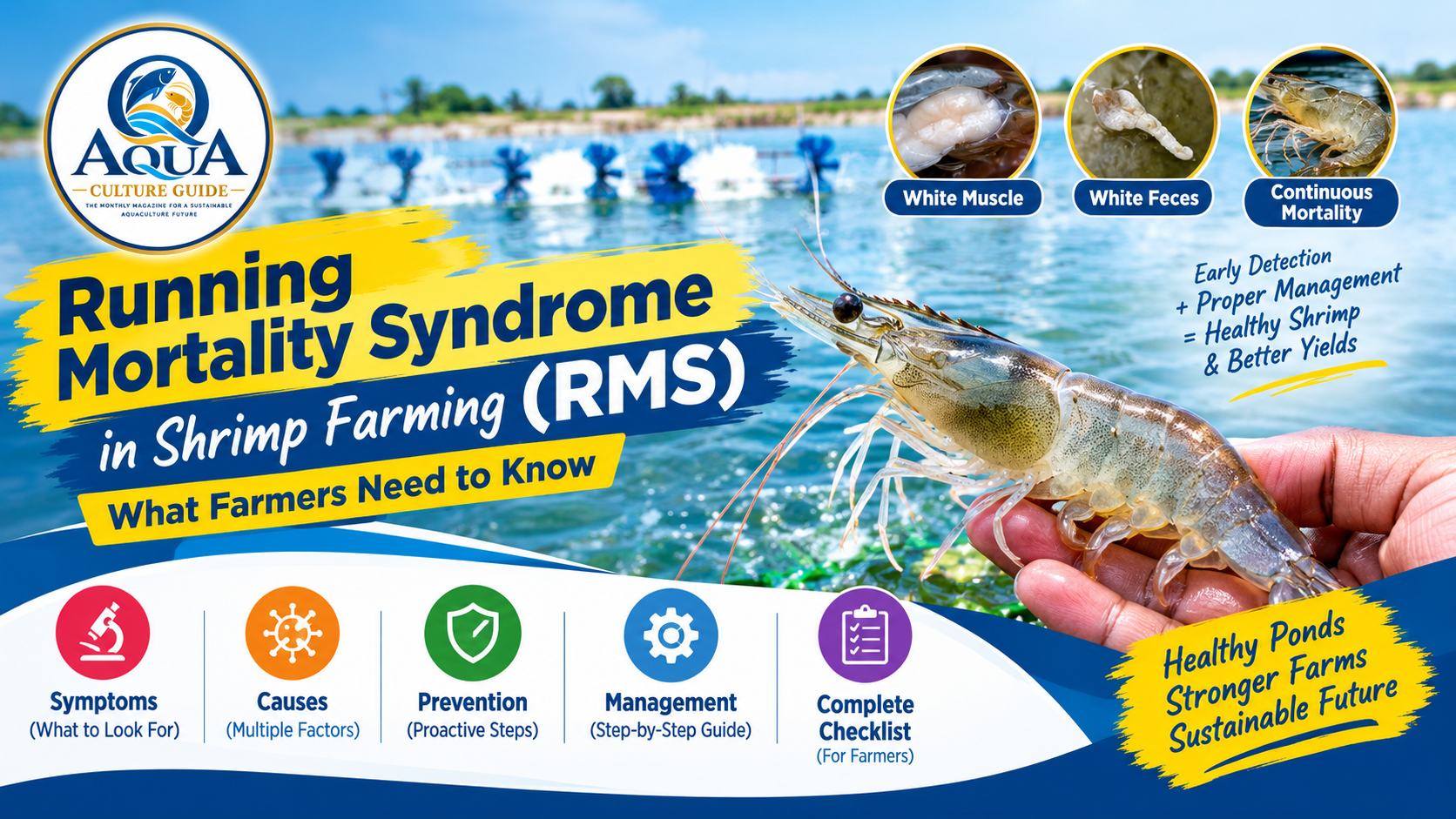
Learn about Running Mortality Syndrome (RMS) in vannamei shrimp, including common symptoms, possible causes, diagnosis, prevention, farm management and a practical farmer checklist.
Running Mortality Syndrome in Shrimp: Symptoms, Causes & Management
Running Mortality Syndrome, commonly called RMS, is a term used in shrimp farming to describe a pattern of ongoing, usually low-level mortality rather than one sudden mass mortality event.
The subject is important because the term RMS is not always used in exactly the same way in different regions or publications. In India, ICAR-CIBA has historically described RMS as a farmer-named syndrome involving continuous mortality, while more recent CIBA work continues to investigate the causes of running mortalities and emphasizes that several factors may be involved. (ciba.res.in)
This distinction matters.
RMS should not automatically be treated as one specific pathogen or one specific disease.
Recent ICAR-CIFRI field surveillance in West Bengal, for example, found RMS and EHP among possible contributing factors in a mortality event, but explicitly stated that the observations were preliminary and not a confirmed diagnosis. Laboratory testing and histopathology were required for confirmation.
So the best approach for farmers is:
Observe → Sample → Test → Identify the likely cause → Correct farm conditions → Monitor
What Is Running Mortality Syndrome (RMS)?
RMS describes a situation where shrimp mortality continues day after day over an extended period, rather than ending quickly after a single event.
Older ICAR-CIBA field guidance described Indian RMS as continuous low-level mortality that could reduce survival and production. That guidance reported that the condition had been observed in P. vannamei farming areas of Andhra Pradesh and Tamil Nadu and that mortality often began after approximately one month or around 40 days of culture.
More recent CIBA work in 2025 reported that running mortalities remained an important production problem and that investigations were needed to determine the actual causes in affected farms. CIBA noted associations with factors including Vibrio, EHP, white-feces syndrome, white-muscle syndrome and poor water quality in affected crop failures.
Important: RMS Is Not Always the Same as CMNV
This is an important update for anyone writing about RMS.
A 2026 ICAR-CIBA training manual uses the term "running mortality syndrome" in the context of viral covert mortality disease (VCMD) caused by covert mortality nodavirus (CMNV), explaining that VCMD's continuous daily mortality pattern was initially called RMS.
For farmers, the safest rule is:
RMS is a mortality pattern that requires diagnosis—not a diagnosis by itself.
What Does RMS Look Like?
Symptoms can vary depending on the underlying cause.
Historical Indian RMS descriptions included:
Continuous daily mortality
Usually low mortality on any single day
Reduced overall survival
Production loss
Whitish patches in the abdominal muscle of affected shrimp
Mortality often becoming noticeable after approximately 30–40 days of culture
Common Signs Farmers Should Watch For
A farmer should pay attention when several of these signs occur together:
Mortality
Shrimp die every day or repeatedly over an extended period.
White or opaque muscle
Affected shrimp may show whitish areas in the abdominal muscle. Historical CIBA RMS descriptions identified this as an important field sign.
Reduced feeding
Shrimp may show reduced or inconsistent feeding activity.
Slow growth
The surviving shrimp may show poor or uneven growth.
White feces
Some current Indian running-mortality investigations have involved persistent white feces together with mortality.
Survival decline
Even when daily mortality appears small, cumulative mortality can become economically significant.
Why Is RMS Difficult to Manage?
The main challenge is that the same mortality pattern can have different underlying causes.
A pond with continuous mortality may have:
Poor water quality
High organic loading
Vibrio-associated problems
EHP
White-feces syndrome
White-muscle syndrome
Viral disease
Multiple simultaneous problems
Environmental stress
Other causes that require laboratory investigation
Possible Factors Associated With Running Mortality
- Poor Water Quality
Water-quality fluctuations can place shrimp under physiological stress.
Recent ICAR field surveillance associated mortality investigations with fluctuations in:
Dissolved oxygen
pH
Alkalinity
Organic loading
Pond-bottom waste
Poor Pond-Bottom Condition
Accumulated organic matter can create a stressful pond environment.
Check for:
Black sediment
Bad smell
Excess sludge
Uneaten feed
Dead organisms
Poor circulation zones
Pond-bottom management should therefore be part of any investigation into prolonged mortality.
Vibrio and Other Bacterial Problems
Earlier CIBA investigations of Indian RMS found Vibrio species, including Vibrio parahaemolyticus and Vibrio azureus, predominantly in haemolymph samples from affected shrimp. However, the investigation did not establish Vibrio as a single definitive cause of the syndrome.
This is an important distinction:
Detection of a bacterium does not automatically prove that it is the sole cause of mortality.
A proper diagnosis requires the clinical picture, laboratory testing and other evidence.
EHP
Enterocytozoon hepatopenaei (EHP) is another possible factor that may occur in farms experiencing running mortality or poor production.
However:
RMS ≠ EHP
A farm experiencing mortality should not be labelled as EHP-positive based on mortality alone.
EHP requires appropriate diagnostic testing.
White Feces Syndrome
White feces can occur alongside running mortality in some Indian farm investigations.
CIBA's 2025 farmer-researcher initiative specifically investigated running mortalities associated with white muscle and white feces
White Muscle Syndrome
White muscle abnormalities can also occur in affected shrimp.
CIBA training material describes white-muscle syndrome separately and notes that sudden changes in environmental conditions such as salinity, temperature and dissolved oxygen can be associated with the condition.
Environmental Stress
Rapid environmental changes can weaken shrimp and make existing health problems more difficult to control.
Important factors include:
Temperature → Salinity → DO → pH → Alkalinity → Organic load
High Biomass and Management Pressure
As shrimp grow, the pond carries a much larger biological load.
Higher biomass generally means greater demands on:
Oxygen
Feeding
Water quality
Aeration
Waste management
Monitoring
When Does RMS Usually Appear?
There is no single universal day of culture at which RMS begins.
Historical CIBA guidance reported mortality beginning after approximately 30–40 days, while CIBA's 2025 investigation highlighted some recent Indian crop failures particularly around 50–70 days of culture.
Step-by-Step RMS Management Guide
Step 1: Do Not Panic
Finding a few dead shrimp does not automatically mean the pond has RMS.
First determine:
How many shrimp are dying?
How many days has this continued?
Has mortality increased?
Are there other symptoms?
Step 2: Start a Mortality Record
Record daily mortality.
Day Estimated Mortality Feed DO pH Remarks
45 150 75 kg 5.0 7.8 Normal feeding
46 180 74 kg 4.7 7.7 Slightly reduced feed
47 220 70 kg 4.4 7.6 Reduced feeding
48 250 68 kg 4.2 7.5 Monitor closely
Numbers are illustrative only.
The value of this record is the trend, not the example numbers.
Step 3: Check Dissolved Oxygen
Check DO as soon as continued mortality is noticed.
Pay particular attention to the early morning.
MPEDA recommends early-morning DO monitoring and provides 4–6 ppm as a reference range for shrimp farming.
If DO is low:
Improve appropriate aeration → improve circulation → recheck DO → investigate the cause.
Step 4: Check pH
Measure:
Morning pH
and
Afternoon pH
This helps determine whether there are significant daily fluctuations.
Step 5: Check Alkalinity
Test total alkalinity.
Low or unstable alkalinity can make pH more difficult to manage.
Also check whether:
Heavy rain occurred
Water exchange recently occurred
The farm is at low salinity
Nitrification activity is high
Step 6: Check Ammonia and Nitrite
Measure:
Total ammonia
Unionised ammonia where available
Nitrite
CAA's L. vannamei guidance includes total ammonia, unionised ammonia and nitrite among water-quality parameters requiring routine monitoring.
Step 7: Check Temperature and Salinity
Record:
Temperature = ____ °C
Salinity = ____ ppt
Look for sudden changes rather than focusing only on the current value.
Step 8: Inspect the Pond Bottom
Check:
Black soil
Bad smell
Excess sludge
Uneaten feed
Dead shrimp
Poor circulation
Organic deposits
Step 9: Review the Feeding Program
Ask:
Has feed recently increased?
Are feed trays showing uneaten feed?
Has feeding declined?
Did mortality begin after a major feed increase?
Feed management should be adjusted according to actual shrimp response and pond conditions.
Do not continue increasing feed simply because the shrimp are expected to be larger.
Step 10: Observe the Shrimp
Collect representative shrimp and examine:
Body color
Muscle condition
Hepatopancreas appearance
Gut fullness
Shell condition
Swimming behaviour
White feces
Growth variation
Remember:
Visual signs are useful for screening, not definitive diagnosis.
Step 11: Collect Proper Samples
When mortality continues, send appropriate shrimp and environmental samples to a competent diagnostic laboratory.
CIBA maintains specific guidance on collection, preservation and dispatch of shrimp samples for disease diagnosis, emphasizing the importance of proper sampling for meaningful diagnostic results.
Step 12: Test for Relevant Diseases
Depending on the symptoms and local disease situation, a diagnostic laboratory may investigate conditions such as:
WSSV
EHP
IMNV
Other viral pathogens
Bacterial problems
Other relevant diseases
Step 13: Do Not Assume RMS From White Muscle Alone
White muscle can be observed in different shrimp-health problems.
Historical RMS descriptions included white abdominal muscle patches, but newer investigations also distinguish white-muscle syndrome and other disease conditions.
Therefore:
White muscle → investigate
not:
White muscle → automatically diagnose RMS
Step 14: Review Farm History
Check:
Seed hatchery
Seed testing
Stocking density
Stocking date
Feed records
Water-quality records
Previous disease
Previous crop performance
Water source
Water exchange
Pond preparation
Biosecurity
Rainfall
Aeration
The history can help the diagnostic team understand what changed before mortality began.
Step 15: Strengthen Biosecurity
When disease is suspected:
Do not move nets, buckets, equipment or workers unnecessarily between ponds.
Pay particular attention to:
Visitors
Equipment
Water movement
Birds
Crabs
Dead shrimp
Pond-to-pond movement
Step 16: Manage the Pond, Not Just the Symptom
Once mortality is identified, focus on correcting the underlying stressors.
Priorities generally include:
Water quality
Maintain stable DO, pH, alkalinity and other relevant parameters.
Feed
Avoid unnecessary feed accumulation.
Pond bottom
Manage excess organic matter.
Biomass
Understand how much shrimp the pond is carrying.
Biosecurity
Reduce opportunities for disease spread.
Diagnosis
Use laboratory evidence before claiming a specific disease.
Step 17: Continue Monitoring Daily
After making management changes, don't stop testing.
Continue recording:
Mortality
DO
pH
Temperature
Salinity
Alkalinity
Ammonia
Nitrite
Feed
Shrimp behavior
Improvement should be visible in the trend.
Step 18: Consider Early Harvest Based on Evidence
Persistent mortality can make continuing a crop economically risky.
If mortality is substantial, growth is poor, FCR is deteriorating and diagnosis/management indicates that recovery is unlikely, the farmer and technical adviser may need to consider partial or early harvest.
This should be an economic and biological decision, not a panic response to one bad day.
Can RMS Be Prevented?
There is no single RMS-prevention product or one-step treatment that can guarantee prevention.
The best strategy is to reduce the factors that make mortality more likely.
- Start With Quality Seed
Use properly tested and authorized seed from approved sources.
- Prepare the Pond Properly
Start the crop with good soil, water and biosecurity conditions.
- Avoid Unnecessary High Stocking Pressure
Choose stocking density based on actual farm carrying capacity.
- Maintain Stable Water Quality
Avoid large fluctuations.
- Manage Feed Carefully
Minimize feed wastage.
- Maintain Good Aeration
Especially as biomass increases.
- Monitor the Pond Bottom
Prevent excessive organic accumulation.
- Maintain Biosecurity
Reduce the movement of possible disease agents between ponds.
- Monitor Shrimp Health
Don't wait for mass mortality.
- Keep Complete Records
Good records make abnormal patterns much easier to recognize.
RMS and Water Quality
One of the clearest lessons from recent Indian investigations is that disease and environmental management cannot be separated.
This supports a practical farm principle:
A healthy shrimp pond needs both disease prevention and environmental stability.
RMS and Feed Management
Persistent mortality can quickly affect FCR.
For example:
Mortality increases → surviving biomass becomes lower than estimated → feed remains high → feed efficiency deteriorates
Therefore, when mortality begins:
Recalculate biomass → review feed → check tray response → monitor FCR
Don't continue feeding based solely on the original stocking estimate.
RMS and FCR
FCR can become an important economic warning indicator.
Formula
FCR = Total feed used ÷ shrimp biomass produced
RMS and Dissolved Oxygen
DO deserves special attention because poor oxygen conditions can stress shrimp and worsen other pond problems.
Recent ICAR field surveillance specifically identified DO fluctuations among important environmental observations in a mortality investigation.
During a running-mortality event:
Check DO particularly during:
Early morning → after cloudy weather → after heavy rain → during high biomass
RMS and pH
Rapid pH changes can be another warning sign.
Check:
Morning pH
Afternoon pH and calculate:
Daily fluctuation = Afternoon pH − Morning pH
A changing pH pattern should trigger investigation of:
Plankton
Alkalinity
DO
Weather
Organic loading
RMS and Ammonia
When mortality increases, don't forget ammonia.
Check:
Total ammonia + unionised ammonia + pH + temperature
Because pH and temperature influence the proportion of ammonia present in the more toxic unionised form, an ammonia reading should not be interpreted independently.
What Not to Do During an RMS Event
Don't assume every mortality is RMS
First investigate the cause.
Don't assume white muscle proves RMS
Several conditions can produce similar signs.
Don't immediately add multiple products
Identify the underlying problem first.
Don't continue feeding blindly
Reassess biomass and feed consumption.
Don't ignore early-morning DO
Low oxygen can rapidly worsen pond stress.
Don't move equipment between ponds without proper sanitation
This can increase disease-spread risk.
Don't dispose of dead shrimp beside the pond
Manage mortalities according to appropriate farm biosecurity procedures.
Don't claim a disease is confirmed without diagnostic evidence
Recent ICAR field investigations explicitly distinguish preliminary observations from confirmed diagnosis.
Complete RMS Monitoring Checklist
Daily Mortality
☐ Count dead shrimp
☐ Record mortality by pond
☐ Compare with previous days
☐ Check whether mortality is increasing
Shrimp Observation
☐ Check activity
☐ Check feeding response
☐ Check swimming behaviour
☐ Check body colour
☐ Look for white muscle
☐ Look for white feces
☐ Check growth variation
Water Quality
☐ DO
☐ pH
☐ Temperature
☐ Salinity
☐ Alkalinity
☐ Ammonia
☐ Nitrite
☐ Transparency
☐ Water colour
Pond Bottom
☐ Check black soil
☐ Check bad smell
☐ Check sludge
☐ Check uneaten feed
☐ Check dead organisms
☐ Check circulation
Feed
☐ Record daily feed
☐ Check feed trays
☐ Recalculate biomass
☐ Review FCR
☐ Adjust feeding when required
Biosecurity
☐ Restrict unnecessary visitors
☐ Disinfect equipment
☐ Avoid sharing equipment between ponds
☐ Control crabs and birds
☐ Manage dead shrimp properly
☐ Check incoming-water protection
RMS Investigation Checklist
When mortality continues for several days:
☐ Start mortality log
☐ Measure early-morning DO
☐ Measure morning and afternoon pH
☐ Check temperature
☐ Check salinity
☐ Check alkalinity
☐ Check ammonia
☐ Check nitrite
☐ Inspect pond bottom
☐ Review feeding records
☐ Review biomass estimate
☐ Collect representative shrimp samples
☐ Contact a competent diagnostic laboratory
☐ Test for relevant pathogens
☐ Review previous crop history
☐ Review seed source
☐ Review weather and rainfall
☐ Review biosecurity
☐ Monitor daily response after intervention
RMS Emergency Checklist
When mortality suddenly increases:
First
Check DO immediately.
Second
Check shrimp behaviour and collect samples.
Third
Review feed and biomass.
Fourth
Check pH, ammonia, nitrite, temperature and salinity.
Fifth
Inspect the pond bottom.
Sixth
Strengthen biosecurity.
Seventh
Send appropriate samples for diagnosis.
Eighth
Continue monitoring until the trend stabilizes.
How Aqua Culture Guide Can Make This Article More Useful
This article can be connected to several practical tools:
RMS Mortality Calculator
Farmer enters:
Pond area → estimated mortality/day → number of days → estimated cumulative mortality
FCR Calculator
Feed used ÷ shrimp biomass produced
Water Quality Checker
Inputs:
DO + pH + ammonia + nitrite + temperature + salinity + alkalinity
Shrimp Health Checklist
A farmer can select observed signs such as:
White muscle / white feces / poor feeding / surface swimming / mortality
and receive a recommendation to seek appropriate diagnostic testing, rather than receiving an unsupported disease diagnosis.
RMS and Other Shrimp Diseases: Don't Confuse Them
Condition / Term What It Means
RMS A term used for a pattern of continuing mortality; underlying cause needs investigation
EHP A specific microsporidian infection requiring diagnosis
WSSV A specific viral disease requiring diagnosis
WFS A syndrome/clinical condition involving white feces; cause may require investigation
WMS White-muscle syndrome with characteristic muscle lesions
VCMD Viral covert mortality disease associated with CMNV
Conclusion
Running Mortality Syndrome is one of the more difficult shrimp-farm problems because continuous mortality can have multiple possible explanations.
The biggest mistake is to see daily mortality and immediately assume:
"This is RMS."
A better approach is:
Observe → Record → Test → Diagnose → Correct → Monitor
Start with the basics:
Good seed + strong biosecurity + stable water quality + proper feed management + good pond-bottom condition + regular shrimp health checks
When mortality continues, investigate:
DO → pH → alkalinity → ammonia → nitrite → temperature → salinity → feed → biomass → pond bottom → disease testing
Questions & Answers
Q1.What is Running Mortality Syndrome in shrimp?
RMS is a term used mainly to describe continuous or recurring low-level shrimp mortality over an extended period. In India, the term has historically been used by farmers and researchers for a broader running-mortality syndrome whose cause was not always established.
Q2.Is RMS caused by one virus?
Not necessarily. This is an important point. Indian CIBA investigations have treated running mortality as a problem requiring investigation of multiple possible factors. Separately, a 2026 CIBA training manual uses RMS historically in relation to VCMD caused by CMNV. These usages should not be automatically conflated.
Q3.What are the common symptoms of RMS?
Historical Indian descriptions include continuous mortality and whitish patches in abdominal muscle. More recent Indian investigations have also reported running mortality associated with white muscle and persistent white feces, but these signs are not sufficient by themselves to establish a diagnosis.
Q4.At what age does RMS usually occur?
There is no fixed age. Historical CIBA descriptions reported mortality beginning around 30–40 days of culture, while a 2025 CIBA investigation highlighted some cases around 50–70 days.
Q5.Can poor water quality contribute to running mortality?
Poor water quality can contribute to shrimp stress and may increase susceptibility to disease. A 2026 ICAR field investigation highlighted DO and pH fluctuations, inadequate alkalinity, high organic loading and bottom waste as important environmental factors associated with a mortality event.
Q6.Can EHP be involved in running mortality?
EHP can be associated with crop failures in which running mortality is observed, and CIBA's 2025 investigation included EHP among possible contributing factors. However, RMS should not automatically be diagnosed as EHP.
Q7.What should I do when daily mortality continues?
Start recording mortality, check water quality, inspect feed and biomass, examine shrimp, strengthen biosecurity and send representative samples to a competent diagnostic laboratory.
Related articles
భారతీయ రిజర్వాయర్లలో కేజ్ ఫిష్ ఫార్మింగ్: సాంకేతికత, అనుమతులు మరియు పెట్టుబడి వివరాలు
భారతదేశంలోని రిజర్వాయర్లలో కేజ్ ఫిష్ ఫార్మింగ్ ఎలా ప్రారంభించాలి? అవసరమైన సాంకేతికత, ప్రభుత్వ అనుమతులు, పెట్టుబడి, చేపల జాతులు, మేత నిర్వహణ మరియు లాభనష్టాల గురించి పూర్తి వివరాలు తెలుసుకోండి.
Freshwater Prawn Farming in IndiaFreshwater Prawn Farming in India: రైతులకు పూర్తి సాగు మార్గదర్శిని
భారతదేశంలో మంచినీటి రొయ్యల సాగు ఎలా ప్రారంభించాలి? జెయింట్ ఫ్రెష్వాటర్ ప్రాన్ సీడ్ ఎంపిక, చెరువు తయారీ, స్టాకింగ్, ఆహారం, నీటి నాణ్యత, పెట్టుబడి, మార్కెటింగ్ గురించి పూర్తి వివరాలు తెలుసుకోండి.
Tilapia farming in Indiaభారతదేశంలో తిలాపియా చేపల పెంపకం – మార్కెట్ అవకాశాలు, ప్రభుత్వ నిబంధనలు మరియు ఆధునిక సాగు పద్ధతులు
భారతదేశంలో తిలాపియా చేపల పెంపకం ఎలా చేయాలి? మార్కెట్ అవకాశాలు, ప్రభుత్వ అనుమతులు, చెరువు సాగు, బయోఫ్లాక్, RAS విధానాలు, పిల్లల ఎంపిక, మేత నిర్వహణ మరియు దిగుబడి గురించి పూర్తి సమాచారం.
PCR Testing in Shrimp Hatcheriesరొయ్యల హ్యాచరీల్లో PCR పరీక్షలు: ఫలితాలను రైతులు ఎలా అర్థం చేసుకోవాలి?
WSSV, EHP, AHPND వంటి వ్యాధికారకాలను గుర్తించడంలో PCR పరీక్షల పాత్ర, పరీక్షా నివేదికలను అర్థం చేసుకోవడం, నాణ్యమైన రొయ్య పిల్లలను ఎంపిక చేసుకోవడం గురించి రైతులు తెలుసుకోవాల్సిన పూర్తి సమాచారం.
Explore Aqua Culture Guide
Aqua companies directory
Feed, seed, probiotics & equipment suppliers
Aquaculture calculators
Feed, FCR, stocking & water quality tools
Telugu aqua magazine
Read the latest monthly issue online
All aqua news & articles
Farming, disease control and market updates
List your company free
Get found by farmers across India
Advertise with us
Magazine and website advertising options