Probiotics vs Water Treatments in Aquaculture: Key Differences
29/10/2026
Understand the difference between probiotics and water treatments in aquaculture. Learn their uses, benefits, limitations and how to choose the right approach for fish and shrimp ponds.
Introduction
Maintaining good water quality is one of the most important parts of successful aquaculture. In shrimp and fish farming, water conditions affect feeding, growth, stress levels and overall animal health. Farmers therefore use different products and management methods to maintain a suitable pond environment.
Two commonly discussed options are probiotics and water treatments. Although both may be used in aquaculture management, they do not necessarily perform the same function.
Probiotics contain selected beneficial microorganisms intended to provide a benefit when used appropriately. Depending on the product, they may be applied to pond water or included in feed to support microbial balance or digestive function.
Water treatments, on the other hand, are a broad category of products and processes used to manage specific water-quality problems. These may include aeration, filtration, liming, alkalinity management, disinfection and other treatments selected according to the actual problem. Some products alter water chemistry, while others target particular organisms or suspended materials.
What Are Probiotics in Aquaculture?
Probiotics are preparations containing selected live microorganisms intended to provide a benefit to the host or the culture environment when administered appropriately.
In aquaculture, probiotic products may be designed for different purposes:
- Water application: Certain products are intended to influence microbial activity in pond water or pond-bottom environments.
- Feed application: Some probiotics are included in feed to support digestive function or animal performance.
- Pond-bottom management: Selected products are marketed for use in systems where organic matter accumulates, although their effectiveness depends on the organisms, product quality and environmental conditions.
Common probiotic groups used in aquaculture products include selected species or strains of Bacillus, lactic acid bacteria and other microorganisms. Not every strain has the same properties, and results from one product cannot automatically be applied to another.
Potential benefits of probiotics
- Supporting selected microbial processes.
- Helping manage organic matter under suitable conditions.
- Supporting digestive function when used in feed.
- Potentially improving certain production outcomes when the product is appropriate and farm management is good.
Important: Probiotics are not an instant solution for low dissolved oxygen, toxic ammonia, severe water-quality deterioration or an active disease outbreak. They should not replace aeration, water-quality monitoring or appropriate veterinary and aquatic animal health advice.
What Are Water Treatments in Aquaculture?
Water treatments are products or management processes used to address specific problems in pond or culture water. They do not all work in the same way.
Some treatments change water chemistry, some remove or reduce unwanted substances, and others control particular microorganisms when their use is appropriate and permitted.
Main types of water treatments
- Aeration and oxygen management
Aerators transfer oxygen into water and help circulate it.
Main purpose: Managing dissolved oxygen and supporting suitable pond conditions. Aeration is essential when oxygen is low; probiotics cannot replace it.
- Liming and alkalinity management
Appropriate liming materials may be used to manage acidity or alkalinity, depending on the water and soil conditions.
Main purpose: Correcting specific water or soil chemistry issues. Different lime products have different uses and must not be treated as interchangeable.
- Filtration and solids removal
Physical filtration, settling and sludge management can remove suspended solids or accumulated waste.
Main purpose: Reducing particles and organic waste that may affect water quality.
- Water-chemistry management
Depending on test results, farmers may need to manage alkalinity, hardness, pH or other water parameters.
Main purpose: Correcting a measured imbalance using a suitable method rather than applying products blindly.
- Disinfection and targeted chemical treatments
Approved disinfectants or other specific treatments may be used in appropriate circumstances, often for pond preparation, equipment or water before stocking.
Main purpose: Targeting a defined biological or water-quality risk. These treatments can harm beneficial microorganisms and aquatic animals if used incorrectly.
The right treatment depends on the actual problem, the species being cultured, the stage of production, product instructions and local regulations. There is no single water treatment suitable for every pond condition.
Probiotics vs Water Treatments: Key Differences
Feature Probiotics Water treatments
Main purpose Introduce selected microorganisms for a defined benefit Address a specific water-quality or management problem
How they work Through the activity of particular microorganisms Through physical, chemical or biological processes
Typical uses Selected microbial management and feed-related applications Oxygen management, chemistry correction, solids removal or targeted control
Speed of effect Depends on the product and environmental conditions Can be rapid or gradual, depending on the method
Need for testing Useful for selecting the product and monitoring results Often essential to identify the problem and determine safe treatment
Effect on beneficial microbes Some products are intended to support selected microbial processes Some treatments may damage or eliminate susceptible microorganisms
Replaces aeration? No Aeration itself manages oxygen; other treatments do not necessarily do so
Replaces disease diagnosis? No No
Main consideration Product identity, viability, application and conditions Correct diagnosis, dosage, compatibility and safety
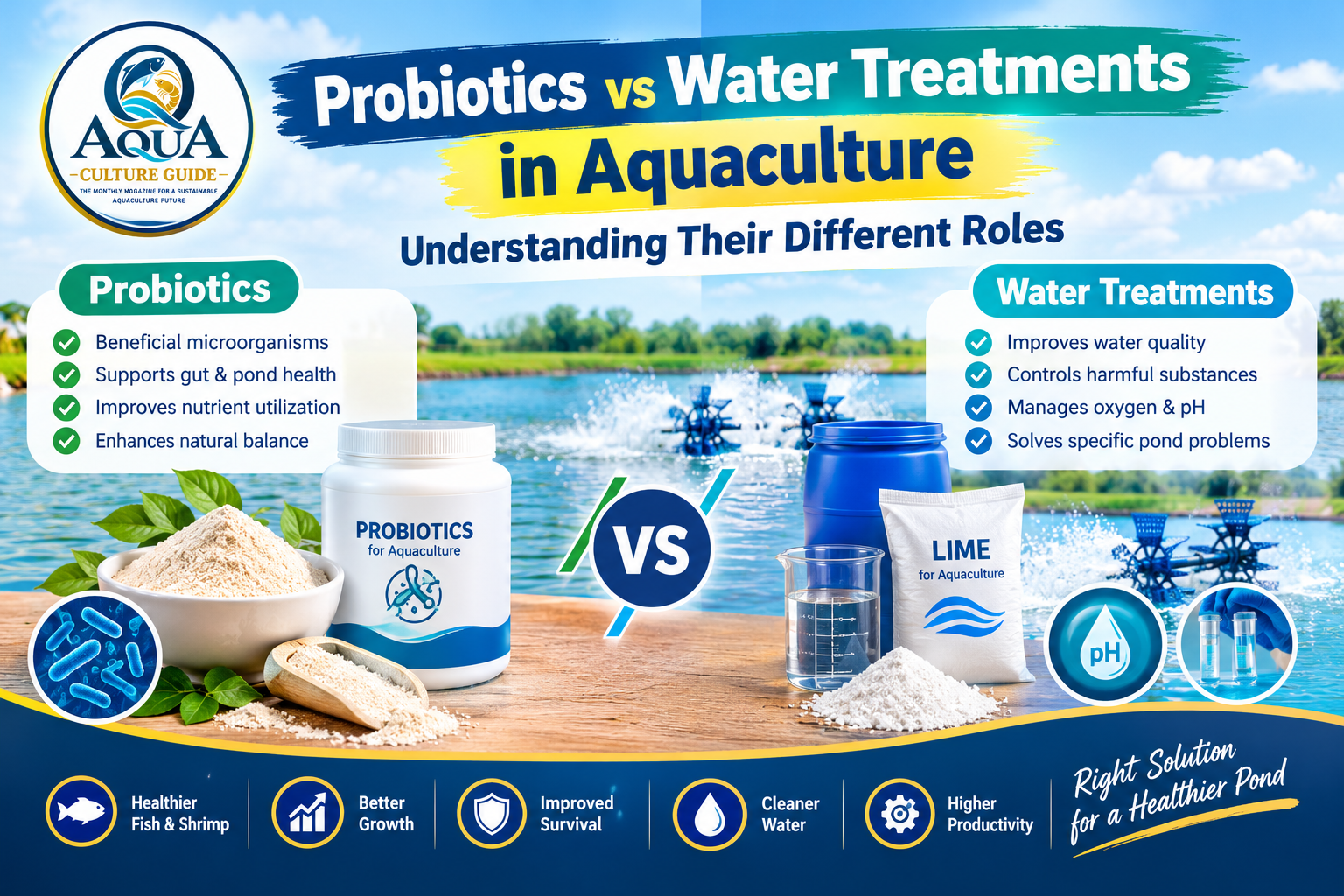
The main difference: Probiotics are selected microbial preparations, while water treatments include a wide range of methods for managing specific pond conditions. Probiotics may form part of a water-management plan, but they are not a substitute for every type of water treatment.
When Should Farmers Use Probiotics?
Probiotics may be considered when there is a clear reason to use a particular product and the pond or feed conditions are suitable.
Possible situations include:
- Routine microbial management using a product designed for pond-water application.
- A feed-management program using a probiotic formulated for dietary use.
- A pond-management plan that includes monitoring of organic matter and bottom conditions.
- A targeted program recommended by a qualified aquaculture professional.
Before using a probiotic, check the product's microorganisms, intended application, recommended dosage, storage conditions and expiry date.
Do not assume that a probiotic used in feed is suitable for pond-water application, or that every water probiotic works under all salinity, temperature or oxygen conditions.
When Should Farmers Use Water Treatments?
Water treatments should be selected according to measured or clearly identified problems.
Pond condition or issue First action to consider
Low dissolved oxygen Start or increase appropriate aeration immediately and investigate the cause
Unstable or unsuitable pH Test pH at relevant times and assess alkalinity before selecting corrective action
Low alkalinity Confirm the test result and choose a suitable corrective method
High ammonia Check ammonia, pH, temperature and oxygen; reduce excess feeding where appropriate and seek technical guidance
Excess suspended solids Review solids sources, settling, filtration or other suitable removal methods
Organic waste accumulation Review feeding, sludge removal, aeration and pond-bottom management
Suspected disease outbreak Check animal behaviour, seek appropriate diagnosis and follow a disease-management plan
Pond preparation before stocking Use a planned preparation protocol with appropriate treatment, safety and stocking checks
A water treatment should not be selected simply because the water looks cloudy, green or brown. Pond appearance alone cannot reliably identify oxygen levels, toxic compounds or disease risk.
Can Probiotics and Water Treatments Be Used Together?
Yes, in some situations, probiotics and water treatments can be part of the same farm-management program. However, they should not automatically be applied at the same time.
Some disinfectants and chemical treatments may kill or inhibit the microorganisms contained in probiotic products. Other products may change the water conditions in ways that affect microbial activity.
Before combining products:
- Identify the purpose of each product.
- Read both product labels and check compatibility.
- Check whether a waiting period is required after disinfection or chemical treatment.
- Follow the manufacturer's instructions for application timing.
- Monitor water quality and animal behaviour.
- Consult an aquaculture professional if compatibility is uncertain.
There is no universal waiting period that applies to every disinfectant and probiotic. The appropriate interval depends on the active ingredient, concentration, water conditions and the probiotic formulation.
Step-by-Step Guide: How to Choose the Right Approach
Step 1: Observe the pond
Look for changes in animal feeding behaviour, swimming activity, water colour, surface conditions and accumulated waste.
Observation is useful, but it cannot replace water testing.
Step 2: Test water quality
Measure the parameters relevant to your farming system, such as:
- Dissolved oxygen (DO)
- pH, preferably at appropriate times of day
- Temperature
- Total ammonia nitrogen (TAN), with pH and temperature considered when assessing ammonia toxicity
- Nitrite
- Alkalinity and, where relevant, hardness
- Salinity in shrimp ponds and other systems where it matters
Use reliable test methods and compare the results with suitable targets for your cultured species and production stage.
Step 3: Identify the main problem
Determine whether the issue relates to oxygen, water chemistry, suspended solids, organic waste, feed management or a possible disease problem.
Avoid choosing a product before identifying what needs to be corrected.
Step 4: Select the appropriate method
- For low oxygen, prioritize aeration.
- For a chemistry imbalance, confirm the test result and choose a suitable corrective method.
- For suspended solids, assess filtration, settling or solids removal.
- For a suitable microbial-management objective, consider a product specifically designed for that use.
- For suspected disease, obtain an appropriate diagnosis instead of relying only on probiotics or general water treatments.
Step 5: Check product suitability
Confirm the product's intended use, ingredients, concentration, dosage, compatibility, expiry date and storage requirements.
A product intended for pond preparation may not be appropriate for use in a stocked pond.
Step 6: Calculate the treatment quantity
Use the actual water volume and the product's label instructions. Pond volume estimates should account for pond area and average water depth.
For a rectangular pond:
Volume (m3)=Length x Width x Average depth
For example, a pond measuring 50 m long, 20 m wide and 1.2 m deep has an estimated volume of 1,200 m³, assuming a regular shape and uniform depth.
This calculation estimates volume only. It is not a treatment recommendation; use the actual product instructions and verify the pond dimensions before dosing.
Step 7: Apply the product safely
Follow the label, use appropriate protective equipment and avoid mixing products unless compatibility is confirmed. Ensure adequate aeration and monitor the animals during and after application where relevant.
Never exceed the recommended dosage in an attempt to obtain faster results.
Step 8: Monitor the outcome
Recheck the relevant water-quality parameters and observe animal behaviour after treatment. Record the results and compare them with the original readings.
If conditions worsen, stop additional unplanned applications and seek technical advice.
Step 9: Maintain a routine management plan
Continue regular water testing, feeding management, aeration checks and pond-bottom management. Use probiotics or other treatments only when their purpose is clear and their use is justified.
Complete Checklist for Probiotics and Water Treatments
Use this practical checklist before and after applying products to a fish or shrimp pond.
Before application
[ ] Identify the pond problem or management objective
[ ] Test the relevant water-quality parameters
[ ] Check the cultured species and production stage
[ ] Confirm the product is intended for the planned application
[ ] Check label instructions, expiry date and storage conditions
Before mixing or dosing
[ ] Estimate pond water volume accurately
[ ] Calculate the quantity using the product label
[ ] Check compatibility with other products used recently
[ ] Confirm whether a waiting period is required after disinfection
[ ] Prepare protective equipment and clean application tools
During application
[ ] Follow the specified dosage and application method
[ ] Avoid unapproved product combinations
[ ] Maintain appropriate aeration
[ ] Watch for unusual animal behaviour
[ ] Follow all safety and environmental precautions
After application
[ ] Recheck the water parameters related to the problem
[ ] Observe feeding and swimming behaviour
[ ] Record the product, batch, quantity, date and time
[ ] Evaluate whether the intended result was achieved
[ ] Seek technical advice if water quality or animal condition worsens
Common Mistakes Farmers Should Avoid
- Using probiotics to solve every water-quality problem: Probiotics do not directly correct low dissolved oxygen or every chemical imbalance.
- Applying disinfectants and probiotics together without checking compatibility: The disinfectant may inactivate the probiotic microorganisms.
- Dosing without testing: Incorrect treatment can worsen pond conditions or create unnecessary costs.
- Using the same product in every pond: Ponds differ in salinity, organic load, water chemistry, culture stage and management.
- Ignoring aeration: Microbial activity and organic matter decomposition can influence oxygen demand. Adequate oxygen management remains important.
- Overusing chemical treatments: Unnecessary or excessive applications may harm cultured animals, beneficial microorganisms or the surrounding environment.
- Expecting instant results: Treatment effectiveness depends on the problem, the product and the conditions.
- Ignoring feed and sludge management: Uneaten feed and accumulated waste can continue to affect water quality even when products are applied.
- Failing to maintain records: Without records, it is difficult to determine whether a product was effective or cost-efficient.
Conclusion
Probiotics and water treatments serve different but sometimes complementary roles in aquaculture. Probiotics may support selected microbial processes or digestive functions, while water treatments address specific physical, chemical or biological challenges in the culture environment.
For fish and shrimp farmers, the best approach is to identify the problem first, test water quality, select the appropriate method and monitor the results. Avoid unnecessary product combinations and always follow product instructions.
Remember: no single product can replace good water quality, proper aeration, responsible feeding and consistent pond management.
Questions & Answers
Q1.What is the main difference between probiotics and water treatments in aquaculture?
Probiotics contain selected microorganisms intended to provide a specific benefit. Water treatments are a broader category of methods used to manage water quality, including aeration, chemistry correction, filtration and certain targeted chemical treatments.
Q2.Are probiotics better than water treatments for shrimp farming?
Neither is universally better. Probiotics may be useful for selected microbial or feed-management objectives, while water treatments address particular problems such as low oxygen, unsuitable water chemistry or suspended solids. The correct choice depends on the actual pond condition.
Q3.Can probiotics improve shrimp pond water quality?
Some pond-water probiotic products may support selected microbial processes under suitable conditions. Their effectiveness varies, and they cannot replace aeration, water testing, appropriate feeding or removal of accumulated waste.
Q4.Can farmers use probiotics after a disinfectant treatment?
Sometimes, but the timing depends on the disinfectant, its concentration, water conditions and the probiotic product. Follow the manufacturers' instructions and confirm that the disinfectant has been adequately neutralized or reduced where required before introducing sensitive microorganisms.
Q5.Do probiotics reduce ammonia in shrimp ponds?
Some microbial products may influence nitrogen cycling under specific conditions, but the effect is product- and system-dependent. Do not rely on probiotics alone to manage high ammonia. Test TAN, consider pH and temperature, maintain suitable oxygen levels and seek technical guidance.
Q6.Can probiotics replace aeration?
No. Probiotics do not supply oxygen to the pond. When dissolved oxygen is low, appropriate aeration and immediate oxygen management take priority.
Q7.Are water treatments safe for fish and shrimp?
They can be safe when the correct product is selected and used at the approved dosage under suitable conditions. Incorrect products, excessive doses or incompatible combinations can harm cultured animals and the pond environment.
Related articles
భారతీయ రిజర్వాయర్లలో కేజ్ ఫిష్ ఫార్మింగ్: సాంకేతికత, అనుమతులు మరియు పెట్టుబడి వివరాలు
భారతదేశంలోని రిజర్వాయర్లలో కేజ్ ఫిష్ ఫార్మింగ్ ఎలా ప్రారంభించాలి? అవసరమైన సాంకేతికత, ప్రభుత్వ అనుమతులు, పెట్టుబడి, చేపల జాతులు, మేత నిర్వహణ మరియు లాభనష్టాల గురించి పూర్తి వివరాలు తెలుసుకోండి.
Freshwater Prawn Farming in IndiaFreshwater Prawn Farming in India: రైతులకు పూర్తి సాగు మార్గదర్శిని
భారతదేశంలో మంచినీటి రొయ్యల సాగు ఎలా ప్రారంభించాలి? జెయింట్ ఫ్రెష్వాటర్ ప్రాన్ సీడ్ ఎంపిక, చెరువు తయారీ, స్టాకింగ్, ఆహారం, నీటి నాణ్యత, పెట్టుబడి, మార్కెటింగ్ గురించి పూర్తి వివరాలు తెలుసుకోండి.
Tilapia farming in Indiaభారతదేశంలో తిలాపియా చేపల పెంపకం – మార్కెట్ అవకాశాలు, ప్రభుత్వ నిబంధనలు మరియు ఆధునిక సాగు పద్ధతులు
భారతదేశంలో తిలాపియా చేపల పెంపకం ఎలా చేయాలి? మార్కెట్ అవకాశాలు, ప్రభుత్వ అనుమతులు, చెరువు సాగు, బయోఫ్లాక్, RAS విధానాలు, పిల్లల ఎంపిక, మేత నిర్వహణ మరియు దిగుబడి గురించి పూర్తి సమాచారం.
PCR Testing in Shrimp Hatcheriesరొయ్యల హ్యాచరీల్లో PCR పరీక్షలు: ఫలితాలను రైతులు ఎలా అర్థం చేసుకోవాలి?
WSSV, EHP, AHPND వంటి వ్యాధికారకాలను గుర్తించడంలో PCR పరీక్షల పాత్ర, పరీక్షా నివేదికలను అర్థం చేసుకోవడం, నాణ్యమైన రొయ్య పిల్లలను ఎంపిక చేసుకోవడం గురించి రైతులు తెలుసుకోవాల్సిన పూర్తి సమాచారం.
Explore Aqua Culture Guide
Aqua companies directory
Feed, seed, probiotics & equipment suppliers
Aquaculture calculators
Feed, FCR, stocking & water quality tools
Telugu aqua magazine
Read the latest monthly issue online
All aqua news & articles
Farming, disease control and market updates
List your company free
Get found by farmers across India
Advertise with us
Magazine and website advertising options