
Mineral Management in Shrimp Farming: Importance, Deficiency Signs and Complete Guide
2/11/2026
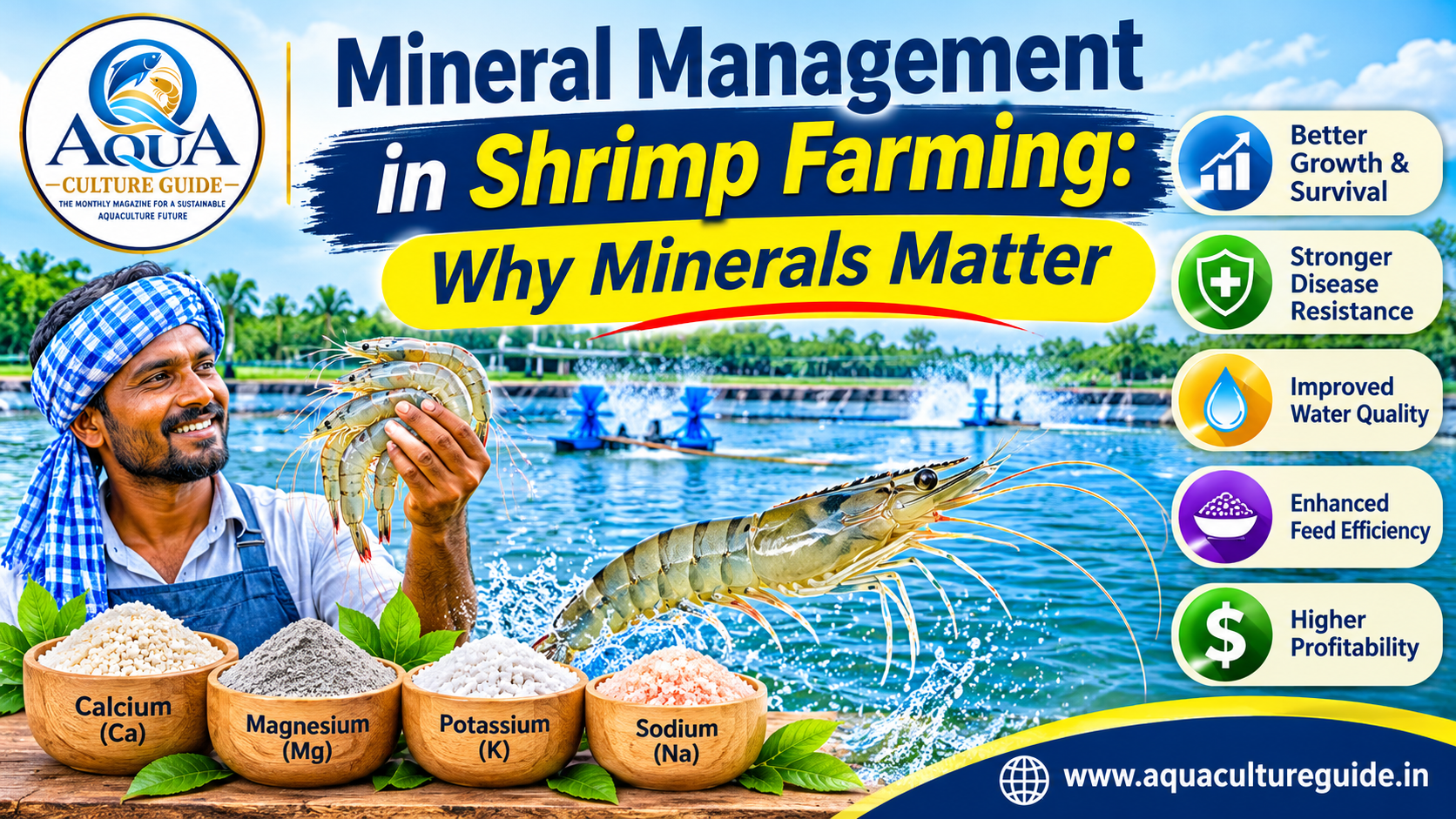
Learn why minerals are important in shrimp farming, how calcium, magnesium and potassium support shrimp growth, how to identify mineral deficiencies and manage pond minerals with a complete checklist.
Introduction
Mineral management is one of the most important parts of successful shrimp farming. Minerals play a major role in shrimp growth, moulting, shell formation, osmoregulation and overall health. Even when farmers provide good-quality feed and maintain proper aeration, an imbalance of essential minerals in pond water can affect shrimp performance.
Shrimp require important minerals such as calcium, magnesium, potassium, sodium and phosphorus for normal body functions. These minerals support the formation of a healthy shell, proper muscle activity, enzyme functions and the regulation of water and salts inside the shrimp's body.
Mineral problems are especially important in low-salinity and freshwater shrimp farming, where the natural mineral concentration of water may be insufficient or unbalanced. Even in coastal ponds, rainfall, evaporation, water exchange and soil conditions can change mineral availability.
In this article, we explain why minerals matter in shrimp farming, the functions of essential minerals, signs of mineral imbalance, a complete checklist and a step-by-step guide to managing minerals for healthier shrimp and better farm performance.
Why Are Minerals Important in Shrimp Farming?
Minerals are essential nutrients that shrimp need for normal growth, development and survival.
Their main functions include:
Supporting shell formation and hardening.
Helping shrimp complete the moulting process.
Maintaining water and salt balance in the body.
Supporting muscle and nerve functions.
Helping enzyme activity and metabolism.
Supporting normal growth and feed utilisation.
Maintaining general health and stress tolerance.
When essential minerals are deficient or poorly balanced, shrimp may experience moulting difficulties, soft shells, slow growth and reduced survival.
Important Minerals Required for Shrimp Farming
Different minerals perform different functions. Farmers should understand their importance before choosing a mineral supplement.
A. Calcium (Ca)
Calcium is one of the most important minerals for shrimp.
Main functions:
Supports shell formation.
Helps in shell hardening after moulting.
Supports muscle and nerve functions.
Participates in several biological processes.
Possible signs of insufficient calcium availability:
Delayed shell hardening.
Soft shells after moulting.
Moulting-related stress.
Poor growth when other factors are also limiting.
Calcium availability depends on water chemistry, salinity, pH and other environmental factors.
B. Magnesium (Mg)
Magnesium is essential for many enzyme-related activities and normal physiological functions.
Main functions:
Supports enzyme activity.
Helps maintain osmoregulation.
Supports muscle and nerve functions.
Plays a role in metabolism.
An imbalance of magnesium may affect shrimp health, especially when water salinity is low or the overall mineral balance is unsuitable.
C. Potassium (K)
Potassium is important for maintaining the balance of fluids and ions inside the shrimp's body.
Main functions:
Supports osmoregulation.
Helps maintain normal cellular functions.
Supports muscle and nerve activity.
Helps maintain physiological balance.
Potassium management is particularly important in low-salinity shrimp farming because freshwater sources may contain low potassium concentrations.
D. Sodium (Na)
Sodium is an important electrolyte involved in maintaining osmotic and ionic balance.
Main functions:
Helps regulate body-fluid balance.
Supports nerve and muscle functions.
Participates in ion regulation.
Sodium should be considered together with other major ions rather than managed independently.
E. Phosphorus (P)
Phosphorus is an essential mineral required for growth and energy-related processes.
Main functions:
Supports bone and structural development.
Helps form ATP, which is involved in energy transfer.
Supports cell membranes.
Participates in several metabolic processes.
Shrimp obtain phosphorus through feed and their environment. Feed quality and mineral availability should be considered together.
F. Trace Minerals
Shrimp also require smaller quantities of trace minerals.
Important examples include:
Zinc: Supports enzyme activity and normal growth.
Copper: Involved in important biological processes, including oxygen transport.
Iron: Required for several metabolic processes.
Manganese: Supports enzyme functions and metabolism.
Selenium: Plays a role in antioxidant defence.
Iodine: Involved in biological and metabolic functions.
Trace minerals should be supplied in appropriate amounts. Excessive supplementation can be harmful.
How Do Minerals Affect Shrimp Moulting?
Shrimp grow by periodically shedding their old exoskeleton and developing a new one. This process is called moulting.
After moulting, the new shell is initially soft and gradually hardens.
Minerals, particularly calcium and other ions, are important during shell development and hardening.
The moulting process involves several stages:
Pre-moult: The shrimp prepares for shedding its old shell.
Moult: The old exoskeleton is shed.
Post-moult: The new shell is soft and requires hardening.
Inter-moult: The shell hardens and the shrimp continues growing.
During this process, shrimp must obtain and regulate essential minerals.
Poor mineral availability may contribute to delayed shell hardening and moulting problems. However, moulting difficulties can also result from poor water quality, stress, disease, unsuitable temperature, nutrition problems and other factors.
Farmers should not assume that every soft-shell problem is caused by mineral deficiency.
Why Mineral Management Is More Important in Low-Salinity Shrimp Farming
Low-salinity shrimp farming can present additional mineral-management challenges.
Seawater contains a natural balance of major ions. Freshwater and inland water sources may have very different mineral compositions.
Even if the salinity reading appears suitable, the concentrations and ratios of individual ions may not be appropriate for shrimp.
Important points include:
Freshwater may contain low potassium.
Calcium and magnesium levels may be insufficient.
The sodium-to-potassium balance may be unsuitable.
Rainfall can dilute important minerals.
Soil conditions can influence water mineral availability.
For this reason, low-salinity shrimp farmers should test individual mineral concentrations rather than depending only on salinity measurements.
Factors That Affect Mineral Levels in Shrimp Ponds
Several factors can change the mineral balance of pond water.
A. Rainfall
Heavy rainfall can dilute pond water and reduce the concentration of important dissolved minerals.
B. Evaporation
Evaporation removes water but leaves most dissolved salts behind. This can increase salinity and change mineral concentrations.
C. Water Source
Borewell, canal, river and seawater sources have different mineral compositions.
D. Soil Conditions
Pond soil may influence mineral availability, alkalinity and water chemistry.
E. Water Exchange
Water exchange can change mineral concentrations depending on the quality of incoming water.
F. Shrimp Growth and Moulting
Shrimp require minerals throughout the culture cycle, including during moulting and shell development.
G. Feed Quality
Feed supplies several essential minerals. Poor feed quality or unsuitable mineral availability may contribute to nutritional deficiencies.
Signs of Possible Mineral Imbalance in Shrimp
Farmers should regularly observe shrimp behaviour and physical condition.
Possible warning signs include:
Soft shells after moulting.
Delayed shell hardening.
Irregular moulting.
Reduced feeding activity.
Slow growth.
Uneven shrimp size.
Weakness or abnormal swimming.
Increased stress after rainfall.
Poor survival under otherwise suitable conditions.
Important: These signs are not specific to mineral deficiency. Disease, poor oxygen, ammonia, nitrite, pH changes, temperature stress and nutritional problems can produce similar symptoms. Confirm the cause through water testing and, where needed, professional diagnosis.
How to Maintain Proper Mineral Balance in Shrimp Ponds
Mineral management should be based on actual water conditions, not guesswork.
A. Test Water Minerals Regularly
Measure the important minerals in the pond and source water.
Focus on:
Calcium.
Magnesium.
Potassium.
Sodium, where relevant.
Total hardness.
Alkalinity.
Salinity.
B. Understand Mineral Ratios
The relationship between minerals can be as important as their individual concentrations.
For example, potassium and magnesium balance is particularly relevant in low-salinity shrimp farming.
Avoid using a single universal mineral ratio for all ponds. Suitable concentrations depend on species, salinity, water source and culture conditions.
C. Select the Right Mineral Supplement
Choose products based on the mineral deficiency identified through testing.
Common mineral sources include:
Calcium-based products.
Magnesium salts.
Potassium salts.
Commercial shrimp mineral mixtures.
The product should have clear composition and application instructions.
D. Maintain Suitable Alkalinity and Hardness
Alkalinity and hardness are important water-quality parameters, but they are not the same as total mineral balance.
Test them separately and manage them according to the culture system.
E. Monitor After Rainfall
Heavy rainfall can change salinity, pH and mineral concentrations.
Test pond water after significant rainfall and adjust management based on actual results.
Complete Mineral Management Checklist for Shrimp Farmers
Use this checklist during regular pond monitoring.
A. Water Quality Checklist
Check pond salinity.
Measure pH.
Check dissolved oxygen.
Measure water temperature.
Test total alkalinity.
Test total hardness.
Check calcium concentration.
Check magnesium concentration.
Check potassium concentration.
Review sodium concentration where relevant.
Test ammonia and nitrite.
Record rainfall and water exchange.
B. Shrimp Health Checklist
Observe feeding activity.
Check shell condition.
Observe shell hardening after moulting.
Monitor moulting activity.
Check shrimp movement and swimming behaviour.
Observe gut condition and general appearance.
Monitor growth and size variation.
Check for unusual mortality.
Record signs of stress.
C. Mineral Product Checklist
Check the product name and manufacturer.
Read the mineral composition.
Check the concentration of each important mineral.
Confirm that the product is suitable for shrimp farming.
Check manufacturing and expiry dates.
Read storage instructions.
Follow the recommended dosage.
Avoid products with unclear composition.
Check compatibility with other pond treatments.
Maintain purchase and application records.
D. Mineral Application Checklist
Identify the actual mineral deficiency.
Test pond water before application.
Calculate the pond water volume.
Select the correct mineral source.
Follow manufacturer instructions.
Apply the product using the recommended method.
Maintain suitable aeration.
Observe shrimp behaviour.
Retest water after application.
Record the results.
Step-by-Step Guide to Mineral Management in Shrimp Farming
Step 1: Test the Source Water Before Pond Preparation
Before filling the pond, test the water source.
Check:
Salinity.
pH
Alkalinity.
Total hardness.
Calcium.
Magnesium.
Potassium.
This helps identify possible mineral deficiencies before stocking.
Step 2: Test the Pond Water
After filling and preparing the pond, test the water again.
Water conditions may change due to soil interaction, rainfall and other preparation activities.
Record the results for future comparison.
Step 3: Identify the Mineral Deficiency
Compare test results with suitable reference ranges for the shrimp species and culture salinity.
Do not add all minerals simply because one mineral is low.
Identify which mineral needs attention and consider its relationship with other ions.
Step 4: Select the Correct Mineral Product
Choose a product that supplies the mineral identified as deficient.
For example:
Calcium-based products for a confirmed calcium requirement.
Magnesium salts for a confirmed magnesium requirement.
Potassium salts for a confirmed potassium requirement.
Balanced mineral mixtures when more than one mineral is deficient.
Check the product composition before purchasing.
Step 5: Calculate the Required Quantity
Calculate the pond water volume and use the manufacturer's dosage instructions.
The required quantity depends on:
Current mineral concentration.
Desired concentration.
Product purity.
Pond water volume.
Application method.
Avoid applying an estimated quantity without calculations.
Step 6: Apply Minerals Correctly
Follow the manufacturer's instructions for preparation and application.
Some products may need to be dissolved or diluted before application. Others may have different instructions.
Do not mix different mineral products together unless compatibility is confirmed.
Step 7: Maintain Proper Aeration
Maintain suitable dissolved oxygen during mineral management.
Aeration is especially important when shrimp are under stress or when other pond-management treatments are being carried out.
Step 8: Observe Shrimp Behaviour
After application, monitor:
Feeding response.
Swimming activity.
Shell condition.
Moulting activity.
General stress signs.
If abnormal behaviour occurs, check the water quality and investigate the cause.
Step 9: Retest Mineral Levels
Repeat the relevant water tests after the recommended monitoring period.
Compare the new readings with the earlier results.
Check whether the target mineral concentration has improved and whether other water-quality parameters have changed.
Step 10: Maintain Regular Mineral Monitoring
Continue checking mineral levels throughout the culture cycle.
Pay particular attention after:
Heavy rainfall.
Large water exchanges.
Significant changes in salinity.
Moulting-related problems.
Changes in the water source.
Step 11: Maintain Farm Records
Record:
Date of water testing.
Pond number.
Salinity.
Calcium concentration.
Magnesium concentration.
Potassium concentration.
Alkalinity and hardness.
Mineral product used.
Quantity applied.
Shrimp health observations.
Results after application.
These records help farmers make better mineral-management decisions in future culture cycles.
Common Mineral Management Mistakes Farmers Should Avoid
Adding minerals without testing pond water.
Depending only on salinity to understand mineral balance.
Ignoring potassium and magnesium in low-salinity ponds.
Applying excessive mineral supplements.
Using the same mineral dosage in every pond.
Ignoring rainfall-related mineral dilution.
Confusing total hardness with alkalinity.
Assuming all soft-shell problems are caused by calcium deficiency.
Buying mineral products without checking their composition.
Failing to monitor water quality after application.
- Best Practices for Better Mineral Management
For better shrimp performance, farmers should follow these practices:
Test source water before pond preparation.
Check individual mineral concentrations
Maintain suitable salinity and ionic balance.
Use mineral supplements according to test results.
Maintain good-quality feed.
Monitor shrimp moulting and shell condition.
Test water after heavy rainfall.
Maintain suitable alkalinity and hardness.
Avoid unnecessary chemical applications.
Maintain proper aeration and feeding management.
Keep complete farm records.
Seek technical advice when mineral problems continue.
Conclusion
Mineral management is an essential part of successful shrimp farming. Calcium, magnesium, potassium, sodium, phosphorus and trace minerals all contribute to shrimp growth, shell formation, moulting and normal body functions.
Mineral imbalances can affect shrimp performance, particularly in low-salinity farming systems where the natural mineral composition of water may be unsuitable.
Farmers should not depend on guesswork or apply mineral supplements without testing. Regular water analysis, correct product selection, suitable application and continuous monitoring are the keys to effective mineral management.
Healthy shrimp need more than good feed and oxygen. They also need the right balance of essential minerals.
Questions & Answers
Q1.Why are minerals important in shrimp farming?
Minerals support shell formation, moulting, osmoregulation, muscle activity, metabolism and overall shrimp health.
Q2.Which minerals are most important for shrimp?
Calcium, magnesium, potassium, sodium and phosphorus are important. Shrimp also require trace minerals such as zinc, copper, iron and manganese.
Q3.Why is potassium important in shrimp farming?
Potassium helps maintain the ionic and osmotic balance inside shrimp cells. It is particularly important in low-salinity shrimp farming.
Q4.What is the role of calcium in shrimp farming?
Calcium supports shell formation and hardening after moulting, along with other important physiological functions.
Q5.What is the role of magnesium in shrimp farming?
What is the role of magnesium in shrimp farming? Magnesium supports enzyme activity, metabolism and osmoregulation. It is an important part of the mineral balance in shrimp pond water.
Q6.What are the signs of mineral deficiency in shrimp?
Possible signs include soft shells, delayed shell hardening, irregular moulting, slow growth and reduced feeding activity. These symptoms can also have other causes, so water testing is important.
Q7.Why is mineral management important in low-salinity shrimp farming?
Freshwater and low-salinity sources may have insufficient or unbalanced concentrations of potassium, magnesium and calcium. Farmers should test individual minerals instead of relying only on salinity.
Related articles
భారతీయ రిజర్వాయర్లలో కేజ్ ఫిష్ ఫార్మింగ్: సాంకేతికత, అనుమతులు మరియు పెట్టుబడి వివరాలు
భారతదేశంలోని రిజర్వాయర్లలో కేజ్ ఫిష్ ఫార్మింగ్ ఎలా ప్రారంభించాలి? అవసరమైన సాంకేతికత, ప్రభుత్వ అనుమతులు, పెట్టుబడి, చేపల జాతులు, మేత నిర్వహణ మరియు లాభనష్టాల గురించి పూర్తి వివరాలు తెలుసుకోండి.
Freshwater Prawn Farming in IndiaFreshwater Prawn Farming in India: రైతులకు పూర్తి సాగు మార్గదర్శిని
భారతదేశంలో మంచినీటి రొయ్యల సాగు ఎలా ప్రారంభించాలి? జెయింట్ ఫ్రెష్వాటర్ ప్రాన్ సీడ్ ఎంపిక, చెరువు తయారీ, స్టాకింగ్, ఆహారం, నీటి నాణ్యత, పెట్టుబడి, మార్కెటింగ్ గురించి పూర్తి వివరాలు తెలుసుకోండి.
Tilapia farming in Indiaభారతదేశంలో తిలాపియా చేపల పెంపకం – మార్కెట్ అవకాశాలు, ప్రభుత్వ నిబంధనలు మరియు ఆధునిక సాగు పద్ధతులు
భారతదేశంలో తిలాపియా చేపల పెంపకం ఎలా చేయాలి? మార్కెట్ అవకాశాలు, ప్రభుత్వ అనుమతులు, చెరువు సాగు, బయోఫ్లాక్, RAS విధానాలు, పిల్లల ఎంపిక, మేత నిర్వహణ మరియు దిగుబడి గురించి పూర్తి సమాచారం.
PCR Testing in Shrimp Hatcheriesరొయ్యల హ్యాచరీల్లో PCR పరీక్షలు: ఫలితాలను రైతులు ఎలా అర్థం చేసుకోవాలి?
WSSV, EHP, AHPND వంటి వ్యాధికారకాలను గుర్తించడంలో PCR పరీక్షల పాత్ర, పరీక్షా నివేదికలను అర్థం చేసుకోవడం, నాణ్యమైన రొయ్య పిల్లలను ఎంపిక చేసుకోవడం గురించి రైతులు తెలుసుకోవాల్సిన పూర్తి సమాచారం.
Explore Aqua Culture Guide
Aqua companies directory
Feed, seed, probiotics & equipment suppliers
Aquaculture calculators
Feed, FCR, stocking & water quality tools
Telugu aqua magazine
Read the latest monthly issue online
All aqua news & articles
Farming, disease control and market updates
List your company free
Get found by farmers across India
Advertise with us
Magazine and website advertising options