Mineral Management in Shrimp Farming: Importance, Checklist & Guide
25/10/2026
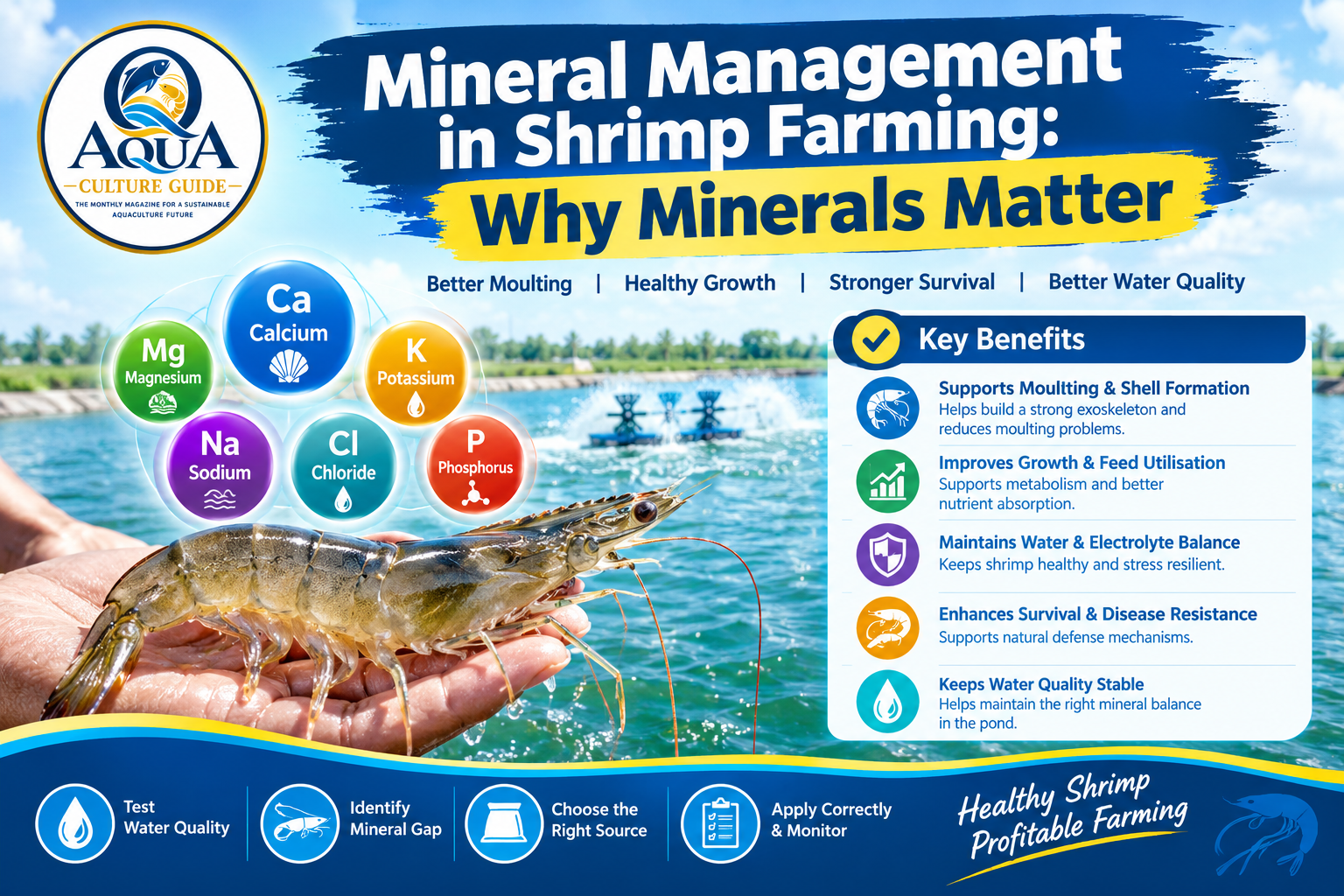
Learn why minerals matter in shrimp farming, how they affect moulting, growth and survival, how to monitor mineral balance, and how to manage minerals step by step.
Introduction
Successful shrimp farming depends on more than good seed, quality feed, and proper aeration. Mineral management is also an important part of maintaining healthy shrimp, normal moulting, growth, and survival.
Shrimp need minerals to support the formation of their hard outer shell, muscle and nerve function, and other essential body processes. Minerals such as calcium, magnesium, potassium, and sodium also help maintain the balance of salts and fluids in the shrimp's body.
In shrimp ponds, mineral availability can vary depending on salinity, water source, soil conditions, rainfall, evaporation, water exchange, and the mineral composition of the feed. These differences can be particularly important in low-salinity or inland shrimp farming, where the water may not contain the same mineral balance as seawater.
Why Are Minerals Important in Shrimp Farming?
Minerals are essential nutrients that help shrimp maintain normal body functions. They are obtained from the surrounding water, formulated feed, and natural food available in the culture system.
Their importance becomes especially noticeable in intensive farming and low-salinity shrimp culture, where mineral availability may not meet the animals' needs
The main benefits of proper mineral management include:
- Supporting normal moulting and shell formation.
- Maintaining salt and water balance in the body.
- Supporting muscle function and metabolism.
- Contributing to growth and survival.
- Supporting normal physiological functions during different growth stages.
- Helping farmers manage low-salinity culture systems more effectively.
Important: Minerals alone cannot guarantee good growth or survival. Seed quality, feed, dissolved oxygen, disease control, stocking density, and overall pond management remain essential.
Important Minerals for Shrimp Culture
- Calcium (Ca)
Calcium is an important component of the shrimp's exoskeleton. It also contributes to muscle and nerve function. Shrimp obtain calcium from the water and feed, and water availability is particularly important in many culture systems.
- Magnesium (Mg)
Magnesium supports enzyme activity, energy metabolism, and normal physiological functions. It is particularly important to monitor magnesium availability in low-salinity shrimp farming.
- Potassium (K)
Potassium helps regulate the movement of fluids and electrolytes in the body. Insufficient potassium in low-salinity water can affect shrimp growth and survival.
- Sodium (Na) and Chloride (Cl)
These electrolytes help shrimp maintain osmotic balance. Their availability and relationship with other ions matter when managing water of different salinities.
- Phosphorus (P)
Phosphorus is involved in energy transfer, cellular processes, and skeletal structures. Feed formulation is an important source of phosphorus, and its balance with other nutrients should be considered.
- Trace minerals: Zinc, copper, iron, manganese and selenium
These minerals are required in smaller quantities for functions such as enzyme activity, metabolism, and normal development. Excessive amounts can also be harmful, so supplementation should follow feed specifications and professional guidance.
How Does Mineral Balance Affect Shrimp Moulting?
Shrimp grow by moulting, the process of shedding their old exoskeleton and developing a new one. After moulting, the new shell is initially soft and must harden as the shrimp recovers.
Minerals, especially calcium, contribute to shell formation. However, successful moulting also depends on overall nutrition, water chemistry, physiological condition, and environmental stability.
When farmers observe delayed moulting, soft shells, poor growth, or increased mortality, mineral imbalance may be one possible factor. These signs are not proof of mineral deficiency; disease, stress, poor water quality, and nutritional problems can produce similar symptoms.
Signs That May Indicate a Mineral Management Problem
Observation What farmers should investigate
Soft shells for longer than expected Mineral availability, moulting stage, nutrition, and water chemistry
Uneven growth Feed intake, stocking density, animal health, and mineral availability
Poor survival in low-salinity water Potassium, magnesium, sodium, chloride, salinity, and other water parameters
Weak performance after heavy rainfall Changes in salinity and ionic composition, plus pH and alkalinity
Irregular moulting Water quality, nutrition, stress, disease, and possible mineral imbalance
Poor performance despite good feed Feed quality, disease, oxygen, toxic compounds, and water mineral composition
These are investigation points, not diagnostic criteria. A proper assessment should combine water testing, feed information, animal observations, and farm records.
When Should Farmers Pay More Attention to Mineral Management?
Mineral management deserves extra attention during the following situations.
- Low-salinity shrimp farming: Freshwater and low-salinity groundwater may have an ionic composition different from seawater.
- Heavy rainfall: Rain can dilute pond water and change salinity and mineral concentrations.
- Water exchange: Incoming water may have a different mineral profile from the pond.
- Intensive culture: High stocking density and greater feed inputs increase the importance of monitoring water chemistry and nutrition.
- Biofloc farming: Mineral levels and other water parameters need to be monitored as the system develops and biomass increases.
- Poor moulting or growth performance: Investigate minerals alongside feed, health, and environmental factors.
- Changes in water source: Test the new source before relying on the mineral profile of the previous water.
Step-by-Step Guide to Mineral Management in Shrimp Farming
- Test the pond water
Measure salinity, pH, alkalinity, hardness, and other relevant water quality parameters. Where low-salinity culture is used, arrange testing for key ions such as potassium, magnesium, calcium, sodium, and chloride when appropriate.
Do not rely on salinity alone to confirm mineral balance.
2. Check the source water
Test the water before filling the pond, particularly if it comes from a borewell, freshwater source, or a different supply than usual. Two sources with similar salinity can have different ionic compositions.
- Review shrimp behavior and growth
Monitor feed consumption, growth, survival, moulting observations, and unusual changes in the pond. Review recent rainfall, water exchange, and any changes in management.
4. Identify the mineral gap
Compare test results with suitable recommendations for your shrimp species, salinity, production system, and culture stage. Distinguish between low calcium, low magnesium, low potassium, low alkalinity, and other water chemistry problems because they require different responses.
- Select an appropriate mineral source
Depending on the confirmed need, a qualified aquaculture professional may recommend a suitable mineral salt or a feed mineral formulation. Different products contribute different ions and can affect water chemistry in different ways.
For example, gypsum contributes calcium and sulfate, while potassium chloride contributes potassium and chloride. Neither should be used without considering the actual water conditions.
- Calculate the required quantity
Base the application on the measured deficiency, pond volume, product composition, and a suitable target recommended by an aquaculture professional.
Do not use a universal dose for every pond. Excessive or inappropriate mineral additions can create imbalances and increase costs.
- Apply according to product instructions
Follow the recommended preparation, dosage, application method, and safety precautions. Avoid mixing products unless their compatibility is confirmed. Maintain aeration and normal water quality management throughout the process.
- Recheck and record the results
Test the relevant parameters again at an appropriate interval. Record the product, quantity, application date, water results, and shrimp response. Adjust the programme according to the test results rather than repeating applications automatically.
Complete Mineral Management Checklist for Shrimp Farmers
Use this checklist before and during the culture cycle.
Water quality testing
[ ] Salinity is measured and recorded.
[ ] pH and alkalinity are checked.
[ ] Hardness is measured where relevant.
[ ] Potassium, magnesium, calcium, sodium and chloride are assessed when needed.
[ ] Source water is tested before use.
Shrimp and feed monitoring
[ ] Feed consumption and growth are recorded.
[ ] Moulting and shell condition are observed.
[ ] Mortality and unusual behaviour are recorded.
[ ] Feed quality and mineral supplementation are reviewed.
[ ] Disease and other water quality causes are investigated when performance drops.
Mineral application
[ ] A specific mineral management need has been identified.
[ ] The selected product is suitable for shrimp farming.
[ ] Product composition and instructions are checked.
[ ] Pond volume and application quantity are calculated correctly.
[ ] The application is recorded and follow-up testing is planned.
Ongoing farm management
[ ] Water changes after rainfall are monitored.
[ ] Changes in water source and water exchange are recorded.
[ ] Mineral levels are reviewed as biomass increases.
[ ] Unnecessary or excessive supplementation is avoided.
[ ] The mineral programme is reviewed using test results.
Common Mistakes in Mineral Management
- Adding minerals without testing
A mineral product may not address the actual problem. Test the water and identify the need before application.
2. Treating salinity as the only indicator
Salinity measures the overall concentration of dissolved salts, but it does not reveal the exact concentration or balance of individual ions.
- Confusing hardness with calcium concentration
Hardness reflects contributions from calcium, magnesium, and other divalent ions. A hardness reading alone does not tell farmers exactly how much calcium or magnesium is present.
4. Using the same mineral dose in every pond
Pond volume, water chemistry, product composition, and shrimp requirements vary. Application quantities should be calculated for the actual situation.
- Ignoring the feed
Feed provides minerals and other essential nutrients. Review feed quality and nutritional formulation as well as the mineral composition of the water.
- Applying excessive amounts
More minerals do not automatically produce better growth or moulting. Unnecessary supplementation may waste money and disturb the balance of the water.
- Expecting minerals to solve every problem
Poor growth, soft shells, or mortality can have several causes. Check dissolved oxygen, toxic ammonia and nitrite, disease, feeding, and other relevant factors.
Conclusion
Mineral management is an important part of successful shrimp farming. Calcium, magnesium, potassium, sodium, chloride, phosphorus, and trace minerals all play roles in normal shrimp development and body function.
Farmers can improve decision-making by testing source water and pond water, monitoring shrimp performance, reviewing feed quality, and correcting only confirmed deficiencies. Particular attention is needed in low-salinity systems and after heavy rainfall, when water chemistry may change.
The key principle is simple: test first, identify the need, apply the right mineral correctly, and monitor the results. Good mineral management works alongside proper feeding, aeration, biosecurity, and overall water quality management.
Questions & Answers
Q1.Why are minerals important in shrimp farming?
Minerals support shell formation, moulting, electrolyte balance, metabolism, and other normal physiological functions. Maintaining suitable mineral availability is especially important in low-salinity and intensive culture systems.
Q2.Which minerals are important for shrimp?
Calcium, magnesium, potassium, sodium, chloride, and phosphorus are important. Trace minerals such as zinc, copper, iron, manganese, and selenium also contribute to normal body functions.
Q3.When should farmers check mineral levels?
Check them before stocking, when changing water sources, after significant rainfall or water exchange, and when shrimp performance or water chemistry raises concerns. Low-salinity farms may require more detailed ionic testing.
Q4.Are mineral supplements necessary in every shrimp pond?
No. The need depends on the source water, salinity, feed composition, farming system, and test results. Some ponds may require targeted supplementation, while others may already have suitable mineral availability.
Q5.Do minerals help shrimp during moulting?
Minerals contribute to shell formation and normal physiological functions during moulting. However, moulting is also affected by nutrition, environmental conditions, and the shrimp's health.
Q6.Why is potassium important in low-salinity shrimp farming?
Potassium contributes to electrolyte balance and normal physiological function. Some low-salinity waters have insufficient potassium relative to shrimp requirements, so testing may be needed to determine whether supplementation is appropriate.
Q7.What is the difference between hardness and alkalinity?
Hardness mainly reflects dissolved calcium and magnesium and other divalent ions. Alkalinity measures the water's acid-neutralising capacity. Both affect water chemistry, but they are not interchangeable and should be managed according to the specific need.
Related articles
భారతీయ రిజర్వాయర్లలో కేజ్ ఫిష్ ఫార్మింగ్: సాంకేతికత, అనుమతులు మరియు పెట్టుబడి వివరాలు
భారతదేశంలోని రిజర్వాయర్లలో కేజ్ ఫిష్ ఫార్మింగ్ ఎలా ప్రారంభించాలి? అవసరమైన సాంకేతికత, ప్రభుత్వ అనుమతులు, పెట్టుబడి, చేపల జాతులు, మేత నిర్వహణ మరియు లాభనష్టాల గురించి పూర్తి వివరాలు తెలుసుకోండి.
Freshwater Prawn Farming in IndiaFreshwater Prawn Farming in India: రైతులకు పూర్తి సాగు మార్గదర్శిని
భారతదేశంలో మంచినీటి రొయ్యల సాగు ఎలా ప్రారంభించాలి? జెయింట్ ఫ్రెష్వాటర్ ప్రాన్ సీడ్ ఎంపిక, చెరువు తయారీ, స్టాకింగ్, ఆహారం, నీటి నాణ్యత, పెట్టుబడి, మార్కెటింగ్ గురించి పూర్తి వివరాలు తెలుసుకోండి.
Tilapia farming in Indiaభారతదేశంలో తిలాపియా చేపల పెంపకం – మార్కెట్ అవకాశాలు, ప్రభుత్వ నిబంధనలు మరియు ఆధునిక సాగు పద్ధతులు
భారతదేశంలో తిలాపియా చేపల పెంపకం ఎలా చేయాలి? మార్కెట్ అవకాశాలు, ప్రభుత్వ అనుమతులు, చెరువు సాగు, బయోఫ్లాక్, RAS విధానాలు, పిల్లల ఎంపిక, మేత నిర్వహణ మరియు దిగుబడి గురించి పూర్తి సమాచారం.
PCR Testing in Shrimp Hatcheriesరొయ్యల హ్యాచరీల్లో PCR పరీక్షలు: ఫలితాలను రైతులు ఎలా అర్థం చేసుకోవాలి?
WSSV, EHP, AHPND వంటి వ్యాధికారకాలను గుర్తించడంలో PCR పరీక్షల పాత్ర, పరీక్షా నివేదికలను అర్థం చేసుకోవడం, నాణ్యమైన రొయ్య పిల్లలను ఎంపిక చేసుకోవడం గురించి రైతులు తెలుసుకోవాల్సిన పూర్తి సమాచారం.
Explore Aqua Culture Guide
Aqua companies directory
Feed, seed, probiotics & equipment suppliers
Aquaculture calculators
Feed, FCR, stocking & water quality tools
Telugu aqua magazine
Read the latest monthly issue online
All aqua news & articles
Farming, disease control and market updates
List your company free
Get found by farmers across India
Advertise with us
Magazine and website advertising options