
Low Dissolved Oxygen in Shrimp Ponds: Night & Early Morning Management Guide
26/10/2026
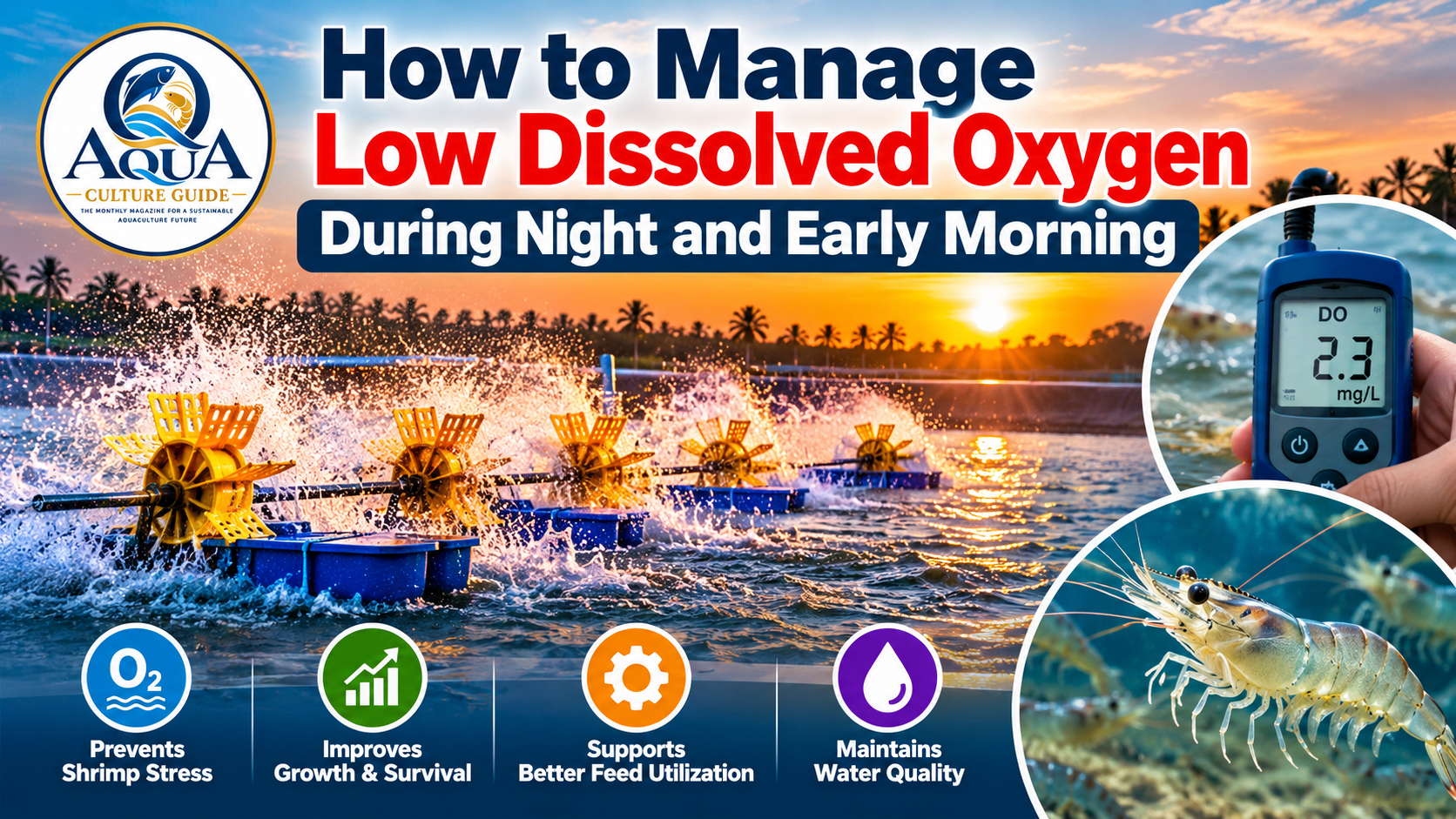
Learn how to prevent and manage low dissolved oxygen in shrimp ponds at night and early morning. Discover emergency aeration steps, safe DO levels, and a complete farmer checklist.
Introduction
Dissolved Oxygen (DO) is one of the most critical water quality parameters in shrimp farming. Adequate oxygen is essential for shrimp respiration, feed utilization, growth, survival, and overall pond productivity.
One of the most challenging situations shrimp farmers face is a sudden reduction in dissolved oxygen during the night and early morning hours. Oxygen levels can decline significantly after sunset because photosynthesis stops while shrimp, plankton, bacteria, and other organisms continue consuming oxygen.
The lowest dissolved oxygen concentration often occurs shortly before sunrise, making the early morning period particularly risky for shrimp ponds.
If oxygen levels fall too low, shrimp may experience stress, reduced feeding, poor growth, increased disease susceptibility, and, in severe cases, mortality.
Effective management requires three important actions: continuous monitoring during risk periods, timely aeration, and proper pond management practices that reduce oxygen demand.
Understanding Dissolved Oxygen in Shrimp Ponds
Dissolved oxygen refers to the amount of oxygen present in water and available for aquatic organisms to breathe. It is generally measured in milligrams per litre (mg/L), approximately equivalent to parts per million (ppm) in freshwater and typical pond-water conditions.
Recommended dissolved oxygen levels
DO level (mg/L) Pond condition Recommended action
5.0 and above Preferred operating target Maintain routine monitoring
4.0–4.9 Reduced safety margin Increase monitoring; assess aeration
3.0–3.9 Low oxygen; stress risk Start additional aeration and investigate
2.0–2.9 Serious oxygen deficiency Immediate corrective action
Below 2.0 Critical emergency Maximum safe aeration and emergency response
These are practical screening ranges, not universal biological thresholds. Risk depends on shrimp species, size, salinity, temperature, exposure duration, and pond conditions. Farmers should follow farm-specific and technical-adviser targets.
For intensive shrimp farming, maintaining DO around 5 mg/L or higher, particularly near the pond bottom, provides a useful operational target.
Why Does Dissolved Oxygen Decrease at Night?
During daylight, phytoplankton and aquatic plants produce oxygen through photosynthesis. At night, photosynthesis stops, but oxygen consumption continues.
The major causes of nighttime oxygen depletion include:
- Respiration by shrimp: Shrimp continuously consume oxygen, including during nighttime feeding and activity.
- Phytoplankton respiration: Algae produce oxygen during daylight but consume it during darkness.
- Bacterial decomposition: Bacteria consume oxygen while breaking down uneaten feed, faeces, and organic matter.
- High stocking density: More shrimp increase total oxygen demand.
- Excessive feeding: Uneaten feed and accumulated waste increase biological oxygen demand.
- Poor aeration: Insufficient aerator capacity or improper placement reduces oxygen transfer and circulation.
- Cloudy and rainy weather: Reduced sunlight limits photosynthetic oxygen production.
- Plankton crashes: Sudden phytoplankton die-offs can increase decomposition and oxygen consumption.
- Bottom sludge accumulation: Organic-rich sediment increases oxygen demand near the pond bottom.
Warning Signs of Low Dissolved Oxygen in Shrimp Ponds
Farmers should recognize early warning signs before oxygen depletion becomes severe.
Behavioural warning signs
- Shrimp gathering near the pond edges or water surface.
- Unusual swimming behaviour or increased restlessness.
- Shrimp congregating near aerators or water inlets.
- Reduced feeding response.
- Weak or sluggish shrimp.
- Increased mortality in severe cases.
These symptoms are not specific to oxygen deficiency. Poor water quality, toxic substances, and disease can produce similar behaviour. Always confirm using a DO meter.
Environmental warning signs
- Thick, dark-green or brown plankton blooms.
- Sudden changes in pond water colour.
- Heavy accumulation of organic sludge.
- Several consecutive cloudy days.
- Unusually high water temperature.
- Reduced aerator performance or interrupted electricity supply.
Important: Shrimp may experience harmful low oxygen levels without obvious surface behaviour. Direct measurement is essential.
Complete Step-by-Step Emergency Guide for Low DO
Emergency response sequence
- Measure DO immediately at representative pond locations and depths.
- Start all available, safely operating aerators.
- Stop feeding temporarily during significant oxygen deficiency.
- Inspect electricity, motors, paddlewheels, and aerator positioning.
- Recheck DO frequently until the pond stabilizes.
- Seek technical assistance if DO remains low or shrimp show distress.
Step 1: Check dissolved oxygen immediately
Use a properly calibrated dissolved oxygen meter.
Measure DO at multiple representative locations, including areas away from aerators, feeding zones, and deeper parts of the pond.
Where possible, measure near the pond bottom as well as the surface, taking care not to disturb sediment.
Also record water temperature, salinity, and the time of measurement.
Step 2: Increase aeration immediately
If DO is low, activate additional paddlewheel aerators, aspirators, or other available oxygen-transfer systems.
Check that aerators are working efficiently and circulating water across the pond.
Avoid directing strong currents into accumulated bottom sludge, as this can resuspend waste and worsen water quality.
Step 3: Stop feeding temporarily
During significant oxygen deficiency, temporarily suspend feeding.
Feeding increases shrimp metabolic demand and contributes to subsequent oxygen consumption through waste decomposition.
Resume feeding gradually only after DO has recovered and shrimp behaviour has returned to normal. Reassess feed quantities rather than automatically supplying the missed ration.
Step 4: Check aerator performance and electricity
Inspect the following:
- Power supply and backup generator.
- Aerator motors and electrical protection systems.
- Paddlewheel rotation and immersion depth.
- Aspirator air intake and discharge.
- Obstructions, damaged components, and abnormal vibration.
Do not enter the pond or handle electrical equipment under unsafe conditions.
Step 5: Monitor DO until recovery
During a serious event, repeat measurements approximately every 15–30 minutes where practical, adjusting the interval according to severity.
Record DO readings and compare them with previous measurements.
Continue appropriate aeration until oxygen levels are stable, including at locations away from the aerators.
Step 6: Consider emergency water exchange only when appropriate
Water exchange may help if the incoming water is confirmed to have adequate oxygen and acceptable quality.
However, poorly planned water exchange can introduce pathogens, alter salinity or temperature, or further stress shrimp.
Do not exchange water solely because oxygen is low without testing the incoming source.
Step 7: Investigate the underlying cause
After stabilizing the pond, assess biomass, feed loading, plankton density, sludge accumulation, weather conditions, and aeration capacity.
Correct the root cause to prevent another nighttime oxygen crisis.
Night and Early Morning DO Monitoring Schedule
A consistent monitoring routine helps farmers detect falling oxygen levels before shrimp become stressed.
Time Activity
4:00–5:00 PM Record afternoon DO and pond conditions
8:00–10:00 PM Measure DO and assess nighttime decline
12:00–2:00 AM Additional DO check for high-risk ponds
4:00–6:00 AM Critical early morning DO monitoring
After sunrise Check recovery before reducing aeration
These are suggested monitoring windows, not fixed operating rules. High-density ponds may require continuous monitoring and automated alerts.
How to Prevent Nighttime Oxygen Depletion
Maintain sufficient aeration capacity
Aeration equipment should be selected according to pond size, stocking density, shrimp biomass, feed input, and measured oxygen demand.
Different aeration systems serve different purposes.
Aeration system Main advantage Consideration
Paddlewheel aerator Surface aeration and water circulation Needs appropriate positioning
Aspirator aerator Air entrainment and oxygen transfer Performance varies with equipment design
Diffused-air system Distributed bubble aeration Requires blower capacity and maintenance
Venturi aerator Mixes air with pumped water Depends on pump and hydraulic design
Emergency oxygenation Rapid oxygen supply where properly installed Requires dedicated equipment and controls
Manage feeding carefully
Use feed trays, shrimp growth sampling, and consumption records to adjust feeding quantities.
Avoid unnecessary late-evening feeding when nighttime oxygen levels are already declining.
Reduce feeding during prolonged cloudy weather, plankton instability, or recurring low-DO events.
Control plankton blooms
Dense plankton blooms can create large day–night oxygen fluctuations.
Monitor water colour, transparency, pH, and DO trends. Sudden bloom collapse requires additional aeration and close monitoring.
Avoid unplanned algicide applications because dying algae can sharply increase oxygen demand.
Manage organic waste
Uneaten feed, faeces, dead plankton, and bottom sludge contribute to biological oxygen demand.
Use appropriate waste collection and removal methods without disturbing anaerobic sediment.
Plan pond-bottom cleaning and drying between production cycles where the farming system permits.
Prepare for adverse weather
Before expected heavy rainfall or prolonged cloudy conditions, check backup power, inspect aerators, and increase DO monitoring.
Rainfall can also cause salinity stratification in brackish-water ponds, leaving deeper water oxygen deficient.
Complete Daily Checklist for Shrimp Farmers
Before sunset
☐ Check afternoon DO and water temperature
☐ Inspect all aerators and power connections
☐ Check backup generator and fuel
☐ Review feed-tray consumption and biomass
☐ Observe water colour and weather conditions
During the night
☐ Measure DO during the evening
☐ Operate aerators according to oxygen demand
☐ Check for power interruptions or equipment failure
☐ Monitor high-risk ponds more frequently
☐ Avoid excessive feeding and unnecessary chemical applications
Early morning
☐ Measure DO before sunrise
☐ Check near-bottom oxygen in representative locations
☐ Observe shrimp behaviour and feeding response
☐ Keep additional aeration running if DO remains low
☐ Record readings and corrective actions
After an oxygen emergency
☐ Confirm DO recovery throughout the pond
☐ Inspect aerator performance and circulation
☐ Check pH, ammonia and other relevant parameters
☐ Investigate sludge, feeding and plankton conditions
☐ Update the farm's emergency response plan
Common Mistakes Farmers Should Avoid
Even experienced shrimp farmers can face oxygen emergencies when routine precautions are overlooked.
- Relying only on afternoon DO readings: Afternoon oxygen can be high even when predawn DO becomes dangerously low.
- Waiting for shrimp to show stress: By the time obvious symptoms appear, oxygen deficiency may already be serious.
- Running aerators without checking DO: Equipment operation does not guarantee sufficient oxygen in every pond area.
- Overfeeding during cloudy weather: This can increase oxygen demand when photosynthetic oxygen production is limited.
- Ignoring pond-bottom conditions: Surface DO may appear acceptable while deeper areas have low oxygen.
- Using unverified oxygen-boosting chemicals: Products should not replace proven aeration and monitoring methods.
- Stopping aeration immediately after sunrise: Oxygen may not yet have recovered to a safe level.
How to Improve Long-Term Oxygen Management
Farmers should maintain an oxygen-management plan throughout the crop cycle.
This includes estimating shrimp biomass regularly, matching aeration capacity to increasing oxygen demand, calibrating DO meters, maintaining backup equipment, and reviewing records after every low-oxygen event.
Automated DO sensors and alarms can be particularly useful in intensive farming systems because oxygen depletion may develop when farm staff are not actively monitoring the pond.
The best approach combines early detection, sufficient aeration capacity, careful feeding, organic waste management, and emergency preparedness.
Conclusion
Low dissolved oxygen during night and early morning is one of the most important preventable risks in shrimp farming.
Farmers can reduce this risk by monitoring DO regularly, maintaining reliable aeration systems, managing feeding carefully, controlling organic waste, and preparing for weather-related changes.
The most important principle is simple: do not wait for shrimp to show signs of oxygen stress before taking action.
A properly monitored pond with sufficient aeration and a clear emergency response plan is better positioned to maintain shrimp health, improve feed efficiency, and achieve consistent production.
Questions & Answers
Q1.Why is dissolved oxygen lowest in the early morning?
Photosynthesis stops after sunset while respiration and decomposition continue consuming oxygen. DO therefore commonly reaches its lowest level shortly before sunrise.
Q2.What is the ideal dissolved oxygen level for shrimp farming?
MPEDA lists 4–6 ppm as an ideal range in its better-management guidance. Maintaining approximately 5 mg/L or more is a useful operating target for intensive ponds, with adjustments based on the farming system
Q3.What should farmers do when DO falls below 3 mg/L?
Immediately increase aeration, suspend feeding, measure DO at several locations, and monitor the pond closely. Seek technical assistance if the situation does not improve.
Q4.Can heavy rainfall reduce dissolved oxygen in shrimp ponds?
Yes. Rainfall can reduce photosynthesis, alter water temperature and salinity, and cause water-column stratification. These changes may contribute to oxygen depletion.
Q5.Should paddlewheel aerators run throughout the night?
In intensive shrimp ponds, nighttime aeration is often essential. Operating hours should depend on measured DO, shrimp biomass, oxygen demand, and aerator capacity rather than a universal fixed schedule.
Q6.Can probiotics immediately increase dissolved oxygen?
Probiotics are not a substitute for emergency aeration. Some microbial treatments can increase oxygen consumption, so avoid relying on them to correct an acute low-DO event.
Related articles
భారతీయ రిజర్వాయర్లలో కేజ్ ఫిష్ ఫార్మింగ్: సాంకేతికత, అనుమతులు మరియు పెట్టుబడి వివరాలు
భారతదేశంలోని రిజర్వాయర్లలో కేజ్ ఫిష్ ఫార్మింగ్ ఎలా ప్రారంభించాలి? అవసరమైన సాంకేతికత, ప్రభుత్వ అనుమతులు, పెట్టుబడి, చేపల జాతులు, మేత నిర్వహణ మరియు లాభనష్టాల గురించి పూర్తి వివరాలు తెలుసుకోండి.
Freshwater Prawn Farming in IndiaFreshwater Prawn Farming in India: రైతులకు పూర్తి సాగు మార్గదర్శిని
భారతదేశంలో మంచినీటి రొయ్యల సాగు ఎలా ప్రారంభించాలి? జెయింట్ ఫ్రెష్వాటర్ ప్రాన్ సీడ్ ఎంపిక, చెరువు తయారీ, స్టాకింగ్, ఆహారం, నీటి నాణ్యత, పెట్టుబడి, మార్కెటింగ్ గురించి పూర్తి వివరాలు తెలుసుకోండి.
Tilapia farming in Indiaభారతదేశంలో తిలాపియా చేపల పెంపకం – మార్కెట్ అవకాశాలు, ప్రభుత్వ నిబంధనలు మరియు ఆధునిక సాగు పద్ధతులు
భారతదేశంలో తిలాపియా చేపల పెంపకం ఎలా చేయాలి? మార్కెట్ అవకాశాలు, ప్రభుత్వ అనుమతులు, చెరువు సాగు, బయోఫ్లాక్, RAS విధానాలు, పిల్లల ఎంపిక, మేత నిర్వహణ మరియు దిగుబడి గురించి పూర్తి సమాచారం.
PCR Testing in Shrimp Hatcheriesరొయ్యల హ్యాచరీల్లో PCR పరీక్షలు: ఫలితాలను రైతులు ఎలా అర్థం చేసుకోవాలి?
WSSV, EHP, AHPND వంటి వ్యాధికారకాలను గుర్తించడంలో PCR పరీక్షల పాత్ర, పరీక్షా నివేదికలను అర్థం చేసుకోవడం, నాణ్యమైన రొయ్య పిల్లలను ఎంపిక చేసుకోవడం గురించి రైతులు తెలుసుకోవాల్సిన పూర్తి సమాచారం.
Explore Aqua Culture Guide
Aqua companies directory
Feed, seed, probiotics & equipment suppliers
Aquaculture calculators
Feed, FCR, stocking & water quality tools
Telugu aqua magazine
Read the latest monthly issue online
All aqua news & articles
Farming, disease control and market updates
List your company free
Get found by farmers across India
Advertise with us
Magazine and website advertising options