
How to Manage Water Quality in Vannamei Farming
1/10/2026
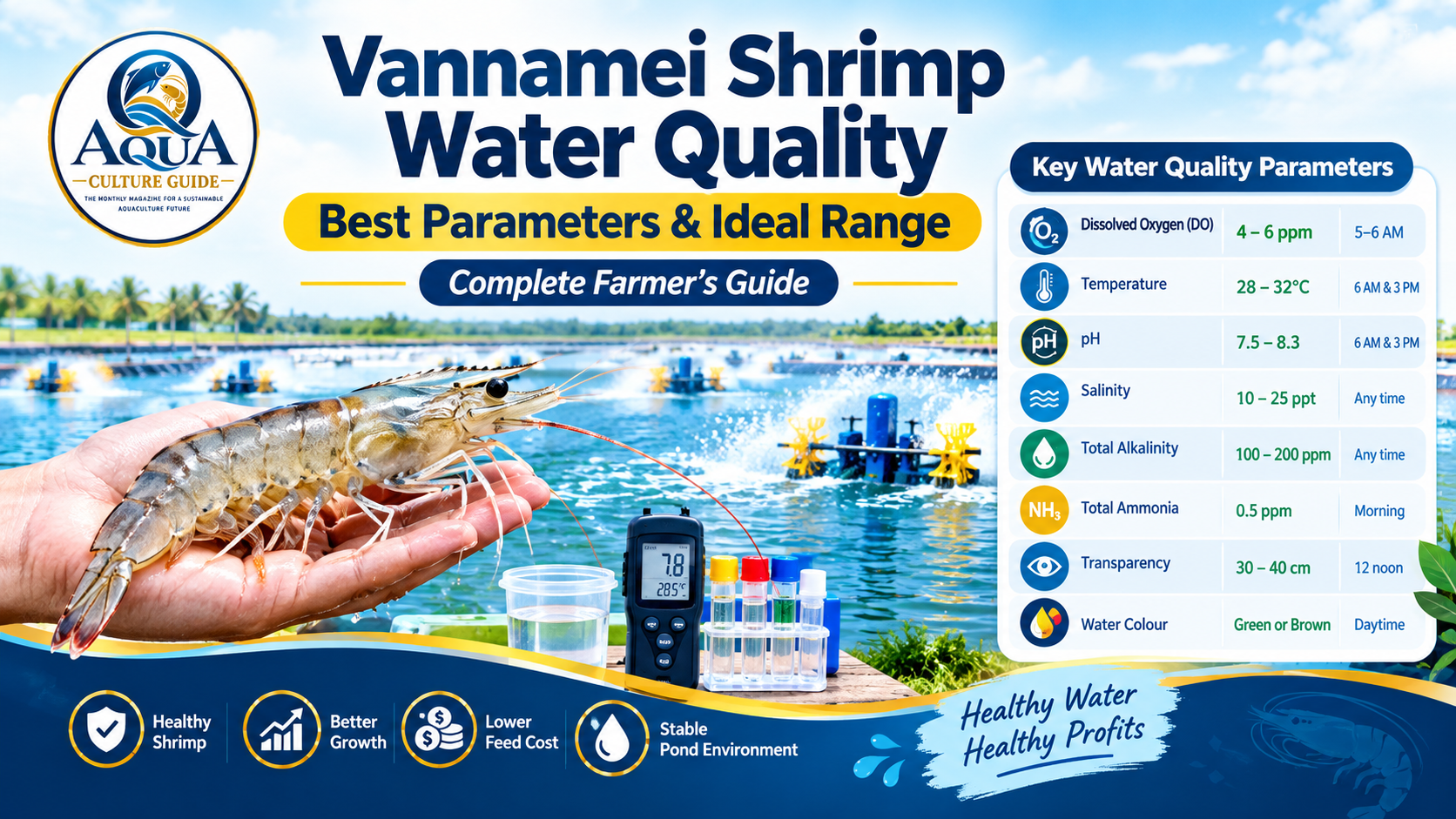
Learn the best water quality parameters for vannamei shrimp farming, including pH, dissolved oxygen, temperature, salinity, alkalinity, ammonia and transparency, with practical monitoring tips
Vannamei Shrimp Water Quality: Best Parameters & Ideal Range
Water quality is one of the most important factors in vannamei shrimp farming. Shrimp live continuously in the pond environment, so changes in oxygen, temperature, pH, salinity and other parameters can affect feeding, growth, stress and overall pond performance.
Good water-quality management is not about maintaining one parameter at the correct number. The objective is to keep the overall pond environment stable and identify unfavorable changes early.
Why Is Water Quality Important in Vannamei Farming?
Poor water quality can create stress for shrimp and can make other farm-management problems more difficult to control.
Important factors include:
Dissolved oxygen → Temperature → pH → Salinity → Alkalinity → Ammonia → Transparency → Water colour
CAA guidance for SPF L. vannamei specifically calls for routine monitoring of pH, alkalinity, dissolved oxygen, total ammonia, unionised ammonia, nitrite, nitrate, total nitrogen, phosphorus, BOD and COD, in addition to shrimp health and bacterial monitoring.
Ideal Water Quality Parameters for Vannamei Shrimp
According to MPEDA's current farmer guidance
| Water Quality Parameter | Ideal Range / Reference | Recommended Monitoring |
|---|---|---|
| Dissolved Oxygen (DO) | 4–6 ppm | 5–6 AM |
| Temperature | 28–32°C | 6 AM & 3 PM |
| pH | 7.5–8.3 | 6 AM & 3 PM |
| Salinity | 10–25 ppt | Any time |
| Total Alkalinity | 100–200 ppm | Any time |
| Total Ammonia | 0.5 ppm | Morning |
| Transparency | 30–40 cm | 12 noon |
| Water Colur | Green or brown | Daytime |
Dissolved Oxygen (DO)
Ideal reference: 4–6 ppm
Dissolved oxygen is one of the most important parameters in a shrimp pond.
Shrimp require oxygen for respiration, and oxygen conditions can change substantially between daytime and nighttime.
Signs of oxygen stress
Watch for:
Shrimp swimming near the surface
Weak activity
Reduced feeding
Shrimp gathering near water inlets or aerators
Increased early-morning stress
How to manage DO
Use:
Adequate aerators
Proper aerator positioning
Good water circulation
Biomass-based aeration planning
Regular early-morning DO testing
Water Temperature
Ideal reference: 28–32°C
Temperature affects shrimp metabolism, feeding activity and overall pond biology.
MPEDA recommends measuring temperature at approximately 6 AM and 3 PM, allowing farmers to observe both morning and afternoon conditions.
Why monitor morning and afternoon?
The pond can experience a significant daily temperature cycle.
Recording both readings helps identify:
Daily temperature changes
Unusual heat
Sudden weather-related changes
Conditions that may affect shrimp feeding
Avoid relying on a single temperature reading.
Temperature management
Farmers should focus on:
Maintaining sufficient water depth
Avoiding unnecessary disturbance
Monitoring during extreme weather
Adjusting feeding when shrimp activity changes
Maintaining adequate aeration
- pH
Ideal reference: 7.5–8.3
pH is one of the most important measurements in shrimp culture because it can change considerably between morning and afternoon.
MPEDA recommends checking pH at approximately 6 AM and 3 PM and advises keeping daily pH fluctuation below 0.5.
Why does pH change?
Phytoplankton and other biological activity affect carbon dioxide and therefore can cause daily pH movement.
Typically:
Morning → lower pH
Afternoon → higher pH
Large fluctuations are more concerning than a small normal daily change.
High pH
MPEDA identifies over-liming and excessive plankton bloom as potential causes of high pH.
Low pH
Low pH can occur in poorly buffered water and under certain soil and water conditions.
The response should be based on the actual pond condition rather than automatically adding a large quantity of any chemical.
- Salinity
MPEDA reference: 10–25 ppt
Salinity indicates the concentration of dissolved salts in the water.
MPEDA lists 10–25 ppt as its reference range for vannamei culture and recommends measuring salinity with a refractometer.
When can salinity change quickly
Heavy rainfall
Freshwater inflow
Evaporation
Water exchange
Changes in source-water salinity
After heavy rain
Check salinity rather than assuming the pond remains unchanged.
Total Alkalinity
MPEDA reference: 100–200 ppm
Alkalinity is an important component of pond buffering and helps stabilize pH.
MPEDA recommends maintaining total alkalinity between 100 and 200 ppm in its vannamei BMP guidance.
What should farmers do?
Test alkalinity routinely and make adjustments based on:
Water chemistry
Soil condition
Salinity
Shrimp biomass
pH trend
Do not apply large amounts of lime or other mineral products simply because pH changes once. First measure pH + alkalinity + the daily trend.
Ammonia
MPEDA reference: Total ammonia 0.5 ppm
Ammonia is a major water-quality concern in shrimp ponds.
It can originate from:
Shrimp waste
Uneaten feed
Decomposing organic matter
High stocking biomass
Poor pond-bottom condition
MPEDA recommends testing total ammonia in the morning
Total ammonia vs unionised ammonia
The ammonia measured in water exists in different chemical forms. The unionised form (NH₃) is particularly important when assessing toxicity.
The proportion of unionised ammonia changes with factors such as pH and temperature.
Nitrite
Nitrite should also be included in a good shrimp-farm water-quality program.
Nitrite problems can be associated with:
High organic loading
Incomplete nitrogen cycling
High stocking biomass
Poor water management
When nitrite increases, review the entire pond system instead of treating the number in isolation.
Check:
Feed → Biomass → Organic load → Aeration → Water quality → Pond bottom
Water Transparency
MPEDA reference: 30–40 cm
Transparency is commonly measured with a Secchi disc.
MPEDA recommends measuring transparency around 12 noon and provides 30–40 cm as the reference range in its farmer guidance.
Very clear water
May indicate insufficient plankton development.
Very low transparency
May indicate excessive plankton or suspended matter.
The transparency reading should therefore be interpreted together with water colour, pH, DO and pond observations.
Water Colour
Preferred reference: Green or brown
MPEDA identifies green or brown as the preferred water colour in its shrimp-farming guidance.
A stable plankton community can provide a more suitable pond environment.
However:
Dark green water does not automatically mean a healthy pond.
Calcium and Magnesium
Mineral balance is another important part of vannamei pond management.
MPEDA's BMP guidance highlights the importance of calcium and magnesium in vannamei farming and gives a general Ca:Mg ratio of 1:3 as a management reference
Mineral management can become particularly important when:
Salinity is low
Water source has low mineral content
Shrimp show growth or molting concerns
Large amounts of water are exchanged
Water Hardness
Water hardness represents the concentration of certain dissolved minerals, particularly calcium and magnesium.
Although hardness is not included in MPEDA's short farmer reference table above, ICAR-CIBA's multiparameter water-quality testing program includes calcium, magnesium and total hardness among the parameters that can be monitored on farms.
BOD and COD
CAA's vannamei guidance includes BOD (Biochemical Oxygen Demand) and COD (Chemical Oxygen Demand) among the water-related parameters to be routinely monitored.
These are particularly relevant when evaluating organic pollution and wastewater management.
It is important to distinguish:
Pond water-quality management from effluent discharge standards.
Complete Vannamei Water Quality Table
| Parameter | MPEDA Reference | How Often / When to Check |
|---|---|---|
| Dissolved Oxygen | 4–6 ppm | 5–6 AM |
| Temperature | 28–32°C | 6 AM & 3 PM |
| pH | 7.5–8.3 | 6 AM & 3 PM |
| Salinity | 10–25 ppt | Any time |
Step-by-Step Daily Water Quality Monitoring
Check DO in the Early Morning
Measure DO around 5–6 AM.
This is one of the most important daily checks because oxygen can be low after nighttime respiration.
Record:
DO = ____ ppm
MPEDA recommends this monitoring time.
Measure Morning Temperature
Take the temperature around 6 AM.
Record:
Temperature = ____ °C
This becomes your baseline for comparison with the afternoon reading.
Measure Morning pH
Check pH around 6 AM.
Record:
Morning pH = ____
Measure Afternoon pH and Temperature
Repeat the measurements around 3 PM.
Record:
Afternoon temperature = ____ °C
Afternoon pH = ____
Now compare morning and afternoon readings.
This helps identify daily fluctuations rather than looking at only one measurement.
Check Salinity
Use a properly calibrated refractometer.
Record:
Salinity = ____ ppt
Check more frequently when:
Heavy rain occurs
Water is exchanged
Source-water salinity changes
The farm operates at low salinity
MPEDA lists refractometer testing as the method for salinity measurement in its BMP table.
Check Alkalinity
Use a reliable alkalinity test kit or laboratory method.
Record:
Total alkalinity = ____ ppm
Track the trend rather than waiting until a serious pH problem appears.
Check Ammonia
Test ammonia in the morning according to the MPEDA monitoring schedule.
Record:
Total ammonia = ____ ppm
If the value rises, investigate:
Feed quantity
Uneaten feed
Shrimp biomass
Pond-bottom condition
Aeration
Organic loading
Do not simply add a water-treatment product without investigating the cause.
Measure Transparency
Use a Secchi disc around noon.
Record:
Transparency = ____ cm
Compare the reading with previous days rather than interpreting one reading alone.
Observe Water Color
Look at the pond during daylight.
Record:
Water colour = Green / Brown / Clear / Dark / Other
Also check for:
Sudden colour changes
Surface scum
Excessive algae
Foam
Unusual smell
Record Everything
A water-quality log can look like this:
Date DO Temp AM Temp PM pH AM pH PM Salinity Alkalinity Ammonia Transparency
Day 1 4.8 28.2 31.0 7.7 8.0 15 140 0.20 35
Day 2 4.6 28.5 31.3 7.6 8.1 15 138 0.22 34
Day 3 4.2 28.8 31.5 7.5 8.2 14 136 0.25 32
What Should You Do When Water Quality Changes?
When DO Falls
Check aerators → increase appropriate aeration → reduce feeding if necessary → observe shrimp → continue monitoring.
When pH Becomes High
Check:
Plankton density
Transparency
Alkalinity
Liming history
Daily pH fluctuation
MPEDA identifies excessive plankton bloom and over-liming as possible causes of high pH.
When Ammonia Increases
Review:
Feed → biomass → oxygen → pond bottom → organic loading
Avoid automatically adding multiple products without determining why ammonia increased.
After Heavy Rain
Immediately review:
Salinity → pH → temperature → DO → alkalinity
Rain can change pond conditions rapidly.
Water Quality and Feed Management Are Connected
Water quality cannot be managed separately from feeding.
Excess feed can increase organic loading, which can contribute to deterioration of pond conditions.
MPEDA states that feed represents approximately 50–60% of operating cost and advises reducing feeding during low DO, plankton crashes, rainfall, molting, extreme temperatures and disease outbreaks.
Therefore:
Poor feeding → more waste → higher organic load → greater water-quality pressure
Good feeding management helps support good water quality.
Common Water Quality Mistakes
- Checking DO only in the afternoon
Early morning is an important time for DO measurement.
- Checking pH only once a day
Morning and afternoon measurements show daily fluctuation.
- Treating numbers instead of causes
A high ammonia reading is a signal to investigate the pond system.
- Ignoring pond-bottom condition
Black soil and bad odors can indicate deterioration. MPEDA recommends weekly bottom checks.
- Over-fertilizing to make water dark green
Excessive plankton can reduce nighttime oxygen.
- Changing water unnecessarily
MPEDA recommends minimizing water exchange when pond conditions are good and shrimp are healthy.
- Not calibrating equipment
A faulty meter can lead to incorrect management decisions.
- Not recording results
A single number is less useful than a trend.
- Ignoring rainfall
Rain can rapidly change salinity and other water conditions.
- Waiting until shrimp show stress
Regular monitoring allows earlier detection.
Best Water Quality Monitoring Schedule
Every Morning
DO → Temperature → pH → Ammonia → Shrimp behaviour
Afternoon
Temperature → pH → Water colour
Any Time / Routine Schedule
Salinity → Alkalinity
Noon
Transparency
Weekly or According to Farm Risk
Nitrite → Nitrate → Calcium → Magnesium → Hardness and other laboratory parameters
Vannamei Water Quality Checklist
Daily
☐ DO checked
☐ Temperature checked
☐ Morning pH checked
☐ Afternoon pH checked
☐ Shrimp behaviour observed
☐ Water colour checked
☐ Transparency checked
Routine
☐ Salinity checked
☐ Alkalinity checked
☐ Ammonia checked
☐ Nitrite checked
☐ Pond-bottom condition checked
☐ Aerators inspected
After Rainfall
☐ DO checked
☐ pH checked
☐ Salinity checked
☐ Temperature checked
☐ Alkalinity reviewed
☐ Shrimp activity observed
Simple Water Quality Targets for Farmers
For a quick reminder:
DO
4–6 ppm
Temperature
28–32°C
pH
7.5–8.3
Salinity
10–25 ppt
Alkalinity
100–200 ppm
Total Ammonia
0.5 ppm reference
Transparency
30–40 cm
Water Colour
Green or brown
These figures are from MPEDA's current Better Management Practices for shrimp farming.
Important Note on "Ideal" Water Quality
Farmers should avoid thinking of water quality as a set of isolated numbers.
For example:
pH = 8.2 by itself may not tell the complete story.
You also need to know:
DO
Alkalinity
Temperature
Transparency
Plankton condition
Ammonia
Nitrite
Shrimp behavior
The most useful approach is therefore:
Measure → Record → Compare → Identify the cause → Take appropriate action → Recheck
Conclusion:
Good water quality management is the foundation of successful vannamei shrimp farming.
Farmers should pay particular attention to:
Dissolved oxygen, temperature, pH, salinity, alkalinity, ammonia, transparency and water colour.
The most important practice is not simply achieving a target number once. It is maintaining stable conditions and identifying changes early.
Questions & Answers
Q1.What is the ideal pH for vannamei shrimp?
MPEDA's farmer guidance gives 7.5–8.3 as the reference range and recommends checking pH at around 6 AM and 3 PM.
Q2.What is the ideal dissolved oxygen level for shrimp ponds?
MPEDA provides 4–6 ppm as its reference range and recommends early-morning monitoring
Q3.What is the recommended alkalinity for vannamei?
MPEDA recommends 100–200 ppm as a reference range.
Q4.What is the acceptable ammonia level in a shrimp pond?
MPEDA's farmer guidance lists 0.5 ppm for total ammonia as a reference. CAA also emphasizes monitoring both total and unionised ammonia
Q5.How often should shrimp pond water be tested?
Critical parameters should be checked routinely. MPEDA specifies different monitoring times for DO, temperature, pH, salinity, alkalinity, ammonia and transparency
Q6.What water colour is good for vannamei shrimp?
MPEDA gives green or brown as its reference water colour and advises against creating excessively dark-green water through heavy fertilization
Related articles
భారతీయ రిజర్వాయర్లలో కేజ్ ఫిష్ ఫార్మింగ్: సాంకేతికత, అనుమతులు మరియు పెట్టుబడి వివరాలు
భారతదేశంలోని రిజర్వాయర్లలో కేజ్ ఫిష్ ఫార్మింగ్ ఎలా ప్రారంభించాలి? అవసరమైన సాంకేతికత, ప్రభుత్వ అనుమతులు, పెట్టుబడి, చేపల జాతులు, మేత నిర్వహణ మరియు లాభనష్టాల గురించి పూర్తి వివరాలు తెలుసుకోండి.
Freshwater Prawn Farming in IndiaFreshwater Prawn Farming in India: రైతులకు పూర్తి సాగు మార్గదర్శిని
భారతదేశంలో మంచినీటి రొయ్యల సాగు ఎలా ప్రారంభించాలి? జెయింట్ ఫ్రెష్వాటర్ ప్రాన్ సీడ్ ఎంపిక, చెరువు తయారీ, స్టాకింగ్, ఆహారం, నీటి నాణ్యత, పెట్టుబడి, మార్కెటింగ్ గురించి పూర్తి వివరాలు తెలుసుకోండి.
Tilapia farming in Indiaభారతదేశంలో తిలాపియా చేపల పెంపకం – మార్కెట్ అవకాశాలు, ప్రభుత్వ నిబంధనలు మరియు ఆధునిక సాగు పద్ధతులు
భారతదేశంలో తిలాపియా చేపల పెంపకం ఎలా చేయాలి? మార్కెట్ అవకాశాలు, ప్రభుత్వ అనుమతులు, చెరువు సాగు, బయోఫ్లాక్, RAS విధానాలు, పిల్లల ఎంపిక, మేత నిర్వహణ మరియు దిగుబడి గురించి పూర్తి సమాచారం.
PCR Testing in Shrimp Hatcheriesరొయ్యల హ్యాచరీల్లో PCR పరీక్షలు: ఫలితాలను రైతులు ఎలా అర్థం చేసుకోవాలి?
WSSV, EHP, AHPND వంటి వ్యాధికారకాలను గుర్తించడంలో PCR పరీక్షల పాత్ర, పరీక్షా నివేదికలను అర్థం చేసుకోవడం, నాణ్యమైన రొయ్య పిల్లలను ఎంపిక చేసుకోవడం గురించి రైతులు తెలుసుకోవాల్సిన పూర్తి సమాచారం.
Explore Aqua Culture Guide
Aqua companies directory
Feed, seed, probiotics & equipment suppliers
Aquaculture calculators
Feed, FCR, stocking & water quality tools
Telugu aqua magazine
Read the latest monthly issue online
All aqua news & articles
Farming, disease control and market updates
List your company free
Get found by farmers across India
Advertise with us
Magazine and website advertising options