How to Evaluate Aquaculture Products Before Farm Use
29/10/2026
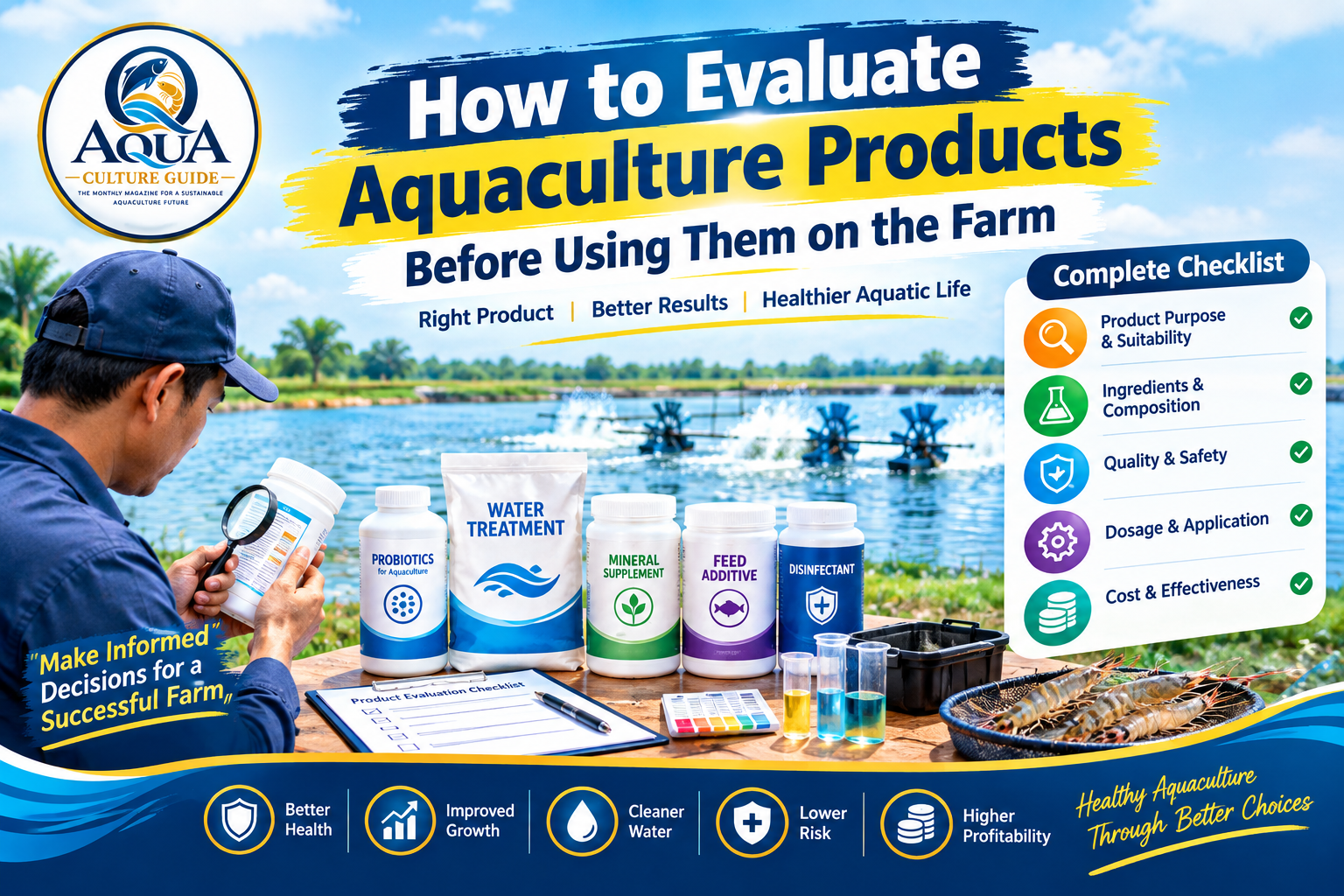
Learn how to evaluate aquaculture products before using them on your farm. Check product quality, ingredients, dosage, safety, effectiveness, cost and results with a complete checklist.
Introduction
Aquaculture farmers use a wide range of products to support fish and shrimp farming. These include probiotics, water treatments, mineral supplements, feed additives, disinfectants, pond conditioners and other farm-management products. Choosing the right product can help farmers address specific problems, but using an unsuitable or poor-quality product may increase costs and affect farm performance.
Many products are marketed with claims such as faster growth, better survival, improved water quality, stronger immunity or reduced disease risk. However, these claims should not be accepted without checking the product's ingredients, intended use, quality, safety and supporting evidence.
Evaluating an aquaculture product before using it on the farm is an important step in responsible farm management. Farmers should understand what a product contains, what it is designed to do, how it should be applied and whether its expected benefits justify the cost.
A product that works well on one farm may not produce the same results on another. Pond conditions, salinity, species, stocking density, water quality, feed management and application methods can all influence its performance.
Why Is It Important to Evaluate Aquaculture Products?
Before using any product, farmers should understand its purpose and whether it is suitable for their farming conditions.
Proper evaluation can help farmers:
- Avoid unnecessary expenses: Buy products based on actual farm needs rather than marketing claims.
- Check product quality: Identify missing information, damaged packaging, expired products or unclear ingredient details.
- Reduce risks to fish and shrimp: Check safety instructions, appropriate dosage and possible adverse effects.
- Understand product limitations: Determine what a product can and cannot do.
- Improve farm decisions: Compare products using reliable information and measurable results.
- Prevent unsuitable combinations: Identify possible interactions with other products, treatments or feed ingredients.
- Measure cost-effectiveness: Check whether the product provides enough benefit to justify its cost.
- Maintain farm records: Document product use and results to guide future decisions.
Types of Aquaculture Products Farmers Should Evaluate
- Probiotics
Check the microorganism identity, intended application, viable count where relevant, storage conditions and expiry date. Confirm whether the product is designed for pond water, feed or another specific use.
- Water Treatments
Check the active ingredients, intended target, recommended dosage, water-volume calculation, safety precautions and compatibility with stocked ponds.
- Mineral Supplements
Check the mineral composition, concentration, solubility, intended use and suitability for the pond's salinity and measured mineral requirements.
- Feed Additives
Review the active ingredients, species suitability, inclusion rate, feed compatibility, storage instructions and evidence supporting the claimed benefit.
- Disinfectants and Other Chemical Products
Check the active ingredient, approved purpose, required protective equipment, safe handling, application conditions and environmental precautions. Confirm whether use is permitted in a stocked pond or only during preparation.
Seven Important Factors to Check Before Buying an Aquaculture Product
1. Product purpose and suitability
First, identify the problem you want to solve. Is it related to water quality, mineral balance, feed efficiency, pond-bottom conditions or another issue?
Check whether the product is intended for your cultured species, production stage and application method. Do not use a product for a different purpose simply because it is marketed for aquaculture.
Ingredients and composition
Read the label and product technical information carefully.
Look for:
- Active ingredients or microorganisms.
- Concentration or strength, where relevant.
- Guaranteed specifications and quality parameters.
- Carrier materials or other important ingredients.
- Restrictions on use or known incompatibilities.
If the composition is unclear, ask the manufacturer or supplier for a technical data sheet. Avoid relying on product colour, smell or appearance as proof of quality.
Manufacturer and supplier credibility
Check the manufacturer's identity, contact details, batch traceability and ability to provide technical information.
Ask whether the supplier can provide a product label, batch-specific certificate of analysis where appropriate, safety data sheet for relevant chemical products, and credible supporting information.
A professional-looking package or a well-known brand name alone does not prove that every batch is suitable or effective.
Product quality and packaging
Before accepting the product, inspect:
- The manufacturing and expiry dates.
- The batch or lot number.
- The seal and packaging condition.
- Any signs of leakage, moisture damage or tampering.
- Storage and transport conditions.
- The product's appearance against its normal specifications.
Do not use a product if its identity, integrity or suitability is in doubt. For sensitive products, such as certain live microbial preparations, improper storage may reduce effectiveness even before the expiry date.
Dosage and application method
Confirm the recommended dose, frequency, method of application and conditions of use.
Check whether the dose is calculated per kilogram of feed, per unit of water volume, per pond area or according to another measure. These units are not interchangeable.
Do not increase the dosage to try to obtain faster results. Excessive or incorrect application can increase cost and may harm cultured animals or the environment.
Safety and compatibility
Check whether the product is suitable for use around the cultured species and at the current stage of production.
Consider its compatibility with:
- Other water treatments.
- Probiotics and disinfectants.
- Feed additives or binders.
- Pond-water chemistry.
- Equipment and application materials
Evidence of effectiveness and cost
Look for credible evidence relevant to the species, production system and intended use. Manufacturer trials can be useful, but independent research or well-documented farm trials can provide additional confidence.
Compare the cost per actual application, not just the price of the package. Consider whether the expected benefit is measurable and whether it justifies the total cost.
Step-by-Step Guide to Evaluating an Aquaculture Product
Step 1: Identify the farm's actual requirement
Start by identifying the issue or objective. Review farm records, water-quality readings, feed intake, growth trends, survival and other relevant observations.
For example, if shrimp growth has slowed, check feed quality, dissolved oxygen, water chemistry, animal health and other likely causes before purchasing a growth-related product.
Do not assume that every farm problem can be solved with an additive or treatment.
Step 2: Collect the product information
Request the product label and relevant technical documents from the supplier.
Depending on the product, these may include:
- Technical data sheet.
- Safety data sheet for applicable chemicals.
- Batch-specific certificate of analysis.
- Microbial specifications for probiotic products.
- Instructions for storage, dosage and application.
- Supporting trial data or references.
Check whether the information is specific to the product being sold and, where relevant, the batch you will receive.
Step 3: Verify the product's intended use
Confirm that the product is designed for your species, production stage and farming conditions.
For example, a product intended for pond preparation may not be suitable for a stocked pond. Similarly, a feed additive designed for fish may not automatically be appropriate for shrimp.
If the intended use is unclear, ask a qualified aquaculture professional before proceeding.
Step 4: Check the quality specifications
Compare the product label and technical documents against the supplier's claims.
For example:
- For probiotics, review strain identity, viable count specifications and storage requirements.
- For mineral products, review the declared mineral composition and concentration.
- For water treatments, review active ingredients and application restrictions.
- For feed additives, check the declared composition and recommended inclusion rate.
Where the quality of a product is uncertain or critical, consider suitable independent laboratory testing. The test should match the product type and the question being investigated.
Step 5: Calculate the total cost
Consider the amount needed for one treatment, the number of applications and the size of the farm.
Example: A product costs ₹1,000 for a package that provides five applications at the label-recommended rate.
Cost per application:
₹1000 \ 5 = ₹200
This is a simple cost example, not a product recommendation. Include additional application expenses, labour and any required equipment when comparing products.
Step 6: Review the safety instructions
Before using the product, check protective equipment, handling precautions, storage requirements, disposal instructions and any restrictions on use around aquatic animals.
For chemical treatments, confirm the active ingredient and the suitability of the proposed application. If safety information is missing or unclear, do not guess the dosage or proceed without qualified advice.
Step 7: Plan a suitable evaluation
Where safe and practical, evaluate a new product on a small, representative scale before wider use. This is not appropriate for every product: products needed for urgent treatment or those with specific safety restrictions require professional guidance rather than informal experimentation.
For a suitable trial:
- Define the expected result in advance.
- Record the starting conditions.
- Follow the label-recommended application.
- Use a comparable untreated group or baseline where feasible and ethically appropriate.
- Monitor the relevant parameters for an appropriate period.
- Record any unexpected effects.
- Compare the results before deciding whether to continue.
Do not deliberately expose animals to a harmful condition to create a comparison group. Seek professional advice if the product has potential animal-health or environmental risks.
Step 8: Monitor the results
Choose indicators that match the product's purpose.
Product objective Possible indicators to monitor
Water-quality management Relevant pH, dissolved oxygen, ammonia, nitrite or other target parameters
Feed efficiency Feed consumption, biomass gain and FCR
Mineral management Relevant mineral concentrations and water chemistry
Probiotic application Product-specific indicators and relevant pond or animal performance measures
Feed preservation Feed condition, storage stability and signs of deterioration
Use suitable test methods and compare results under reasonably similar conditions. A change observed after application does not automatically prove that the product caused it.
Step 9: Make a decision based on evidence
After the evaluation period, decide whether the product is suitable, needs further assessment or should not be used again.
Consider product performance, safety, consistency, cost and ease of application. Keep the records so the decision can be reviewed during future production cycles.
Complete Checklist: Before Using an Aquaculture Product
Use this checklist before purchasing or applying any aquaculture product on your farm.
Aquaculture product evaluation
A. Product purpose
[ ] Identified the actual farm problem or objective
[ ] Confirmed the product is suitable for the cultured species
[ ] Checked suitability for the current production stage
[ ] Reviewed whether non-product management changes are needed
B. Product quality
[ ] Checked ingredients and active components
[ ] Reviewed product specifications and technical information
[ ] Verified manufacturer and supplier details
[ ] Checked batch number and expiry date
[ ] Inspected packaging and storage condition
C. Safety and application
[ ] Read the full product label and instructions
[ ] Confirmed dosage units and application method
[ ] Checked safety precautions and required protective equipment
[ ] Reviewed compatibility with other products
[ ] Confirmed applicable legal and regulatory requirements
D. Cost and effectiveness
[ ] Calculated the cost per application
[ ] Reviewed credible evidence supporting product claims
[ ] Defined measurable indicators of success
[ ] Planned suitable monitoring and recordkeeping
[ ] Considered a safe, appropriate small-scale evaluation where feasible
E. After use
[ ] Recorded product name, batch and quantity used
[ ] Recorded application date and pond conditions
[ ] Measured the relevant parameters before and after use
[ ] Checked for unexpected effects
[ ] Reviewed results and cost-effectiveness before further use
Warning Signs to Watch for Before Buying
Be cautious if you notice any of the following:
- No clear list of ingredients or active components.
- Missing manufacturer details, batch number or expiry date.
- Broken seals, damaged packaging or signs of poor storage.
- No clear instructions for dosage and application.
- Claims such as guaranteed growth, zero mortality or complete disease prevention without credible supporting evidence.
- Pressure to buy immediately without time to review the product information.
- Recommendations to exceed the stated dosage.
- Advice to combine multiple products without checking compatibility.
- No clear response from the supplier to basic technical or safety questions.
One warning sign does not automatically prove a product is ineffective, but unresolved concerns should be addressed before use. For products with uncertain identity, quality or safety, avoid application until the issue is resolved.
Common Mistakes Farmers Should Avoid
Choosing products based only on price: A low-cost product may not provide the required concentration, quality or performance. Compare cost per application and relevant specifications.
Believing every marketing claim: Ask what was measured, under what conditions, and whether the results are relevant to your farm.
Using products without testing the pond: A water treatment that is appropriate for one condition may be unsuitable for another.
Changing several products at the same time: It becomes difficult to determine which change caused the observed result.
Ignoring expiry and storage requirements: Product quality can decline when packaging is damaged or storage conditions are unsuitable.
Increasing the dosage without advice: Higher doses do not necessarily provide better results and can increase risk.
Failing to maintain records: Without records, farmers may repeat ineffective applications or overlook avoidable costs.
Conclusion
Evaluating an aquaculture product before using it on the farm helps farmers make informed decisions, control unnecessary expenses and reduce avoidable risks to fish, shrimp and the pond environment.
Before buying a product, check its purpose, composition, quality, safety, application instructions, supporting evidence and total cost. After use, monitor the relevant parameters and maintain clear records so its performance can be assessed objectively.
The best aquaculture product is not necessarily the most expensive or the most heavily advertised. It is the product that is suitable for the actual farm requirement, meets appropriate quality and safety standards, and provides a measurable benefit when used correctly.
Questions & Answers
Q1.How do I evaluate an aquaculture product before buying it?
Check its intended purpose, ingredients, manufacturer, product specifications, batch number, expiry date, dosage, safety instructions, supporting evidence and cost per application. Confirm that it is suitable for your species and farming conditions.
Q2.How can I check the quality of a probiotic product?
Review the microorganism identity, strain information where available, viable count specifications, storage requirements, expiry date and application instructions. For critical quality concerns, consider appropriate laboratory testing.
Q3.How can I know whether an aquaculture product is genuine?
Purchase from a credible supplier, check packaging and batch details, verify manufacturer information and request relevant technical documents. Contact the manufacturer if the product's authenticity is uncertain.
Q4.Should I test a product before using it in the entire pond?
Where safe, practical and permitted by the product instructions, a small-scale evaluation may help assess performance before wider use. However, not every product is suitable for informal trials. Products involving urgent treatment, potential toxicity or specific safety restrictions require appropriate professional guidance.
Q5.What documents should I request from an aquaculture product supplier?
Depending on the product, request its label, technical data sheet, safety data sheet where applicable, batch-specific certificate of analysis where relevant, application instructions and credible supporting evidence.
Q6.How do I compare two aquaculture products?
Compare their active ingredients, concentrations, quality specifications, intended uses, recommended dosages, safety requirements, supporting evidence and total cost per application. Do not compare products using package price alone.
Q7.Can I use a product if the dosage instructions are unclear?
No. Do not guess the dosage. Contact the manufacturer or supplier for written instructions, or seek advice from a qualified aquaculture professional before use.
Related articles
భారతీయ రిజర్వాయర్లలో కేజ్ ఫిష్ ఫార్మింగ్: సాంకేతికత, అనుమతులు మరియు పెట్టుబడి వివరాలు
భారతదేశంలోని రిజర్వాయర్లలో కేజ్ ఫిష్ ఫార్మింగ్ ఎలా ప్రారంభించాలి? అవసరమైన సాంకేతికత, ప్రభుత్వ అనుమతులు, పెట్టుబడి, చేపల జాతులు, మేత నిర్వహణ మరియు లాభనష్టాల గురించి పూర్తి వివరాలు తెలుసుకోండి.
Freshwater Prawn Farming in IndiaFreshwater Prawn Farming in India: రైతులకు పూర్తి సాగు మార్గదర్శిని
భారతదేశంలో మంచినీటి రొయ్యల సాగు ఎలా ప్రారంభించాలి? జెయింట్ ఫ్రెష్వాటర్ ప్రాన్ సీడ్ ఎంపిక, చెరువు తయారీ, స్టాకింగ్, ఆహారం, నీటి నాణ్యత, పెట్టుబడి, మార్కెటింగ్ గురించి పూర్తి వివరాలు తెలుసుకోండి.
Tilapia farming in Indiaభారతదేశంలో తిలాపియా చేపల పెంపకం – మార్కెట్ అవకాశాలు, ప్రభుత్వ నిబంధనలు మరియు ఆధునిక సాగు పద్ధతులు
భారతదేశంలో తిలాపియా చేపల పెంపకం ఎలా చేయాలి? మార్కెట్ అవకాశాలు, ప్రభుత్వ అనుమతులు, చెరువు సాగు, బయోఫ్లాక్, RAS విధానాలు, పిల్లల ఎంపిక, మేత నిర్వహణ మరియు దిగుబడి గురించి పూర్తి సమాచారం.
PCR Testing in Shrimp Hatcheriesరొయ్యల హ్యాచరీల్లో PCR పరీక్షలు: ఫలితాలను రైతులు ఎలా అర్థం చేసుకోవాలి?
WSSV, EHP, AHPND వంటి వ్యాధికారకాలను గుర్తించడంలో PCR పరీక్షల పాత్ర, పరీక్షా నివేదికలను అర్థం చేసుకోవడం, నాణ్యమైన రొయ్య పిల్లలను ఎంపిక చేసుకోవడం గురించి రైతులు తెలుసుకోవాల్సిన పూర్తి సమాచారం.
Explore Aqua Culture Guide
Aqua companies directory
Feed, seed, probiotics & equipment suppliers
Aquaculture calculators
Feed, FCR, stocking & water quality tools
Telugu aqua magazine
Read the latest monthly issue online
All aqua news & articles
Farming, disease control and market updates
List your company free
Get found by farmers across India
Advertise with us
Magazine and website advertising options