How to Control Ammonia & Nitrite in Shrimp Ponds
3/10/2026
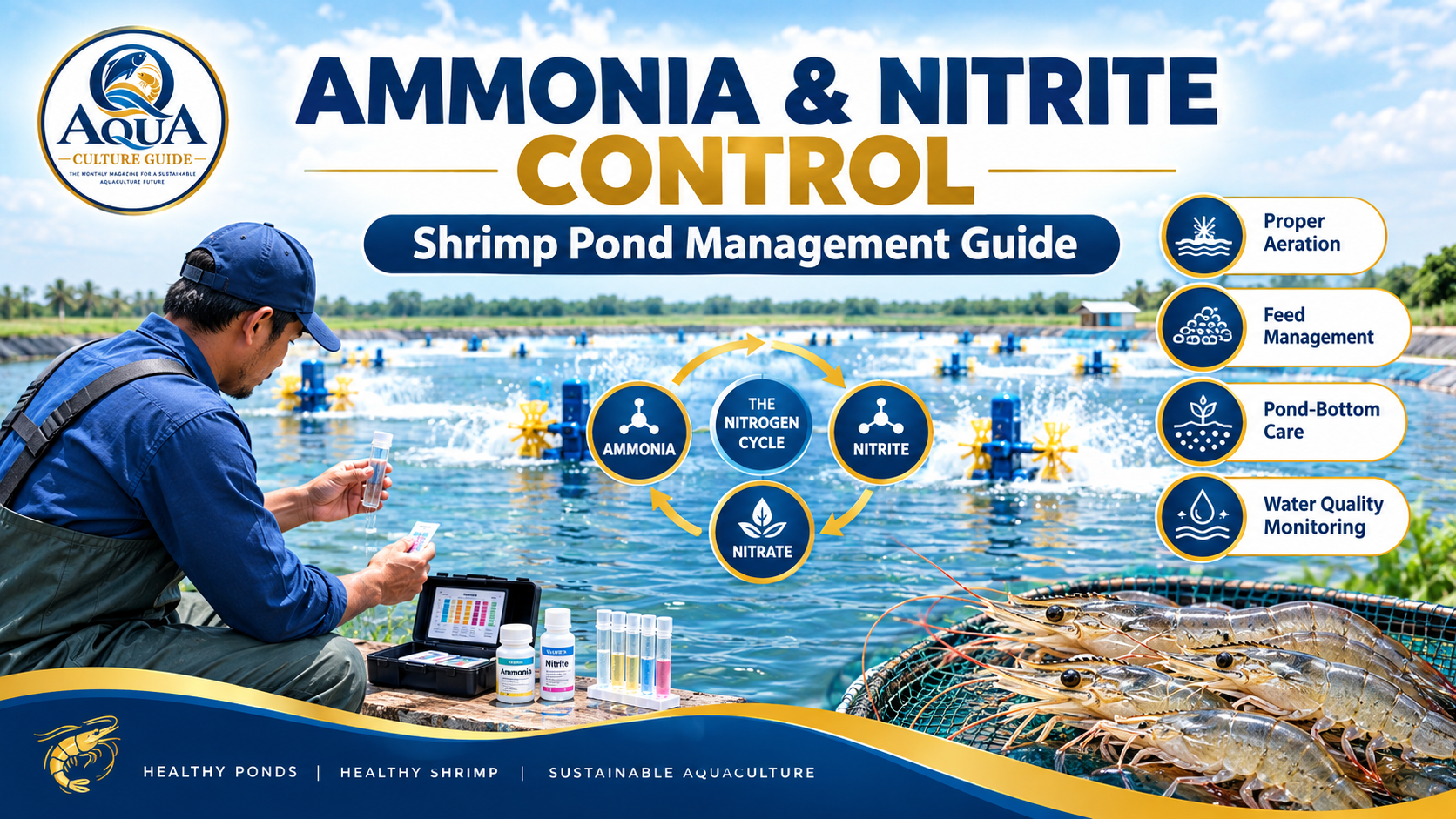
Learn how to control ammonia and nitrite in shrimp ponds with this simple step-by-step guide covering causes, testing, aeration, feed management, pond-bottom care and prevention
How to Control Ammonia & Nitrite in Shrimp Ponds
Ammonia and nitrite are two important water-quality parameters that every shrimp farmer should monitor regularly.
They are part of the nitrogen cycle in a shrimp pond and are closely connected with feed, shrimp biomass, organic matter, oxygen, bacteria and pond-bottom condition.
When feed and organic waste accumulate, nitrogen compounds can build up. Poor oxygen conditions can further disturb the normal conversion of nitrogen compounds in the pond. FAO identifies ammonia as a product of animal metabolism and decomposition of organic matter, and notes that pH and temperature influence the proportion of ammonia present in the more toxic unionised form.
For Indian vannamei farms, the Coastal Aquaculture Authority (CAA) specifically requires routine monitoring of total ammonia, unionised ammonia, nitrite and other water-quality parameters.
What Are Ammonia and Nitrite?
The nitrogen cycle in a shrimp pond can be simplified as:
Feed & shrimp waste → Ammonia → Nitrite → Nitrate
Ammonia is produced from shrimp metabolism and the decomposition of organic matter. Under suitable conditions, microorganisms convert ammonia into nitrite and subsequently nitrate.
The process depends on the pond's biological and environmental conditions.
Simple explanation
Ammonia: Comes mainly from shrimp waste, uneaten feed and decomposition.
Nitrite: An intermediate nitrogen compound formed during the conversion of ammonia.
Nitrate: A later-stage nitrogen compound that is generally less immediately toxic than ammonia and nitrite at typical pond concentrations.
The objective is not simply to "remove ammonia" with one product. It is to keep the whole nitrogen cycle working properly.
Why Are Ammonia and Nitrite Dangerous?
High concentrations can create stress for cultured shrimp and interfere with normal growth and survival.
Ammonia is particularly important because the toxic unionised ammonia (NH₃) fraction increases as pH and temperature rise. FAO explains that the percentage of toxic unionised ammonia can change substantially with pH and temperature.
This means:
The same total-ammonia reading can represent a different level of risk under different pH and temperature conditions.
What Causes High Ammonia in Shrimp Ponds?
Several factors can contribute.
- Overfeeding
Uneaten feed decomposes and adds organic nitrogen to the pond.
More wasted feed → More decomposition → More ammonia
This is why feed management is also water-quality management.
- High Shrimp Biomass
As shrimp biomass increases, the amount of metabolic waste entering the pond increases.
A pond that was comfortable early in the crop may experience greater nitrogen loading later.
- Excess Organic Matter
Organic matter can accumulate in:
Feeding areas
Pond corners
Sludge zones
Areas with poor circulation
- Poor Dissolved Oxygen
Oxygen is important for the biological processes responsible for nitrogen conversion.
FAO notes that when dissolved oxygen becomes low, nitrate can be reduced back toward ammonia, while low oxygen also increases the toxicity concern associated with unionised ammonia.
- Algal Crash
When a large amount of phytoplankton dies, decomposition can increase the organic load and oxygen demand of the pond.
- Poor Pond-Bottom Condition
Black sediment, bad smell and accumulated organic matter are warning signs that the pond bottom needs attention.
What Causes High Nitrite?
Nitrite can increase when the nitrogen cycle is not functioning efficiently.
Possible contributing factors include:
High organic loading
High ammonia production
High shrimp biomass
Inadequate oxygen
Poor biological filtration or nitrification
Rapid changes in pond conditions
Ammonia vs Nitrite: Simple Comparison
| Parameter | Main Source | Why Monitor It? |
|---|---|---|
| Ammonia | Shrimp waste, feed and decomposition | Toxicity risk, particularly from NH₃ |
| Nitrite | Intermediate product in nitrogen cycling | Can stress shrimp at elevated levels |
| Nitrate | Later-stage nitrogen conversion | Indicates continuing nitrogen cycling |
What Ammonia Level Should Shrimp Farmers Watch?
This is an area where terminology matters.
CAA's general coastal-aquaculture guideline lists an optimal ammonia-N level below 0.01 ppm and nitrite-N below 0.01 ppm.
MPEDA's current farmer BMP table, meanwhile, lists total ammonia = 0.5 ppm as a practical reference and recommends morning testing.
These numbers should not be mixed together, because measurements may refer to different forms or reporting conventions.
For farmers
Always check whether your test kit reports:
Total Ammonia Nitrogen (TAN)
or
Ammonia-N
or
NH₃ / unionised ammonia
Also consider pH and temperature when interpreting ammonia results because they affect the unionised fraction
Step-by-Step Guide to Control Ammonia and Nitrite
Step 1: Test the Water First
Before adding anything to the pond, measure the water.
At minimum, check:
☐ Total ammonia
☐ Unionised ammonia, where available
☐ Nitrite
☐ pH
☐ Dissolved oxygen
☐ Temperature
☐ Alkalinity
☐ Salinity
Step 2: Recheck the Test
If the ammonia or nitrite reading is unexpectedly high:
Repeat the test.
Check the test kit expiry date.
Follow the test procedure carefully.
Verify the sample location.
Consider laboratory confirmation for an important management decision.
Step 3: Check Dissolved Oxygen Immediately
Low oxygen can make nitrogen management more difficult.
MPEDA recommends checking DO around 5–6 AM and gives 4–6 ppm as a reference range.
CAA's current L. vannamei guidance calls for DO to remain above 5 mg/L throughout the culture period.
If DO is low
Increase appropriate aeration → improve circulation → recheck DO → reassess feeding and pond conditions.
Step 4: Review the Feeding Program
This is one of the first things to investigate.
Check:
Daily feed quantity
Feed-tray response
Recent feed increases
Shrimp biomass estimate
Uneaten feed
Feed storage quality
Simple rule
Do not keep feeding the same quantity just because the feeding chart says so.
Step 5: Reduce Unnecessary Feed During Stress
If shrimp are stressed and water quality has deteriorated, continuing the same feeding quantity can add more organic matter.
MPEDA recommends reducing feeding during conditions such as low DO, plankton crash, rainfall, extreme temperature and disease outbreaks.
Step 6: Check the Pond Bottom
Inspect:
Feeding zones
Corners
Sludge areas
Central accumulation areas
Look for:
Black soil + bad smell + organic deposits
Step 7: Remove Excess Organic Matter
Where practical, remove accumulated:
Sludge
Uneaten feed
Dead organisms
Benthic organic deposits
Step 8: Improve Aeration and Circulation
Good aeration is not only about increasing oxygen.
It also helps maintain circulation and reduces stagnant areas.
Step 9: Check pH and Temperature
This is especially important when ammonia is present.
The toxic unionised fraction of ammonia rises as pH and temperature increase.
Therefore, when you get an ammonia reading, also record:
pH = ____
Temperature = ____°C
Step 10: Check Alkalinity
Alkalinity contributes to the buffering capacity of pond water and supports stable pH conditions.
MPEDA's current BMP reference for total alkalinity is 100–200 ppm.
Step 11: Review Plankton Condition
Observe:
Water colour
Transparency
pH trend
DO trend
Sudden changes in bloom density
Step 12: Maintain Healthy Biological Filtration
Beneficial nitrifying microorganisms play an important role in converting ammonia through the nitrogen cycle.
Their performance depends on environmental conditions such as:
Oxygen
pH
Temperature
Organic loading
Available surfaces for microbial growth
Step 13: Use Probiotics Carefully
Probiotics are widely used in aquaculture, but they should be part of an overall management program rather than treated as a guaranteed cure.
Before using a product, check:
Product composition
Intended application
Dosage
Storage
Compatibility with the farm system
Local regulatory requirements
Most importantly:
Do not use probiotics as a substitute for fixing overfeeding, low DO or excessive organic matter.
Step 14: Be Careful With Water Exchange
Water exchange can sometimes help manage accumulated dissolved and suspended waste, but it is not automatically the correct response to every ammonia or nitrite reading.
MPEDA's current BMP guidance emphasizes minimizing unnecessary water exchange when pond conditions are good and using appropriate screened water and reservoirs.
Before exchanging water, consider:
Incoming-water quality
Disease risk
Salinity difference
Biosecurity
Reservoir availability
Current pond condition
Applicable regulations
Step 15: Monitor Nitrite Separately
Do not assume that controlling ammonia automatically means nitrite is under control.
Continue testing nitrite.
A simple monitoring record:
Date Pond Ammonia Nitrite DO pH Temperature
Day 1 Pond 1 0.20 ppm 0.01 ppm 5.2 7.8 29°C
Day 2 Pond 1 0.25 ppm 0.02 ppm 4.8 7.9 29°C
Day 3 Pond 1 0.35 ppm 0.04 ppm 4.3 8.0 30°C
The numbers above are examples only.
The important point is to identify whether the values are increasing, decreasing or remaining stable
Step 16: Look at Trends, Not Just One Reading
Suppose ammonia readings are:
0.15 → 0.20 → 0.28 → 0.40 ppm
Even before reaching a critical value, the upward trend tells you that something in the pond is changing.
Investigate:
Feed → biomass → DO → pond bottom → plankton → water exchange → nitrogen cycling
Step 17: Check Shrimp Behaviour
Water testing should be combined with observation.
Look for:
Reduced feeding
Weak swimming
Surface activity
Unusual aggregation
Poor growth
Increased mortality
Abnormal swimming
How to Control High Ammonia: Simple Action Plan
When ammonia rises:
- Test
Confirm the ammonia result.
- Check pH and temperature
These affect ammonia toxicity.
- Check DO
Low oxygen can worsen the nitrogen-cycle problem.
- Review feed
Look for overfeeding and uneaten feed.
- Check pond bottom
Look for sludge and organic accumulation.
- Improve aeration
Maintain adequate oxygen and circulation.
- Review plankton
Look for excessive bloom or sudden crash.
- Consider appropriate water management
Only where suitable and safe.
- Continue testing
Do not stop after one measurement.
How to Control High Nitrite: Simple Action Plan
When nitrite increases:
- Confirm the reading.
- Check ammonia.
High ammonia can indicate broader nitrogen-cycle loading.
- Check DO.
Nitrogen conversion depends on appropriate environmental conditions.
- Review organic loading.
Check feed, sludge and mortality.
- Check alkalinity and pH.
Stable conditions support biological processes.
- Review biofiltration/nitrification.
Determine whether biological conversion is functioning properly.
- Recheck nitrite.
Monitor the trend after corrective actions.
Ammonia and Nitrite Management Are Connected to Feed
Feed is one of the biggest nitrogen inputs into an aquaculture pond.
Consider this simple chain:
More feed → more shrimp growth and waste + more uneaten feed → more organic matter → more nitrogen compounds
This does not mean feeding less is always better.
Ammonia and Nitrite Management Are Connected to Dissolved Oxygen
Oxygen is a major part of good pond management.
When DO falls:
Shrimp become stressed.
Decomposition can continue consuming oxygen.
Biological nitrogen conversion can become less efficient.
The overall water-quality situation can deteriorate.
Good oxygen management supports good ammonia and nitrite management.
Ammonia and pH: Why Farmers Should Check Both
This is extremely important.
A farmer may see:
Total ammonia = 0.5 ppm
But that number alone does not tell the complete risk picture.
The proportion present as unionised NH₃ changes with pH and temperature. FAO's reference tables demonstrate that the toxic fraction can become much higher as pH increases.
Therefore, whenever ammonia increases:
Check ammonia + pH + temperature together.
**Simple Ways to Prevent Ammonia and Nitrite Problems
**
- Avoid overfeeding.
- Use feed trays and observe feed consumption.
- Sample shrimp regularly and update biomass estimates.
- Maintain adequate dissolved oxygen.
- Maintain good pond circulation.
- Remove excessive organic matter.
- Monitor the pond bottom regularly.
- Watch for excessive plankton blooms and algal crashes.
- Test ammonia and nitrite routinely.
- Investigate the cause rather than relying on a single treatment product.
Complete Ammonia & Nitrite Monitoring Checklist
Daily
☐ Check early-morning DO
☐ Observe shrimp behaviour
☐ Check feed response
☐ Observe water colour
☐ Record unusual smell or surface activity
Routine Water Testing
☐ Total ammonia
☐ Unionised ammonia where available
☐ Nitrite
☐ pH
☐ Temperature
☐ Alkalinity
☐ DO
☐ Salinity
Pond-Bottom Checklist
☐ Check feeding areas
☐ Check corners
☐ Look for black soil
☐ Check for bad smell
☐ Look for sludge accumulation
☐ Check for uneaten feed
☐ Check for dead organisms
☐ Remove excessive organic matter
Feed Management Checklist
☐ Estimate shrimp biomass
☐ Check feed-tray response
☐ Record daily feed
☐ Check for uneaten feed
☐ Adjust feeding when shrimp are stressed
☐ Avoid feeding heavily over deteriorated bottom areas
☐ Store feed correctly
Aeration Checklist
☐ All aerators working
☐ Motors checked
☐ Paddlewheels checked
☐ Electrical connections checked
☐ Aerators positioned for circulation
☐ Backup power available
☐ Nighttime operation planned
☐ Aeration reviewed as biomass increases
What NOT to Do When Ammonia or Nitrite Is High
Don't immediately add several products.
First identify the cause.
Don't ignore low DO.
Oxygen problems can make the overall situation worse.
Don't continue heavy feeding without checking consumption.
Uneaten feed adds organic loading.
Don't rely on water colour alone.
A visually attractive pond can still have poor ammonia or nitrite conditions.
Don't use unapproved chemicals or antibiotics.
CAA regulations and applicable food-safety requirements must be followed.
Don't assume one treatment works for every pond.
Each pond has its own biomass, soil, water source and management history.
Easy Formula for Your Website
This topic would be excellent for an Aqua Culture Guide Water Quality Calculator.
Farmer enters:
Ammonia: ___
pH: ___
Temperature: ___
Nitrite: ___
DO: ___
Calculator can display:
Ammonia status
Nitrite status
DO status
Possible risk factors to check
Recommended parameters to re-test
For ammonia, the calculator should distinguish between TAN and unionised NH₃ rather than treating all ammonia readings as interchangeable.
Quick Reference Table
Parameter Reference / Point to Monitor
Total ammonia MPEDA current farmer reference: 0.5 ppm
Ammonia-N CAA general optimal level: <0.01 ppm
Nitrite-N CAA general optimal level: <0.01 ppm
Dissolved oxygen MPEDA: 4–6 ppm
pH MPEDA: 7.5–8.3
Total alkalinity MPEDA: 100–200 ppm
Conclusion
Ammonia and nitrite management starts with good overall pond management.
Instead of looking for one product that will solve the problem, focus on the complete system:
Good Feed Management
↓
Lower Organic Waste
↓
Good Dissolved Oxygen
↓
Healthy Nitrogen Cycling
↓
Better Water Quality
The most useful farmer habit is to measure regularly, record the results and investigate trends.
When ammonia or nitrite increases, check:
Feed → Biomass → DO → pH → Temperature → Alkalinity → Pond Bottom → Plankton → Nitrogen Cycle
Questions & Answers
Q1.What causes ammonia to increase in shrimp ponds?
The main sources include shrimp metabolism, uneaten feed and decomposition of organic matter. High biomass and poor pond-bottom conditions can increase the overall nitrogen load.
Q2.What causes nitrite to increase?
Nitrite is an intermediate product in the nitrogen cycle. Increasing ammonia loading, poor oxygen conditions and an inefficient biological conversion process can contribute to nitrite accumulation.
Q3.How can I reduce ammonia naturally?
Start with the fundamentals: control feeding, reduce organic loading, maintain good oxygen and circulation, maintain pond-bottom condition and support stable biological nitrogen cycling
Q4.Does aeration reduce ammonia?
Aeration primarily improves oxygen and circulation. Better oxygen conditions can support the biological processes involved in nitrogen cycling and reduce stress associated with poor water quality. It is not a standalone ammonia-removal treatment.
Q5.Why should I check pH when ammonia is high?
Because the proportion of ammonia present as the more toxic unionised NH₃ form increases with pH and temperature.
Q6.Is water exchange always the answer?
No. Water exchange may be useful in some circumstances, but source-water quality, disease risks, salinity changes, biosecurity and local requirements should be considered. MPEDA recommends avoiding unnecessary water exchange when pond conditions are good
Related articles
భారతీయ రిజర్వాయర్లలో కేజ్ ఫిష్ ఫార్మింగ్: సాంకేతికత, అనుమతులు మరియు పెట్టుబడి వివరాలు
భారతదేశంలోని రిజర్వాయర్లలో కేజ్ ఫిష్ ఫార్మింగ్ ఎలా ప్రారంభించాలి? అవసరమైన సాంకేతికత, ప్రభుత్వ అనుమతులు, పెట్టుబడి, చేపల జాతులు, మేత నిర్వహణ మరియు లాభనష్టాల గురించి పూర్తి వివరాలు తెలుసుకోండి.
Freshwater Prawn Farming in IndiaFreshwater Prawn Farming in India: రైతులకు పూర్తి సాగు మార్గదర్శిని
భారతదేశంలో మంచినీటి రొయ్యల సాగు ఎలా ప్రారంభించాలి? జెయింట్ ఫ్రెష్వాటర్ ప్రాన్ సీడ్ ఎంపిక, చెరువు తయారీ, స్టాకింగ్, ఆహారం, నీటి నాణ్యత, పెట్టుబడి, మార్కెటింగ్ గురించి పూర్తి వివరాలు తెలుసుకోండి.
Tilapia farming in Indiaభారతదేశంలో తిలాపియా చేపల పెంపకం – మార్కెట్ అవకాశాలు, ప్రభుత్వ నిబంధనలు మరియు ఆధునిక సాగు పద్ధతులు
భారతదేశంలో తిలాపియా చేపల పెంపకం ఎలా చేయాలి? మార్కెట్ అవకాశాలు, ప్రభుత్వ అనుమతులు, చెరువు సాగు, బయోఫ్లాక్, RAS విధానాలు, పిల్లల ఎంపిక, మేత నిర్వహణ మరియు దిగుబడి గురించి పూర్తి సమాచారం.
PCR Testing in Shrimp Hatcheriesరొయ్యల హ్యాచరీల్లో PCR పరీక్షలు: ఫలితాలను రైతులు ఎలా అర్థం చేసుకోవాలి?
WSSV, EHP, AHPND వంటి వ్యాధికారకాలను గుర్తించడంలో PCR పరీక్షల పాత్ర, పరీక్షా నివేదికలను అర్థం చేసుకోవడం, నాణ్యమైన రొయ్య పిల్లలను ఎంపిక చేసుకోవడం గురించి రైతులు తెలుసుకోవాల్సిన పూర్తి సమాచారం.
Explore Aqua Culture Guide
Aqua companies directory
Feed, seed, probiotics & equipment suppliers
Aquaculture calculators
Feed, FCR, stocking & water quality tools
Telugu aqua magazine
Read the latest monthly issue online
All aqua news & articles
Farming, disease control and market updates
List your company free
Get found by farmers across India
Advertise with us
Magazine and website advertising options