How to Choose the Right Aquaculture Feed: A Complete Farmer's Guide
4/11/2026
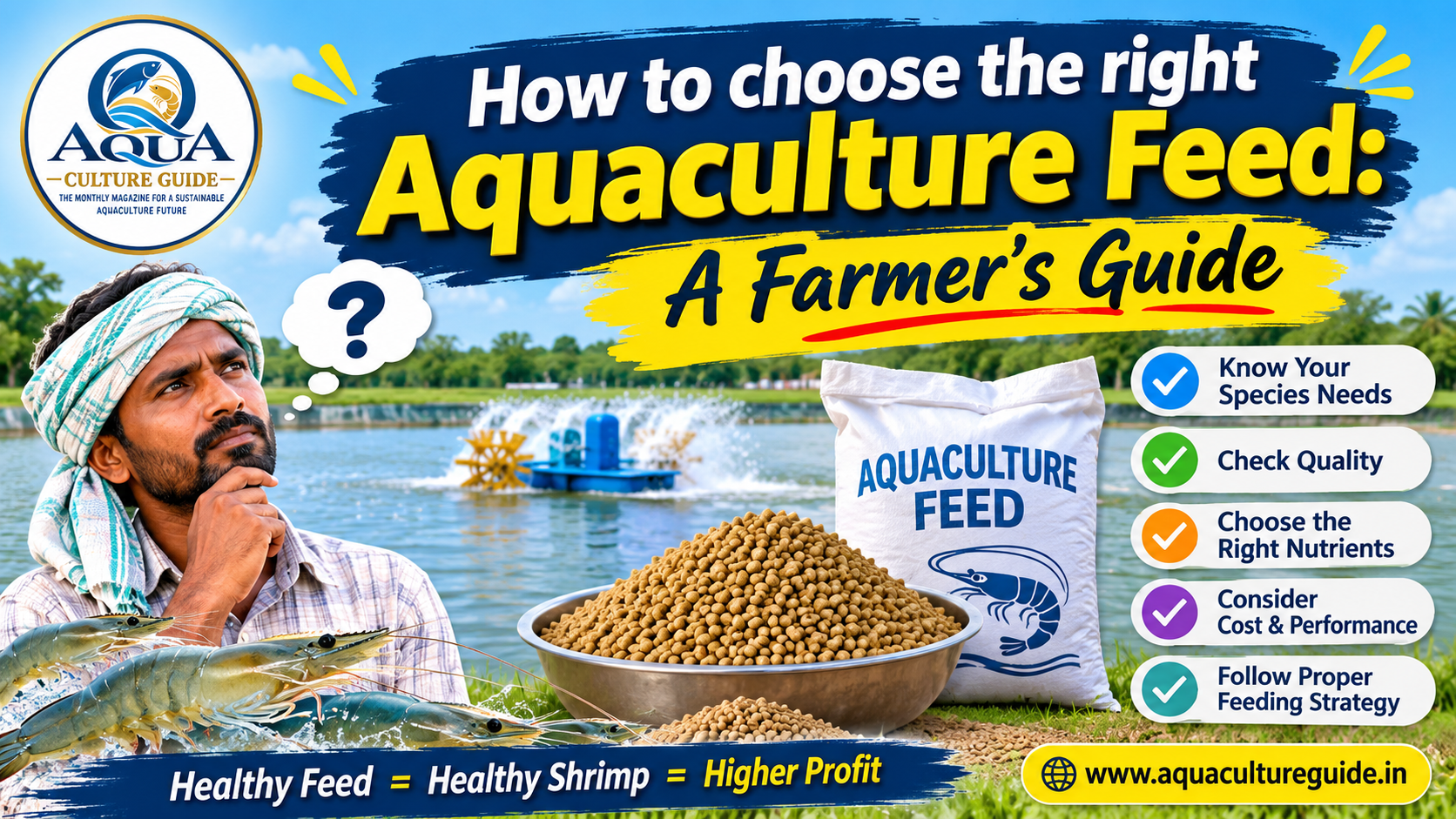
Learn how to choose the right aquaculture feed for fish and shrimp farming. Understand feed quality, protein, ingredients, pellet size, FCR, storage and feeding management with a complete checklist a
Introduction
Feed is one of the most important inputs in aquaculture. Whether a farmer is raising shrimp, tilapia, pangasius, catfish or other farmed fish, the quality and suitability of feed directly influence growth, health, survival and production costs.
In many aquaculture farms, feed is one of the largest operating expenses. Choosing feed only because it is cheaper or contains a higher protein percentage can lead to poor results. Farmers must also consider the cultured species, size of the animals, feed ingredients, digestibility, pellet quality, nutritional balance and feeding response.
The right feed should meet the nutritional requirements of the cultured species at its current growth stage. It should also remain stable in water for an appropriate period, be easy for the animals to consume and support efficient feed utilisation.
Why Is Choosing the Right Aquaculture Feed Important?
Feed provides the nutrients required for growth, energy, body maintenance and normal biological functions.
Selecting suitable feed can help farmers:
Support healthy growth.
Improve feed utilisation.
Maintain suitable body condition.
Support survival and production.
Reduce unnecessary feed waste.
Improve feed conversion ratio (FCR).
Manage overall production costs.
Maintain better pond or tank water quality.
Poor-quality or unsuitable feed may result in slow growth, poor feeding response, increased waste and higher production costs.
Important: Good feed alone cannot guarantee good production. Water quality, seed quality, stocking density, animal health and farm management also influence the final results.
Understand the Nutritional Requirements of Your Species
Different aquatic species have different nutritional requirements. Farmers should select feed according to the species being cultured.
A. Shrimp Feed
Shrimp require a balanced diet containing protein, lipids, carbohydrates, vitamins and minerals.
When selecting shrimp feed, consider:
Shrimp species.
Shrimp size and growth stage.
Protein and lipid levels.
Amino acid balance.
Pellet size.
Water stability.
Feed attractability and palatability.
Digestibility.
Feed requirements may change as shrimp grow.
B. Fish Feed
Fish feed requirements vary according to species, feeding behaviour, growth stage and culture system
For example:
Tilapia feed should suit the fish's size and production system.
Pangasius feed should meet its growth and nutritional requirements.
Catfish feed should suit its feeding behaviour and life stage.
Carp feed should be selected according to species composition and culture practices.
Do not use the same feed for every fish species without checking its nutritional suitability.
Check the Protein Content of Aquaculture Feed
Protein is essential for growth, tissue development and normal body functions.
However, higher protein does not automatically mean better feed.
Farmers should select protein levels based on:
Species.
Body size.
Growth stage.
Feeding behaviour.
Culture system.
Overall nutritional balance.
What Should Farmers Know About Protein?
Protein is made up of amino acids. Aquatic animals need the right balance of essential amino acids, not simply a high total protein percentage.
A feed with high crude protein but poor amino acid balance or low digestibility may not produce the expected results.
Check the feed label and ask the manufacturer for the recommended protein level for your species and growth stage.
Understand Other Important Feed Nutrients
Protein is important, but it is only one part of a balanced diet.
A. Lipids (Fats)
Lipids provide concentrated energy and essential fatty acids.
They also support cell structure and other important body functions.
B. Carbohydrates
Carbohydrates provide energy. The ability to use carbohydrates varies among aquatic species.
C. Vitamins
Vitamins support normal metabolism, immunity and body functions.
D. Minerals
Minerals are required for growth, skeletal development, enzyme activity and other physiological functions.
E. Essential Amino Acids
Essential amino acids must be supplied through the diet in suitable amounts and proportions.
F. Fatty Acids
Certain fatty acids are important for growth, health and normal development.
Farmer's tip: Do not compare two feeds based on protein percentage alone. Check the complete nutritional profile and the manufacturer's species-specific feeding recommendations.
Check Feed Ingredients and Raw Material Quality
Feed ingredients influence nutritional value, digestibility and consistency.
Common aquaculture feed ingredients include:
Fish meal.
Soybean meal.
Groundnut cake and other plant protein sources.
Wheat flour.
Corn and other energy sources.
Fish oil and vegetable oils.
Vitamins and mineral premixes
Amino acids.
Other approved functional ingredients.
The ingredient combination varies depending on species, feed type and manufacturer.
What Should Farmers Check?
Is the feed designed for the cultured species?
Does it provide a balanced nutritional profile?
Is the ingredient information available?
Does the manufacturer provide quality specifications?
Is the feed consistent between batches?
Is the product from a reliable manufacturer?
Farmers should not judge feed quality only by its colour or smell. Laboratory testing and feeding performance provide more reliable information.
Select the Correct Pellet Size
Pellet size is important because the animals must be able to consume the feed comfortably.
Why Does Pellet Size Matter?
If pellets are too large:
Small shrimp or fish may struggle to consume them.
Feed consumption may decrease.
Uneaten feed may accumulate.
If pellets are too small:
Larger animals may need more feeding activity to consume the required quantity.
Fine particles may be lost into the water.
Feed Size Selection
Choose pellet size according to:
Shrimp or fish body size.
Mouth size.
Feeding behaviour.
Growth stage.
Manufacturer recommendations.
Check pellet size and consistency before purchasing a new feed.
Check Pellet Quality and Water Stability
Pellet quality affects feed handling, consumption and waste generation.
Important Feed Quality Characteristics
Pellet durability: Pellets should maintain their physical form during handling and storage.
Water stability: Feed should remain stable in water for an appropriate feeding period.
Low dust and fines: Excessive broken particles and dust may indicate poor handling or physical quality.
Uniform size: Pellets should have consistent size and shape.
Freshness: Feed should not have a rancid smell, mould or signs of moisture damage.
Why Is Water Stability Important?
Feed that breaks apart too quickly may release nutrients into the water before animals consume it.
This can increase organic loading and reduce feed utilisation.
However, the required water stability depends on the species, feeding method and feeding behaviour. Shrimp and different fish species may require different pellet characteristics.
Understand Feed Conversion Ratio (FCR)
Feed Conversion Ratio is an important measurement used to evaluate feed utilisation.
It indicates how much feed is used to produce a unit of animal weight gain.
Basic formula:
FCR = Total feed used (kg) ÷ Total biomass gain (kg)
Example
Suppose a farm uses 1,000 kg of feed and records 800 kg of biomass gain.
FCR = 1,000 ÷ 800
FCR = 1.25
This means 1.25 kg of feed was used for every 1 kg of biomass gain.
Why Should Farmers Monitor FCR?
Helps evaluate feed utilisation.
Supports feed cost management.
Helps identify feeding problems.
Allows comparison between culture cycles.
Helps identify possible feed wastage.
Important: FCR is influenced by survival, stocking quality, animal health, water quality, biomass measurement and the calculation method. Compare results only when the same method and production period are used.
Compare Feed Price and Actual Feeding Cost
The cheapest feed is not always the most economical option.
Farmers should compare the total feed cost with the feed performance achieved.
Example
Imagine two feed options:
Feed A costs ₹80 per kg and has an FCR of 1.5.
Feed B costs ₹90 per kg and has an FCR of 1.3
Estimated feed cost per kg of biomass gain:
Feed A: ₹80 × 1.5 = ₹120
Feed B: ₹90 × 1.3 = ₹117
In this example, Feed B costs more per kg but has a lower estimated feed cost per kg of biomass gain.
These are illustrative figures, not guaranteed feed performance results. Actual FCR should be measured under comparable farm conditions.
Check Feed Manufacturing and Expiry Details
Before purchasing feed, carefully check the packaging.
Look for:
Manufacturer name.
Product name and feed type.
Species and growth-stage recommendation.
Batch or lot number.
Manufacturing date.
Expiry date or best-before information.
Nutritional composition.
Storage instructions.
Recommended feeding guidelines.
Manufacturer contact details.
Avoid purchasing damaged, wet, mouldy or improperly stored feed.
Buy from authorised dealers or reliable suppliers whenever possible.
- How to Store Aquaculture Feed Properly
Even good-quality feed can lose quality if it is stored incorrectly.
Feed Storage Best Practices
Store feed in a cool and dry place.
Keep bags away from direct sunlight.
Protect feed from rain and moisture.
Store bags above the floor on pallets.
Keep bags away from walls where moisture may collect.
Maintain good ventilation.
Protect feed from rodents and insects.
Separate old and new stock.
Follow first-in, first-out (FIFO) stock rotation.
Keep damaged bags separate.
Never use feed that shows mould growth, moisture damage, rancid odour or unusual contamination.
Common Mistakes Farmers Should Avoid When Choosing Feed
Selecting feed only because it is cheap.
Choosing feed based only on protein percentage.
Using the same pellet size for all growth stages.
Ignoring species-specific nutritional requirements.
Buying feed without checking manufacturing and expiry details.
Purchasing from unreliable suppliers.
Ignoring water stability and pellet quality.
Storing feed in damp conditions.
Changing feed brands suddenly without monitoring performance.
Overfeeding without checking feeding response.
Ignoring FCR and feed cost records.
Assuming that expensive feed always produces better results.
Complete Checklist Before Buying Aquaculture Feed
Use this checkist before selecting or purchasing feed.
A. Species and Growth Stage
Identify the cultured species.
Check the current body weight or growth stage.
Confirm the feed is designed for the species.
Check the recommended pellet size.
Review the manufacturer's feeding instructions.
Confirm suitability for the culture system.
B. Nutritional Quality
Check crude protein percentage.
Check lipid or fat content.
Review carbohydrate information where available.
Check vitamin and mineral information.
Review essential amino acid balance where available.
Check digestibility information.
Compare the complete nutritional profile.
C. Physical Feed Quality
Check pellet size and uniformity.
Check pellet durability.
Check water stability.
Look for excessive dust and broken pellets.
Check freshness.
Reject feed with mould or rancid smell.
D. Packaging and Supplier
Check manufacturer details.
Check batch number.
Check manufacturing date.
Check expiry or best-before date.
Check packaging condition.
Buy from a reliable supplier.
Request product specifications when necessary.
E. Cost and Performance
Compare price per kg.
Review expected feed performance.
Calculate feed cost per kg of biomass gain.
Compare FCR using reliable farm records.
Consider availability and supply consistency.
Evaluate overall production cost.
F. Storage and Management
Check available storage facilities.
Keep feed dry and protected.
Store bags above the floor.
Follow FIFO stock rotation.
Maintain feed stock records.
Monitor feeding response after purchase.
Step-by-Step Guide to Choosing the Right Aquaculture Feed
Step 1: Identify Your Cultured Species
First, identify whether you are farming shrimp, tilapia, pangasius, catfish, carp or another aquatic species.
Each species has different nutritional and feeding requirements.
Step 2: Identify the Growth Stage
Check the current size and body weight of your animals.
Select starter, nursery, grower or finishing feed as appropriate.
Step 3: Check the Nutritional Requirements
Review the recommended protein, lipid, amino acid, vitamin and mineral requirements for the species and growth stage.
Ask the feed manufacturer for technical specifications if the label does not provide enough information.
Step 4: Compare Feed Ingredients
Review the ingredient information and nutritional specifications.
Do not assume that one ingredient or a higher protein percentage automatically makes a feed better.
Step 5: Check Pellet Size and Physical Quality
Inspect pellet size, uniformity, durability, freshness and water stability.
Make sure the feed is suitable for the animals' feeding behaviour.
Step 6: Verify the Manufacturer and Product Details
Check the manufacturer, batch number, manufacturing date and expiry information.
Purchase from a reliable dealer and ask for product specifications when needed.
Step 7: Compare Price and Expected Performance
Compare the price per kg and estimate feed cost per kg of biomass gain.
Use reliable farm performance data rather than promotional claims.
Step 8: Purchase a Suitable Quantity
Avoid buying more feed than can be stored properly and used within its recommended shelf life.
Check the storage space before placing a large order.
Step 9: Introduce New Feed Carefully
When changing feed, monitor feeding response and animal behaviour.
Follow the manufacturer's recommendations and avoid unnecessary sudden changes.
Step 10: Observe Feeding Response
Check:
How quickly feed is consumed.
Whether pellets remain uneaten.
Whether animals show normal feeding behaviour.
Whether feed particles break apart excessively.
Whether feeding trays show unusual waste.
Step 11: Adjust Feeding Quantity
Adjust feed quantity according to biomass, growth, temperature, dissolved oxygen, health condition and actual consumption.
Avoid continuing the same feeding rate when animals are not consuming feed normally.
Step 12: Maintain Farm Records
Record:
Feed brand and type.
Batch number.
Feed quantity used.
Daily feeding schedule.
Animal sampling and biomass estimates.
Feed consumption.
Survival.
Growth.
FCR.
Feed cost.
Review the records regularly to understand which feed performs best under your farm conditions.
Best Practices for Better Feed Management
Choosing suitable feed is only the first step. Proper feeding management is equally important.
Use feed suitable for the species and growth stage.
Follow the manufacturer's feeding recommendations as a starting point.
Monitor feeding trays and actual consumption.
Adjust feed according to biomass and animal health.
Avoid overfeeding.
Maintain good water quality.
Store feed properly.
Monitor FCR throughout the culture cycle.
Compare feed performance across production cycles.
Consult a qualified aquaculture nutritionist when nutritional problems are suspected.
Conclusion
Choosing the right aquaculture feed is an important decision for every fish and shrimp farmer. The right feed should match the cultured species, growth stage, nutritional requirements and farm conditions
Farmers should look beyond protein percentage and price. Pellet size, digestibility, ingredient quality, water stability, freshness, manufacturer reliability and actual farm performance are also important.
Regular feeding observations and FCR records help farmers understand whether the selected feed is delivering good results.
The best aquaculture feed is not simply the cheapest or the one with the highest protein. It is the feed that meets the animals' nutritional needs and delivers reliable performance at a suitable overall cost.
Questions & Answers
Q1.How do I choose the right aquaculture feed?
Select feed according to species, growth stage, nutritional requirements, pellet size, physical quality, freshness and farm performance.
Q2.Is high-protein feed always better?
No. Protein quality, amino acid balance, digestibility and the overall nutritional profile are also important.
Q3.What is FCR in aquaculture?
FCR means Feed Conversion Ratio. It measures the amount of feed used to produce a unit of biomass gain
Q4.How can I calculate FCR?
Divide the total feed used during a production period by the total biomass gain during the same period.
Q5.Why is pellet size important in aquaculture feed?
Pellet size should match the animal's body size and feeding behaviour. Incorrect pellet size can reduce feed consumption and increase wastage.
Q6.What is water stability in aquaculture feed?
Water stability describes how well feed pellets maintain their physical form after entering water. Suitable stability helps reduce premature breakdown and nutrient loss.
Q7.How should aquaculture feed be stored?
Store feed in a cool, dry, well-ventilated place, away from sunlight and moisture. Keep bags above the floor and follow FIFO stock rotation.
Q8.Can farmers change feed brands during the culture cycle?
Yes, when necessary, but the change should be managed carefully. Monitor feed acceptance, animal behaviour and growth after introducing the new feed.
Related articles
భారతీయ రిజర్వాయర్లలో కేజ్ ఫిష్ ఫార్మింగ్: సాంకేతికత, అనుమతులు మరియు పెట్టుబడి వివరాలు
భారతదేశంలోని రిజర్వాయర్లలో కేజ్ ఫిష్ ఫార్మింగ్ ఎలా ప్రారంభించాలి? అవసరమైన సాంకేతికత, ప్రభుత్వ అనుమతులు, పెట్టుబడి, చేపల జాతులు, మేత నిర్వహణ మరియు లాభనష్టాల గురించి పూర్తి వివరాలు తెలుసుకోండి.
Freshwater Prawn Farming in IndiaFreshwater Prawn Farming in India: రైతులకు పూర్తి సాగు మార్గదర్శిని
భారతదేశంలో మంచినీటి రొయ్యల సాగు ఎలా ప్రారంభించాలి? జెయింట్ ఫ్రెష్వాటర్ ప్రాన్ సీడ్ ఎంపిక, చెరువు తయారీ, స్టాకింగ్, ఆహారం, నీటి నాణ్యత, పెట్టుబడి, మార్కెటింగ్ గురించి పూర్తి వివరాలు తెలుసుకోండి.
Tilapia farming in Indiaభారతదేశంలో తిలాపియా చేపల పెంపకం – మార్కెట్ అవకాశాలు, ప్రభుత్వ నిబంధనలు మరియు ఆధునిక సాగు పద్ధతులు
భారతదేశంలో తిలాపియా చేపల పెంపకం ఎలా చేయాలి? మార్కెట్ అవకాశాలు, ప్రభుత్వ అనుమతులు, చెరువు సాగు, బయోఫ్లాక్, RAS విధానాలు, పిల్లల ఎంపిక, మేత నిర్వహణ మరియు దిగుబడి గురించి పూర్తి సమాచారం.
PCR Testing in Shrimp Hatcheriesరొయ్యల హ్యాచరీల్లో PCR పరీక్షలు: ఫలితాలను రైతులు ఎలా అర్థం చేసుకోవాలి?
WSSV, EHP, AHPND వంటి వ్యాధికారకాలను గుర్తించడంలో PCR పరీక్షల పాత్ర, పరీక్షా నివేదికలను అర్థం చేసుకోవడం, నాణ్యమైన రొయ్య పిల్లలను ఎంపిక చేసుకోవడం గురించి రైతులు తెలుసుకోవాల్సిన పూర్తి సమాచారం.
Explore Aqua Culture Guide
Aqua companies directory
Feed, seed, probiotics & equipment suppliers
Aquaculture calculators
Feed, FCR, stocking & water quality tools
Telugu aqua magazine
Read the latest monthly issue online
All aqua news & articles
Farming, disease control and market updates
List your company free
Get found by farmers across India
Advertise with us
Magazine and website advertising options