
How to Calculate Shrimp Biomass Accurately During Culture
8/10/2026
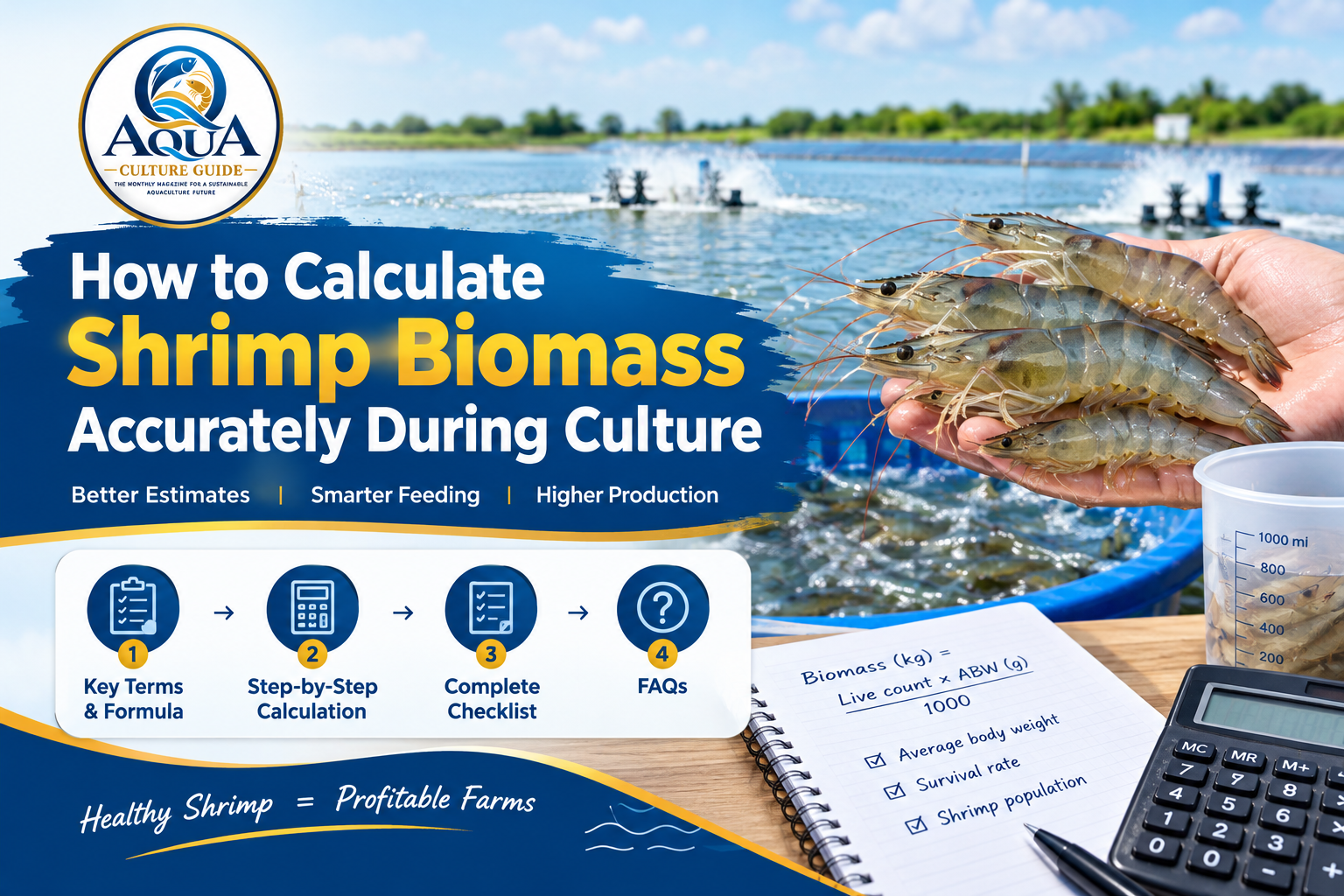
Learn how to calculate shrimp biomass accurately using average body weight, survival rate and shrimp population, with formulas, examples and a practical farm checklist.
How to Calculate Shrimp Biomass Accurately During Culture
Introduction
Accurate shrimp biomass calculation is one of the most important activities in successful shrimp farming. Whether you are farming Litopenaeus vannamei (Pacific white shrimp) or another shrimp species, knowing the estimated total weight of shrimp in your pond helps you make better feeding, water-quality management and harvest decisions.
Many farmers calculate feed based only on the age of the shrimp or the amount of feed given the previous day. However, shrimp growth, survival rate, stocking density and environmental conditions change throughout the culture period.
If biomass is overestimated, farmers may provide excess feed, increasing feed costs and organic waste. If biomass is underestimated, shrimp may receive insufficient feed, resulting in uneven growth and reduced production.
The goal is to estimate the actual standing shrimp biomass as accurately as possible and update the estimate regularly using sampling and survival information.
What Is Shrimp Biomass?
Shrimp biomass is the estimated total live weight of all shrimp currently present in a culture pond at a particular time.
It is usually expressed in kilograms (kg) or tonnes.
For example, if a pond contains an estimated 50,000 live shrimp with an average body weight of 15 grams, the estimated standing biomass is 750 kg.
Why Is Biomass Calculation Important?
Accurate biomass estimation helps farmers to:
Calculate daily feed requirements more appropriately.
Monitor shrimp growth and feed conversion ratio (FCR).
Estimate standing crop and potential harvest production.
Evaluate survival rate and changes in shrimp population.
Adjust feeding when growth, appetite or water quality changes.
Plan aeration capacity and monitor pond carrying capacity.
Identify possible growth problems early.
Improve farm records and production planning.
Important Terms Used in Shrimp Biomass Calculation
Before calculating biomass, understand these five terms.
Term: Stocked PLs
Meaning: Total post-larvae released into the pond
Term: Survival rate (%)
Meaning: Estimated percentage of stocked shrimp still alive
Term: ABW (g)
Meaning: Average body weight of sampled shrimp in grams
Term: Population
Meaning: Estimated number of live shrimp in the pond
Term: Standing biomass (kg)
Meaning: Total estimated live weight of shrimp in the pond
Shrimp Biomass Calculation Formula
The basic formula is:
Biomass (kg)=Live shrimp count×ABW (g)/1000
To estimate the live shrimp count:
Live shrimp count= Stocked PLs × Survival rate (%)/100
Combining both formulas:
Biomass (kg)= Stocked PLs × Survival (%)×ABW (g)/100, 000
This combined formula uses survival rate as a percentage, such as 75 rather than 0.75.
Important: Survival rate during culture is generally an estimate unless the population has been measured reliably. The formula is only as accurate as the survival estimate and the body-weight sample.
Step-by-Step Example: Calculate Biomass in a Vannamei Shrimp Pond
Consider a hypothetical shrimp farm with the following details.
Sample pond data
Initial stocking - 100,000 PLs
Estimated survival rate - 75%
Average body weight - 18 g
Step 1 — Estimate the live population
100,000×75/100 =75,000
Step 2 — Calculate total weight in grams
75,000×18=1,350,000 g
Step 3 — Convert grams to kilograms
1,350,000÷1,000=1,350 kg
Estimated standing biomass
1,350 kg
Equivalent to 1.35 tonnes of live shrimp.
How to Calculate Average Body Weight (ABW)
Average body weight is a key input in biomass calculation.
Use the following formula:
ABW (g)= Total sample weight (g)/Number of shrimp sampled
Example
Suppose you collect 100 shrimp from representative areas of the pond.
Total weight of 100 shrimp: 1,800 g
Number of shrimp sampled: 100
Therefore:
ABW=1800/100=18 g
The average body weight is 18 grams per shrimp.
Best practices for ABW sampling
Collect shrimp using a suitable cast net or other consistent sampling method.
Sample several areas of the pond rather than relying only on feeding points.
Avoid selecting only large, active shrimp.
Count the shrimp and weigh the entire sample using a calibrated weighing scale.
Repeat sampling when results differ substantially between locations.
Record the sampling date, culture day, sample count and ABW.
Return healthy sampled shrimp to the pond carefully, following farm biosecurity practices.
How to Estimate Shrimp Survival Rate During Culture
Survival rate is the estimated percentage of shrimp that remain alive compared with the number initially stocked.
The formula is:
Survival rate (%)= Estimated live shrimp count/Initial stocked PLs×100
For example, if 100,000 PLs were stocked and the estimated live population is 75,000:
75,000/100,000×100=75%
The estimated survival rate is 75%.
How can farmers estimate survival during culture?
Review stocking records and confirm the number of PLs actually released.
Track known mortality events and any shrimp removed from the pond.
Use consistent sampling and population-estimation methods where feasible.
Compare estimated biomass with average body weight and feeding trends.
At harvest, compare the actual harvested count (estimated from harvested weight and harvest ABW) with the original stocked count.
Important: Do not automatically assume that survival is 80% or 90% simply because the crop looks healthy. Unverified survival assumptions can produce significant biomass and feed-calculation errors.
How to Calculate Daily Shrimp Feed Based on Biomass
Once you estimate standing biomass, you can calculate an initial feed allowance using an appropriate feeding rate.
The basic formula is:
Daily feed (kg)=Biomass (kg)×Feeding rate (%)/100
Example
Suppose:
Estimated biomass = 1,350 kg
Feeding rate selected for this example = 2.5% of biomass per day
Then:
1,350×2.5/100=33.75 kg/day
The calculated starting feed allowance is 33.75 kg per day.
How to adjust feeding after tray observations
If feed is consumed well and shrimp show normal activity, continue evaluating the current ration against the farm feeding plan.
If significant feed remains, investigate appetite, water quality, disease, moulting and feed distribution before increasing the ration.
If shrimp show reduced feeding activity, check dissolved oxygen and other water-quality parameters promptly.
Avoid increasing feed automatically just because the calculated biomass has increased.
Alternative Biomass Estimation Using Feed Consumption
Where survival is difficult to estimate, recent feed consumption can provide a useful cross-check on the biomass estimate. However, this method relies on knowing a realistic feeding rate and assumes the feed-consumption records are reliable.
The approximate formula is:
Estimated biomass (kg)=Daily feed (kg)/Feeding rate as a decimal
For example, if the recent daily feed consumption is 30 kg and the assumed feeding rate is 0.025:
30÷0.025=1,200 kg
Complete Shrimp Biomass Calculation Checklist
Use this checklist during routine pond management.
Farm technician's checklist
Confirm the pond area and initial PL stocking count.
Record the date and days of culture (DOC).
Collect a representative shrimp sample from several pond locations.
Count all shrimp in the sample and weigh them accurately.
Calculate the current average body weight (ABW).
Review mortality, health observations and any shrimp removals.
Estimate the current live population and survival rate.
Calculate biomass in kilograms using consistent units.
Compare the result with recent biomass and growth records.
Calculate the initial daily feed allowance using an appropriate feeding rate.
Review feeding trays, appetite and water-quality conditions.
Record the calculation and schedule the next sampling
Simple Biomass Record Format for Shrimp Farmers
Maintain a record for every pond so that biomass estimates can be compared over time.
Date DOC ABW (g) Estimated survival (%) Biomass (kg) Feed (kg/day)
Day 30 30 5 85 425
Day 45 45 9 80 720
Day 60 60 14 76 1,064
Conclusion
Accurate shrimp biomass calculation is essential for effective feed management, growth monitoring and production planning. By measuring average body weight, estimating survival and using the correct formula, shrimp farmers can make more informed management decisions.
For better results, combine regular sampling with mortality records, feeding-tray observations and water-quality monitoring. Review estimates regularly instead of relying on the initial stocking count or a fixed survival assumption.
Remember: Biomass calculation is an estimation tool. The best results come from consistent sampling, reliable farm records and feeding adjustments based on actual shrimp performance.
Questions & Answers
Q1.What is the formula for shrimp biomass calculation?
The formula is: Biomass (kg) = Live shrimp count × Average body weight (g) ÷ 1,000. Use the estimated number of live shrimp, not the initial stocked PL count, unless you are calculating an initial or theoretical biomass.
Q2.How do I calculate shrimp biomass per acre?
First, calculate the total biomass in the pond using live shrimp count and ABW. If you want biomass per acre, divide the total biomass by the pond area in acres. For example, if a 2-acre pond has an estimated biomass of 1,600 kg: 1,600÷2=800 kg/acre The estimated biomass is 800 kg per acre.
Q3.How often should shrimp biomass be calculated?
A practical approach is to sample shrimp weekly or fortnightly, depending on the culture system and farm conditions. Recalculate whenever there is a significant mortality event, partial harvest or major change in growth or feeding behaviour.
Q4.Can I calculate biomass without knowing survival rate?
You can calculate a provisional estimate using feed-consumption trends and a suitable feeding-rate assumption. However, this does not independently verify the actual shrimp population. For a more reliable estimate, combine ABW sampling, survival assessment and feed records.
Q5.What is ABW in shrimp farming?
ABW stands for Average Body Weight. It is the average weight of individual shrimp in a sample and is usually expressed in grams.
Q6.Does biomass increase every day?
Biomass can increase as surviving shrimp grow, but total standing biomass can decrease because of mortality, partial harvesting or shrimp removal. Do not assume biomass always increases.
Related articles
భారతీయ రిజర్వాయర్లలో కేజ్ ఫిష్ ఫార్మింగ్: సాంకేతికత, అనుమతులు మరియు పెట్టుబడి వివరాలు
భారతదేశంలోని రిజర్వాయర్లలో కేజ్ ఫిష్ ఫార్మింగ్ ఎలా ప్రారంభించాలి? అవసరమైన సాంకేతికత, ప్రభుత్వ అనుమతులు, పెట్టుబడి, చేపల జాతులు, మేత నిర్వహణ మరియు లాభనష్టాల గురించి పూర్తి వివరాలు తెలుసుకోండి.
Freshwater Prawn Farming in IndiaFreshwater Prawn Farming in India: రైతులకు పూర్తి సాగు మార్గదర్శిని
భారతదేశంలో మంచినీటి రొయ్యల సాగు ఎలా ప్రారంభించాలి? జెయింట్ ఫ్రెష్వాటర్ ప్రాన్ సీడ్ ఎంపిక, చెరువు తయారీ, స్టాకింగ్, ఆహారం, నీటి నాణ్యత, పెట్టుబడి, మార్కెటింగ్ గురించి పూర్తి వివరాలు తెలుసుకోండి.
Tilapia farming in Indiaభారతదేశంలో తిలాపియా చేపల పెంపకం – మార్కెట్ అవకాశాలు, ప్రభుత్వ నిబంధనలు మరియు ఆధునిక సాగు పద్ధతులు
భారతదేశంలో తిలాపియా చేపల పెంపకం ఎలా చేయాలి? మార్కెట్ అవకాశాలు, ప్రభుత్వ అనుమతులు, చెరువు సాగు, బయోఫ్లాక్, RAS విధానాలు, పిల్లల ఎంపిక, మేత నిర్వహణ మరియు దిగుబడి గురించి పూర్తి సమాచారం.
PCR Testing in Shrimp Hatcheriesరొయ్యల హ్యాచరీల్లో PCR పరీక్షలు: ఫలితాలను రైతులు ఎలా అర్థం చేసుకోవాలి?
WSSV, EHP, AHPND వంటి వ్యాధికారకాలను గుర్తించడంలో PCR పరీక్షల పాత్ర, పరీక్షా నివేదికలను అర్థం చేసుకోవడం, నాణ్యమైన రొయ్య పిల్లలను ఎంపిక చేసుకోవడం గురించి రైతులు తెలుసుకోవాల్సిన పూర్తి సమాచారం.
Explore Aqua Culture Guide
Aqua companies directory
Feed, seed, probiotics & equipment suppliers
Aquaculture calculators
Feed, FCR, stocking & water quality tools
Telugu aqua magazine
Read the latest monthly issue online
All aqua news & articles
Farming, disease control and market updates
List your company free
Get found by farmers across India
Advertise with us
Magazine and website advertising options