Healthy vs Stressed Shrimp: A Simple Guide for Farmers
7/10/2026
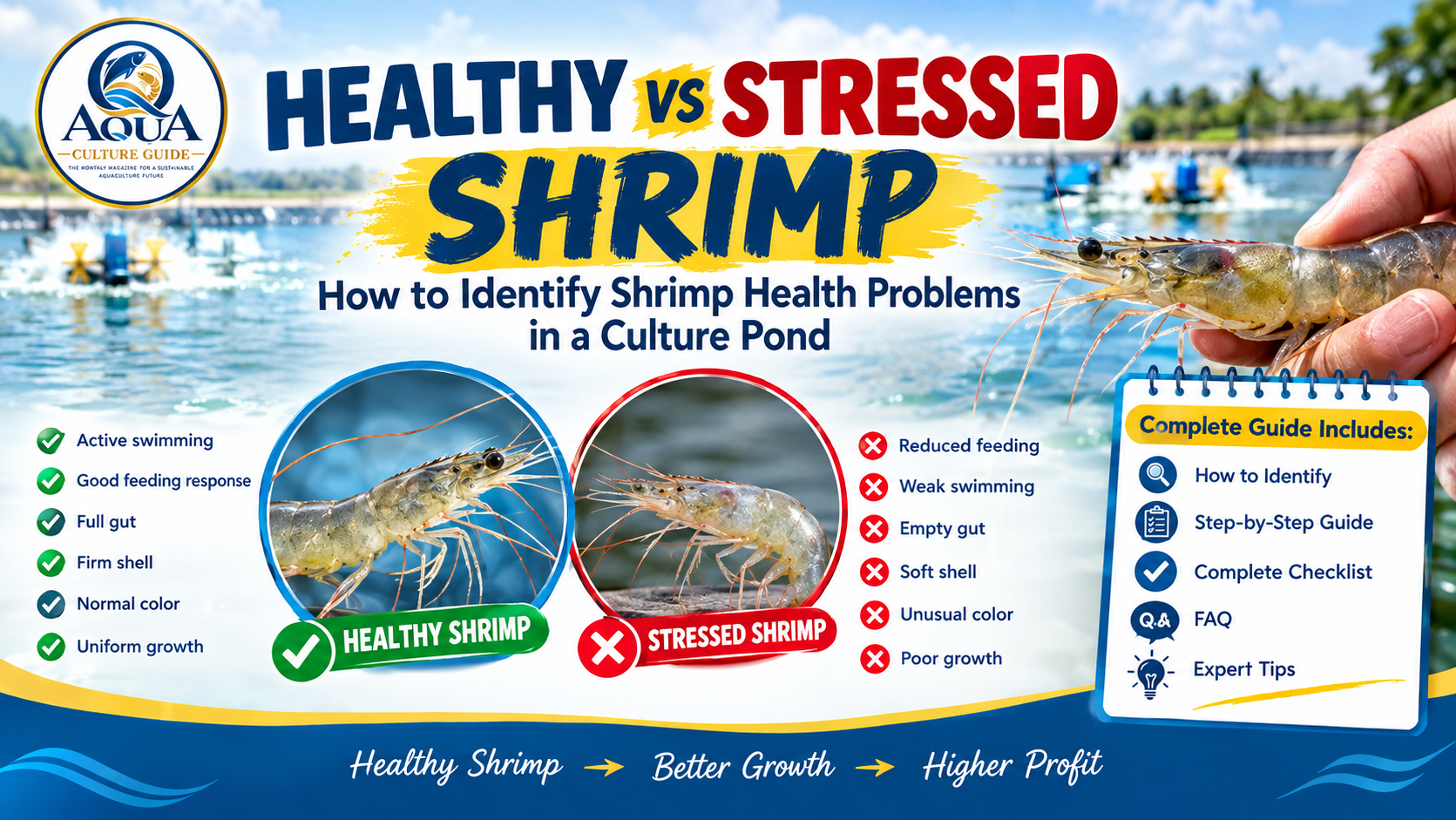
Follow this simple step-by-step guide and checklist covering feeding, swimming, gut, shell, color, growth, water quality and early warning signs.
Healthy vs Stressed Shrimp: How to Identify Shrimp Health Problems in a Culture Pond
In shrimp farming, early observation can make a major difference. Before serious mortality occurs, shrimp may show small changes in feeding, swimming, appearance, growth or behavior.
Learning to recognize the difference between healthy shrimp and stressed shrimp helps farmers respond earlier and investigate possible problems.
However, one symptom alone does not always indicate a disease. Shrimp behavior can change because of water-quality fluctuations, weather, handling, nutrition, stocking density, environmental stress or infectious diseases.
What Does a Healthy Shrimp Look Like?
Healthy shrimp generally show:
Active and normal swimming
Good response to feed
Strong feeding activity
Good body condition
Normal coloration for the species and culture conditions
A reasonably full gut after feeding
Normal molting activity
Firm and intact shell
Good growth and reasonably uniform size
No obvious lesions or unusual discoloration
Normal response to environmental conditions
The most important point is consistency.
What Does a Stressed Shrimp Look Like?
Stressed shrimp may show one or more of the following:
Reduced feeding
Weak or unusual swimming
Swimming near pond edges or surface
Reduced activity
Empty gut
Unusual coloration
Soft shell or incomplete molt
Poor growth
Uneven size
Visible lesions or abnormalities
Increased mortality
Changes in feeding-tray observations
These signs are warning signals, not a diagnosis.
Healthy vs Stressed Shrimp: Quick Comparison
Observation Healthy Shrimp Stressed Shrimp
Swimming Active and normal Weak, unusual or erratic
Feeding Good response Reduced or inconsistent
Gut Generally filled after feeding Often empty or less filled
Body condition Good and active Weak or abnormal
Shell Firm and intact Soft, damaged or abnormal
Color Normal for conditions Unusual color may appear
Growth Regular growth Slow or uneven growth
Mortality Normal/low Increasing or unusual
Behavior Responsive Less responsive
Ponddistribution Normal Unusual aggregation or edge behavior
Step-by-Step Guide to Check Shrimp Health
Step 1: Observe the Pond Before Feeding
Do not immediately depend only on the feeding tray.
Spend a few minutes observing the pond.
Look for:
☐ Normal shrimp activity
☐ Surface swimming
☐ Edge swimming
☐ Unusual aggregation
☐ Dead shrimp
☐ Weak shrimp
☐ Unusual water movement
☐ Changes in water appearance
Step 2: Check Feeding Behavior
Feeding response is one of the most useful routine indicators of shrimp condition.
Compare today's feeding behavior with previous days.
Healthy shrimp
Respond actively to feed.
Show consistent feeding behavior.
Maintain expected feed consumption.
Possible stress
Feed consumption suddenly decreases.
Shrimp take longer to reach feeding areas.
Feed remains uneaten.
Feeding response becomes irregular.
Important:
A feeding reduction does not automatically mean disease.
Step 3: Check the Feeding Tray
Feeding trays can provide useful information about shrimp activity.
Check:
Amount of feed remaining
Shrimp activity around the tray
Gut fullness
Presence of unusual shrimp
Dead or weak shrimp
Feed consumption pattern
Simple rule:
Compare today's tray observation with the farm's normal pattern.
Step 4: Check Shrimp Swimming Behavior
Healthy shrimp should generally show active, coordinated movement.
Watch for:
Slow movement
Erratic swimming
Weak swimming
Surface activity
Edge swimming
Unusual congregation
Reduced response when disturbed
If unusual swimming is observed, check dissolved oxygen and other water-quality parameters immediately.
Step 5: Check Shrimp Appearance
When practical, collect a few representative shrimp for closer observation.
Look at:
Shell
Healthy:
Firm and intact
No obvious damage
Warning signs:
Excessive softness
Damage
Abnormal appearance
Difficult or incomplete molting
Body
Look for:
Unusual discoloration
Lesions
Damage
Abnormal spots
Poor body condition
Step 6: Check the Gut
Gut observation can provide useful information about feeding activity.
Healthy shrimp
A recently fed shrimp generally has visible food in the digestive tract.
Possible stress
A consistently empty gut, particularly together with reduced feeding and abnormal behavior, can be a warning sign.
However, gut fullness changes naturally depending on when the shrimp last fed.
Step 7: Check the Hepatopancreas Carefully
The hepatopancreas is an important organ associated with digestion and metabolism.
Farmers may observe changes in:
Size
Color
General appearance
But visual inspection alone cannot reliably diagnose a specific disease.
Step 8: Monitor Growth
Regular sampling helps farmers understand whether shrimp are growing as expected.
Check:
☐ Average body weight
☐ Size distribution
☐ Growth trend
☐ Survival estimates
☐ Feed consumption
☐ Biomass estimates
Healthy pond
Growth is generally progressing according to the farm's production targets.
Possible problem
Growth slows unexpectedly.
Size variation becomes unusually large.
Feed consumption does not match expected biomass.
Survival appears to decline.
Poor growth can have many causes, so investigate nutrition, stocking density, water quality, feed management and disease rather than assuming one cause.
Step 9: Check Mortality
Mortality is one of the most important warning signs.
Normal situation
A farm should have a known baseline for mortality.
Warning situation
Investigate when there is:
Sudden increase in mortality
Unexplained mortality
Increasing daily mortality
Dead shrimp appearing repeatedly
Mortality combined with feeding reduction
If mortality is increasing, do not wait until the problem becomes severe before investigating.
Step 10: Check Water Quality
Shrimp can become stressed when environmental conditions move outside the suitable range for the culture system.
Important parameters include:
Dissolved oxygen
Temperature
pH
Salinity
Alkalinity
Ammonia
Nitrite
When shrimp suddenly behave abnormally, check water quality before assuming that the problem is an infectious disease.
Step 11: Look for Multiple Warning Signs
One sign may not tell you much.
Several signs occurring together are more concerning.
Example:
Reduced feeding + weak swimming + empty gut + increasing mortality
➡ Requires immediate investigation.
Another example:
Reduced feeding + sudden weather change + abnormal dissolved oxygen
➡ Environmental stress should be investigated.
Step 12: Take Action Based on the Findings
After identifying unusual shrimp behavior:
First
Check water quality.
Second
Review feeding and recent farm-management changes.
Third
Increase observation of the affected pond.
Fourth
If symptoms continue or mortality increases:
Contact an appropriate aquatic animal-health professional or diagnostic laboratory.
Complete Shrimp Health Monitoring Checklist
Daily Pond Observation
☐ Observe shrimp activity
☐ Check surface behavior
☐ Check pond edges
☐ Look for unusual aggregation
☐ Look for dead shrimp
☐ Check aeration
☐ Observe water appearance
Feeding Checklist
☐ Record feed quantity
☐ Check feeding response
☐ Inspect feeding trays
☐ Check remaining feed
☐ Observe gut fullness
☐ Compare with previous days
Shrimp Appearance Checklist
☐ Body condition
☐ Shell condition
☐ Color
☐ Lesions
☐ Appendages
☐ Gut
☐ Hepatopancreas appearance
☐ Molting condition
Growth Checklist
☐ Record body weight
☐ Monitor average growth
☐ Check size variation
☐ Estimate survival
☐ Review biomass
☐ Compare feed consumption with growth
Water-Quality Checklist
☐ Dissolved oxygen
☐ Temperature
☐ pH
☐ Salinity
☐ Alkalinity
☐ Ammonia
☐ Nitrite
Early Warning Signs Farmers Should Never Ignore
🟡 Monitor Closely
Slight reduction in feeding
Small change in activity
Minor growth variation
Weather-related changes
🟠 Investigate
Continued feed reduction
Unusual swimming
Empty gut
Poor growth
Physical abnormalities
🔴 Act Quickly
Rapidly increasing mortality
Severe feeding reduction
Multiple abnormal signs appearing together
Sudden widespread behavioral changes
Unexplained mortality across the pond
What Should Farmers Do When Shrimp Become Stressed?
- Don't Panic
First identify what has changed.
- Check Water Quality
Especially dissolved oxygen and other key parameters.
- Check Feeding
Compare current consumption with the pond's normal feeding pattern.
- Observe Shrimp Again
Look for additional signs.
- Review Recent Changes
Consider:
Weather
Water exchange
Feed changes
Pond operations
Stocking history
Recent treatments
Equipment movement
- Increase Monitoring
Monitor the pond more frequently when necessary.
- Seek Professional Diagnosis
If abnormal signs continue or mortality increases, appropriate laboratory testing may be necessary.
Common Mistakes Farmers Should Avoid
Mistake 1: Assuming One Symptom Means One Disease
The same symptom can occur for different reasons.
Better approach: Look at the complete picture.
Mistake 2: Ignoring Water Quality
Poor environmental conditions can cause significant shrimp stress.
Better approach: Check water quality whenever behavior changes.
Mistake 3: Waiting for Heavy Mortality
Disease and environmental problems may develop before large numbers of shrimp die.
Better approach: Investigate early warning signs.
Mistake 4: Changing Many Things at Once
Making several management changes simultaneously can make it difficult to determine what helped or caused further problems.
Better approach: Record changes and make decisions based on evidence and professional guidance.
Mistake 5: Treating Without Diagnosis
Not every stress response is caused by a bacterial or viral disease.
Simple Daily Shrimp Health Routine
Morning
Observe → Check → Record
Shrimp activity
Pond condition
Water quality
Mortality
Feeding Time
Feed → Observe → Check Tray
Feeding response
Feed consumption
Gut fullness
Unusual shrimp
Evening
Review → Compare → Record
Compare today's observations with previous days.
If Something Changes
Check water → Observe shrimp → Investigate → Take appropriate action
Conclusion
Knowing the difference between healthy and stressed shrimp is an essential skill for every shrimp farmer.
Healthy shrimp generally show active behavior, good feeding response, normal appearance and consistent growth. Stressed shrimp may show reduced feeding, unusual swimming, poor body condition, abnormal appearance or increasing mortality.
But remember: a symptom is not automatically a diagnosis.
The best approach is to combine:
Daily observation + feeding records + shrimp sampling + water-quality monitoring + good farm management + laboratory diagnosis when necessary.
The simple rule for farmers:
Observe early. Check water quality. Compare with normal behavior. Record changes. Investigate unusual signs. Act before the problem becomes severe.
Questions & Answers
Q1.What are the signs of healthy shrimp?
Healthy shrimp generally show active swimming, good feeding response, normal body condition, intact shells, normal appearance and consistent growth.
Q2.What are the main signs of stressed shrimp?
Common warning signs include reduced feeding, unusual swimming, weak activity, empty gut, abnormal appearance, poor growth and increasing mortality.
Q3.Does reduced feeding always mean shrimp are diseased?
No. Reduced feeding can result from water-quality changes, temperature, weather, stress, feed issues or disease. The cause should be investigated.
Q4.How can farmers identify stressed shrimp early?
Daily observation of feeding, swimming, mortality, gut condition, appearance and water quality can help identify changes early.
Q5.Why is the feeding tray important?
Feeding trays help farmers monitor feed consumption and shrimp activity and can provide an early indication when feeding behavior changes.
Q6.Can healthy shrimp sometimes swim near the surface?
Yes. Surface behavior can occur for different reasons. However, unusual or persistent surface activity should prompt farmers to check dissolved oxygen and other water-quality conditions.
Q7.What should I check first when shrimp become inactive?
Start by checking dissolved oxygen and other key water-quality parameters, then assess feeding, shrimp behavior and recent farm-management changes.
Related articles
భారతీయ రిజర్వాయర్లలో కేజ్ ఫిష్ ఫార్మింగ్: సాంకేతికత, అనుమతులు మరియు పెట్టుబడి వివరాలు
భారతదేశంలోని రిజర్వాయర్లలో కేజ్ ఫిష్ ఫార్మింగ్ ఎలా ప్రారంభించాలి? అవసరమైన సాంకేతికత, ప్రభుత్వ అనుమతులు, పెట్టుబడి, చేపల జాతులు, మేత నిర్వహణ మరియు లాభనష్టాల గురించి పూర్తి వివరాలు తెలుసుకోండి.
Freshwater Prawn Farming in IndiaFreshwater Prawn Farming in India: రైతులకు పూర్తి సాగు మార్గదర్శిని
భారతదేశంలో మంచినీటి రొయ్యల సాగు ఎలా ప్రారంభించాలి? జెయింట్ ఫ్రెష్వాటర్ ప్రాన్ సీడ్ ఎంపిక, చెరువు తయారీ, స్టాకింగ్, ఆహారం, నీటి నాణ్యత, పెట్టుబడి, మార్కెటింగ్ గురించి పూర్తి వివరాలు తెలుసుకోండి.
Tilapia farming in Indiaభారతదేశంలో తిలాపియా చేపల పెంపకం – మార్కెట్ అవకాశాలు, ప్రభుత్వ నిబంధనలు మరియు ఆధునిక సాగు పద్ధతులు
భారతదేశంలో తిలాపియా చేపల పెంపకం ఎలా చేయాలి? మార్కెట్ అవకాశాలు, ప్రభుత్వ అనుమతులు, చెరువు సాగు, బయోఫ్లాక్, RAS విధానాలు, పిల్లల ఎంపిక, మేత నిర్వహణ మరియు దిగుబడి గురించి పూర్తి సమాచారం.
PCR Testing in Shrimp Hatcheriesరొయ్యల హ్యాచరీల్లో PCR పరీక్షలు: ఫలితాలను రైతులు ఎలా అర్థం చేసుకోవాలి?
WSSV, EHP, AHPND వంటి వ్యాధికారకాలను గుర్తించడంలో PCR పరీక్షల పాత్ర, పరీక్షా నివేదికలను అర్థం చేసుకోవడం, నాణ్యమైన రొయ్య పిల్లలను ఎంపిక చేసుకోవడం గురించి రైతులు తెలుసుకోవాల్సిన పూర్తి సమాచారం.
Explore Aqua Culture Guide
Aqua companies directory
Feed, seed, probiotics & equipment suppliers
Aquaculture calculators
Feed, FCR, stocking & water quality tools
Telugu aqua magazine
Read the latest monthly issue online
All aqua news & articles
Farming, disease control and market updates
List your company free
Get found by farmers across India
Advertise with us
Magazine and website advertising options