
Feed, Seed and Electricity Costs in Shrimp Farming: Which Matters Most
30/10/2026
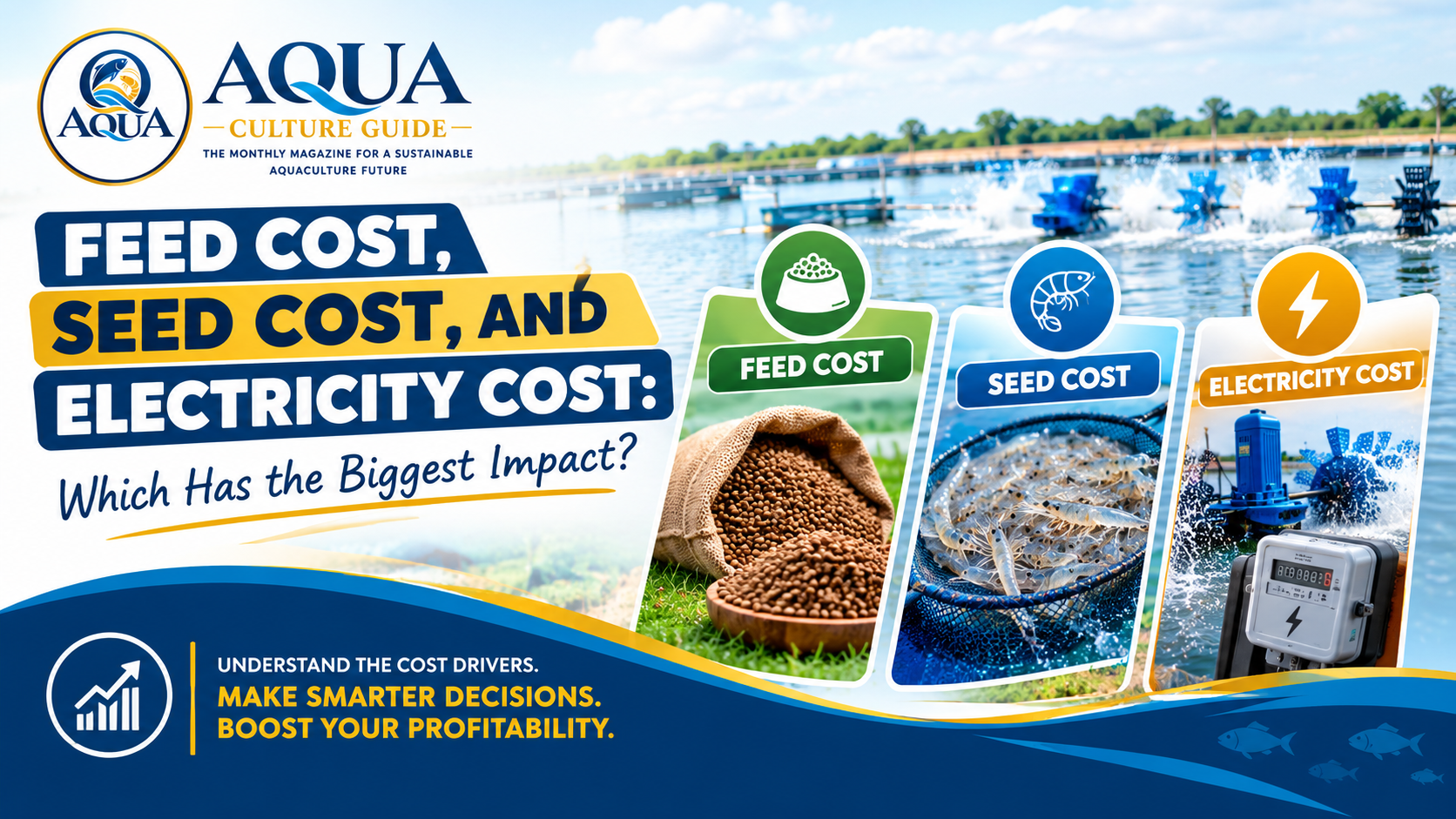
Compare feed, seed and electricity costs in shrimp farming. Learn which expense has the biggest impact on farm profit, how to calculate each cost and practical ways to control expenses.
Introduction
Shrimp farming involves several expenses, but some costs have a greater impact on farm profit than others. Feed, seed and electricity are three important expenses that farmers need to monitor throughout every crop.
Feed is usually one of the largest operating expenses because shrimp require regular feeding throughout the culture period. Seed cost depends on the number and quality of post-larvae (PL) stocked. Electricity costs are mainly related to aeration, water pumping and other farm equipment.
But which of these three expenses has the biggest impact on shrimp farming profit?
The answer depends on stocking density, feed conversion ratio (FCR), survival rate, culture duration, aeration requirements and local prices. In this article, we compare feed, seed and electricity costs with simple examples, practical calculations and a complete checklist to help farmers manage their crop expenses.
Understanding the Three Major Shrimp Farming Costs
Before comparing these expenses, farmers should understand what each cost includes.
A. Feed Cost
Feed is generally one of the largest recurring expenses in shrimp farming.
Shrimp need properly balanced feed to support growth, survival and production. Feed expenses depend on:
Total quantity of feed used.
Feed price per kilogram.
Stocking density.
Shrimp growth and survival.
Feed conversion ratio (FCR).
Culture duration.
Feeding management and wastage.
Feed Cost Formula:
Total Feed Cost = Total Feed Used (kg) × Feed Price per kg
Example:
Total feed used: 3,000 kg
Feed price: ₹90/kg
Total feed cost:
3,000 × ₹90 = ₹2,70,000
This means the farmer spends ₹2,70,000 on feed during the crop.
B. Seed Cost
Seed cost refers to the money spent on purchasing and transporting shrimp post-larvae (PL) for stocking.
The total seed expense depends on:
Number of PL stocked.
Price per PL.
Hatchery quality.
Transportation charges.
PL testing and health checks.
Stocking density.
Seed Cost Formula:
Total Seed Cost = Number of PL Purchased × Price per PL + Other Seed-Related Expenses
Example:
Number of PL purchased: 1,50,000
Price per PL: ₹0.40
Transportation and testing: ₹5,000
Seed purchase cost:
1,50,000 × ₹0.40 = ₹60,000
Total seed cost:
₹60,000 + ₹5,000 = ₹65,000
C. Electricity Cost
Electricity is essential for operating aerators, pumps and other equipment used in shrimp farming.
The electricity expense depends on:
Number of aerators.
Motor capacity.
Hours of operation.
Electricity tariff.
Culture duration.
Pumping requirements.
Generator and diesel usage, where applicable.
Electricity Cost Formula:
Electricity Cost = Power Consumption (kWh) × Electricity Rate per kWh
Example:
Total electricity consumption: 4,000 kWh
Electricity rate: ₹8 per kWh
Total electricity cost:
4,000 × ₹8 = ₹32,000
This is a simplified example. Actual farm energy costs may also include diesel, generator maintenance and other energy-related expenses.
Which Cost Has the Biggest Impact on Shrimp Farming?
In many shrimp farming operations, feed is the largest of these three operating expenses.
However, the order can change depending on farm conditions.
Expense Why is it needed What increases the cost
Feed Helps shrimp grow More feed usage and higher feed prices
Seed Used to stock the pond Number of PL and price per PL
Electricity Runs aerators and water pumps More running hours and higher electricity bills
- Feed Cost: Usually the Biggest Expense
Feed is used regularly throughout the culture period. Poor feeding management, high FCR and unnecessary feed wastage can increase the total production cost.
- Electricity Cost: Important in Intensive Farming
Electricity expenses can become significant in farms that operate many aerators and pumps for long hours. Energy costs may increase as biomass and oxygen demand rise.
- Seed Cost: Smaller Direct Expense, but Important for Production
Seed expenses may be lower than feed expenses, but poor-quality PL can affect survival, growth and final harvest quantity.
Important: The cheapest seed is not always the best choice. Farmers should consider seed quality, health status and hatchery reliability, not only the purchase price.
Practical Example: Comparing Feed, Seed and Electricity Costs
Let's compare these three expenses using a hypothetical one-acre shrimp farm.
Farm Expense Details
Expense Amount
Feed cost- ₹2,70,000
Seed cost- ₹65,000
Electricity cost- ₹32,000
Total of these three costs- ₹3,67,000
In this example, feed is the biggest expense, followed by seed and electricity.
<Note>These figures are only for explaining the calculation. They are not standard costs for every one-acre shrimp farm. Actual expenses vary with stocking density, crop duration, equipment, feed prices, electricity tariffs and farm management.</Note>
Understand How Much Each Cost Contributes
Farmers can calculate the percentage of each expense to understand where most of their money is spent.
Formula:
Cost Percentage = Individual Expense ÷ Total of the Three Expenses × 100
Using the example above:
- Out of ₹3,67,000, the farmer spends the most on feed.
- ₹2,70,000 goes towards feed.
- ₹65,000 goes towards shrimp seed.
- ₹32,000 goes towards electricity.
Key point: In this example, feed takes the biggest share of the total expense.
What does this mean?
Around 74% of these three expenses goes towards feed.
Around 18% goes towards seed.
Around 9% goes towards electricity.
This shows why feed management deserves close attention in this example.
These percentages are based only on the three expenses listed. They are not percentages of the farm's complete production cost.
How Feed Cost Affects Shrimp Farming Profit
Feed management can directly influence the cost of producing each kilogram of shrimp.
Understand FCR
FCR stands for Feed Conversion Ratio. It measures how much feed is used to produce one kilogram of shrimp biomass gain.
FCR Formula:
FCR = Total Feed Used (kg) ÷ Biomass Gain (kg)
Example:
Feed used: 3,000 kg
Biomass gain: 2,500 kg
FCR = 3,000 ÷ 2,500 = 1.20
A higher FCR can increase feed expenses if more feed is required to produce the same amount of shrimp.
Ways to Manage Feed Expenses
Use good-quality feed from reliable manufacturers.
Adjust feed quantity according to shrimp biomass and sampling results.
Monitor feed trays regularly.
Avoid unnecessary overfeeding.
Check shrimp growth and feeding response.
Maintain suitable water quality.
Record daily feed usage.
Calculate FCR after harvest.
Reducing feed wastage should not mean underfeeding. Shrimp must receive enough suitable nutrition for healthy growth.
How Seed Cost Affects Shrimp Farming Profit
Seed cost is not just about the purchase price of PL. Seed quality can influence the final production result.
Poor-quality or unhealthy PL may lead to:
Lower survival.
Uneven growth.
Weak crop performance.
Increased health risks.
Reduced harvest quantity.
Ways to Manage Seed Expenses
Purchase PL from a reliable hatchery.
Check hatchery records and health information.
Request appropriate quality testing.
Check PL activity and physical condition.
Follow proper transportation procedures.
Acclimatize PL carefully before stocking.
Avoid stocking unhealthy or weak seed just because it is cheaper.
Remember: Saving a small amount on seed purchase may not be beneficial if poor seed quality leads to lower survival and reduced harvest.
How Electricity Cost Affects Shrimp Farming Profit
Aeration is important for maintaining dissolved oxygen and supporting shrimp health, especially at higher biomass levels.
Electricity expenses can increase when aerators and pumps operate for longer periods.
Ways to Manage Electricity Expenses
Use properly maintained aerators.
Check motor and equipment efficiency.
Inspect electrical connections regularly.
Maintain aerator blades and gearboxes.
Monitor dissolved oxygen at suitable times.
Plan aerator operation according to pond conditions and biomass.
Record daily electricity consumption.
Check electricity bills and tariff details.
Maintain backup power for emergencies.
Important: Never reduce essential aeration just to save electricity. Low dissolved oxygen can cause serious stress, mortality and financial losses. Energy savings should come from efficient equipment and proper operation, not from compromising shrimp safety.
What Happens If These Costs Increase?
Let's understand how a rise in expenses can affect the farm budget.
Assume the original costs are:
Feed: ₹2,70,000
Seed: ₹65,000
Electricity: ₹32,000
Total ₹3,67,000 ₹4,03,700
Now consider an increase of 10% in each expense.
The total increase is ₹36,700.
This means the farmer needs to spend an additional ₹36,700 on these three expenses.
If harvest quantity and selling price remain unchanged, this additional expense reduces the crop's profit by ₹36,700.
Complete Checklist for Managing Feed, Seed and Electricity Costs
Farmers can use this checklist during every crop.
Feed Cost Checklist
Record the feed brand and type.
Record the price per bag or kilogram.
Record total feed purchased.
Record daily feed usage.
Monitor shrimp biomass through sampling.
Check feed tray response.
Avoid unnecessary feed wastage.
Monitor FCR.
Store feed in a dry and suitable place.
Calculate total feed expenses after harvest.
Seed Cost Checklist
Select a reliable hatchery.
Check PL quality and health records.
Record the number of PL purchased.
Record the price per PL.
Include transportation expenses.
Arrange appropriate health testing.
Check PL activity before stocking.
Follow proper acclimatization.
Record stocking date and density.
Monitor survival and growth.
Electricity Cost Checklist
Record the number of aerators.
Record motor capacity.
Monitor daily operating hours.
Record electricity consumption.
Check the electricity tariff.
Maintain motors and aerators.
Inspect electrical connections.
Monitor dissolved oxygen.
Maintain backup power.
Calculate total energy expenses after harvest.
Final Farm Economics Checklist
Calculate total feed cost.
Calculate total seed cost.
Calculate total electricity and diesel cost.
Add all other farming expenses.
Calculate total production cost.
Record total harvested shrimp.
Calculate production cost per kg.
Calculate total sales revenue.
Calculate final profit or loss.
Compare expenses with the previous crop.
Step-by-Step Guide to Find Your Biggest Farm Expense
Follow these steps to understand which expense has the biggest impact on your shrimp farm.
Step 1: Collect all purchase bills
Collect feed bills, seed purchase bills, electricity bills and other expense records.
Step 2: Calculate total feed expenses
Multiply the total feed quantity used by the purchase price per kilogram. Include relevant feed-related charges.
Step 3: Calculate total seed expenses
Multiply the number of PL purchased by the price per PL. Add transportation and testing expenses.
Step 4: Calculate electricity expenses
Use electricity bills or meter readings to calculate the total energy cost. Add diesel and generator expenses separately.
Step 5: Prepare a cost comparison
Place feed, seed and electricity expenses in one table.
Step 6: Calculate the percentage of each cost
Divide each expense by the combined total of the three expenses and multiply by 100.
Step 7: Identify the highest expense
Compare the amounts and percentages to identify where most of the money is spent.
Step 8: Check whether the expense can be controlled
Look for feed wastage, poor FCR, unnecessary energy consumption, equipment problems or avoidable seed-related losses.
Step 9: Compare with the previous crop
Check whether each expense has increased or decreased. Consider differences in production, crop duration and stocking density before drawing conclusions.
Step 10: Prepare the next crop budget
Set realistic cost targets and monitor expenses throughout the next crop.
Common Mistakes Farmers Should Avoid
Looking only at the purchase price instead of total cost.
Buying low-quality seed only because it is cheaper.
Overfeeding shrimp and increasing feed wastage.
Ignoring FCR and daily feed records.
Running poorly maintained aerators.
Reducing essential aeration to save electricity.
Forgetting diesel and generator expenses.
Comparing costs without considering harvested production.
Ignoring survival rate and shrimp growth.
Failing to maintain separate records for each crop.
Conclusion
Feed, seed and electricity are all important expenses in shrimp farming, but their financial impact is different.
Feed is often the largest recurring expense, seed quality can influence survival and final production, and electricity is essential for aeration and water management.
Farmers should not focus only on reducing expenses. They should understand how each expense affects shrimp growth, survival and final harvest.
By maintaining accurate records, monitoring FCR, selecting quality PL and using energy efficiently, farmers can control unnecessary costs and improve farm profitability.
The goal is not simply to spend less. It is to get better production and value from every rupee spent on the farm.
Questions & Answers
Q1.Which is the biggest expense in shrimp farming: feed, seed or electricity?
Feed is often the biggest of these three operating expenses. However, the actual ranking depends on stocking density, feed usage, FCR, electricity consumption, crop duration and local prices.
Q2.Why is feed cost high in shrimp farming?
Shrimp require regular feeding throughout the culture period. The total expense depends on feed quantity, feed price, stocking density, growth and FCR.
Q3.How can farmers reduce feed expenses?
Farmers can monitor feed trays, adjust feeding according to shrimp biomass, avoid unnecessary wastage and maintain good water quality.
Q4.Does cheaper shrimp seed always reduce farming costs?
No. Poor-quality seed can result in low survival and reduced production. Farmers should consider seed health and quality along with price.
Q5.Why is electricity important in shrimp farming?
Electricity powers aerators and pumps that support water circulation, oxygen supply and pond management.
Q6.How can farmers reduce electricity costs?
They can maintain efficient equipment, inspect motors and aerators, monitor energy consumption and improve operating efficiency without compromising essential aeration.
Q7.What is the formula for calculating feed cost?
Total Feed Cost = Total Feed Used (kg) × Feed Price per kg.
Related articles
భారతీయ రిజర్వాయర్లలో కేజ్ ఫిష్ ఫార్మింగ్: సాంకేతికత, అనుమతులు మరియు పెట్టుబడి వివరాలు
భారతదేశంలోని రిజర్వాయర్లలో కేజ్ ఫిష్ ఫార్మింగ్ ఎలా ప్రారంభించాలి? అవసరమైన సాంకేతికత, ప్రభుత్వ అనుమతులు, పెట్టుబడి, చేపల జాతులు, మేత నిర్వహణ మరియు లాభనష్టాల గురించి పూర్తి వివరాలు తెలుసుకోండి.
Freshwater Prawn Farming in IndiaFreshwater Prawn Farming in India: రైతులకు పూర్తి సాగు మార్గదర్శిని
భారతదేశంలో మంచినీటి రొయ్యల సాగు ఎలా ప్రారంభించాలి? జెయింట్ ఫ్రెష్వాటర్ ప్రాన్ సీడ్ ఎంపిక, చెరువు తయారీ, స్టాకింగ్, ఆహారం, నీటి నాణ్యత, పెట్టుబడి, మార్కెటింగ్ గురించి పూర్తి వివరాలు తెలుసుకోండి.
Tilapia farming in Indiaభారతదేశంలో తిలాపియా చేపల పెంపకం – మార్కెట్ అవకాశాలు, ప్రభుత్వ నిబంధనలు మరియు ఆధునిక సాగు పద్ధతులు
భారతదేశంలో తిలాపియా చేపల పెంపకం ఎలా చేయాలి? మార్కెట్ అవకాశాలు, ప్రభుత్వ అనుమతులు, చెరువు సాగు, బయోఫ్లాక్, RAS విధానాలు, పిల్లల ఎంపిక, మేత నిర్వహణ మరియు దిగుబడి గురించి పూర్తి సమాచారం.
PCR Testing in Shrimp Hatcheriesరొయ్యల హ్యాచరీల్లో PCR పరీక్షలు: ఫలితాలను రైతులు ఎలా అర్థం చేసుకోవాలి?
WSSV, EHP, AHPND వంటి వ్యాధికారకాలను గుర్తించడంలో PCR పరీక్షల పాత్ర, పరీక్షా నివేదికలను అర్థం చేసుకోవడం, నాణ్యమైన రొయ్య పిల్లలను ఎంపిక చేసుకోవడం గురించి రైతులు తెలుసుకోవాల్సిన పూర్తి సమాచారం.
Explore Aqua Culture Guide
Aqua companies directory
Feed, seed, probiotics & equipment suppliers
Aquaculture calculators
Feed, FCR, stocking & water quality tools
Telugu aqua magazine
Read the latest monthly issue online
All aqua news & articles
Farming, disease control and market updates
List your company free
Get found by farmers across India
Advertise with us
Magazine and website advertising options