
Farm Record Book for Aquaculture: 20 Important Numbers to Track
30/10/2026
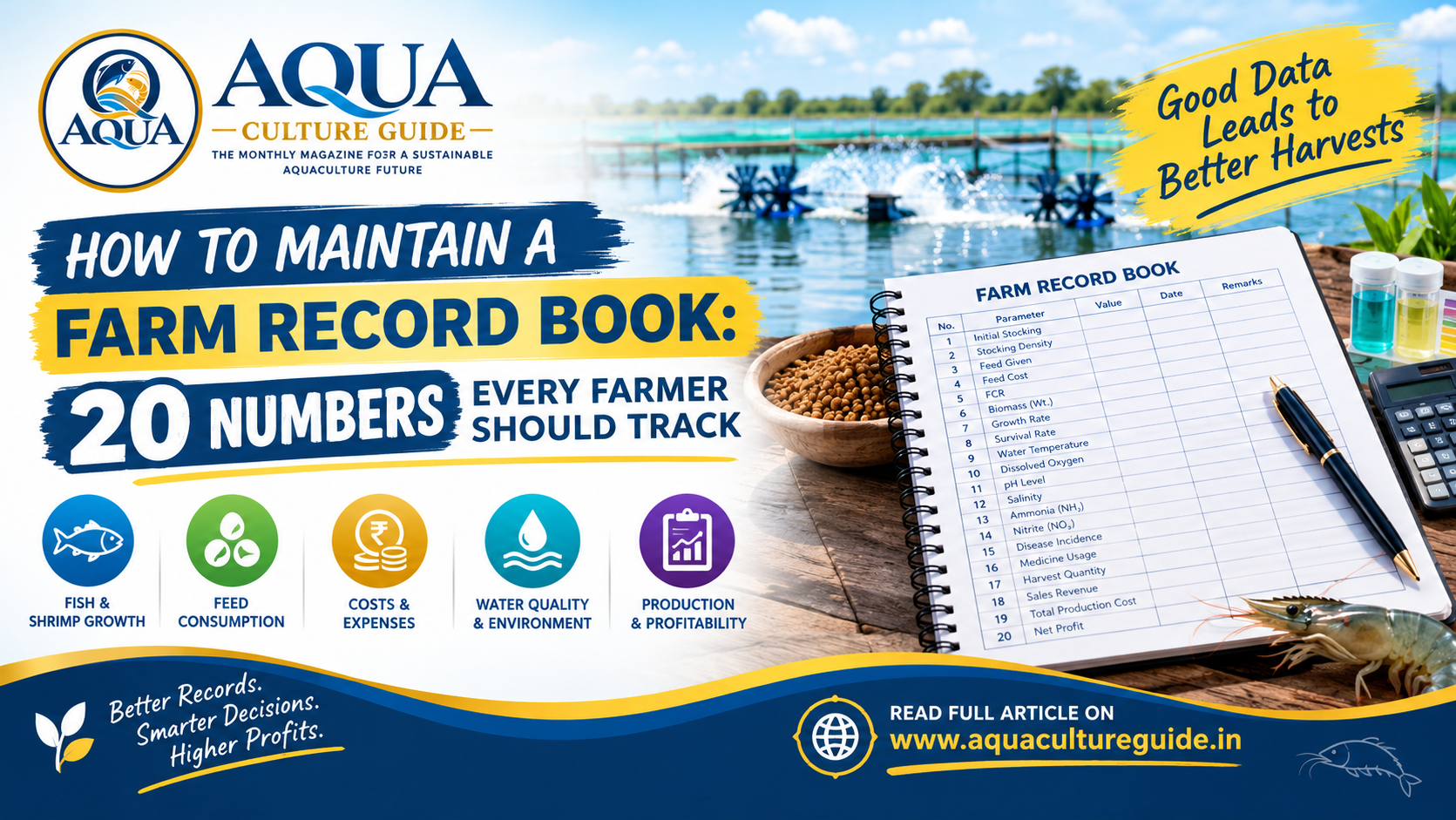
Learn how to maintain an aquaculture farm record book. Discover 20 important numbers to track, including feed, seed, water quality, growth, survival, expenses and profit.
Introduction
Successful aquaculture farming is not only about stocking good-quality seed, providing feed and maintaining water quality. Farmers also need to keep accurate records of everything happening on the farm.
Many farmers remember how much feed they used, when they stocked the pond or how much they spent on electricity. However, remembering everything throughout a culture period can be difficult.
A farm record book helps farmers keep all important information in one place. It shows how much money is spent, how the stock is growing, whether water quality is stable and how much profit or loss is made after harvest.
Whether you are a shrimp farmer or a fish farmer, maintaining daily and weekly records can help you make better decisions.
In this guide, we explain 20 important numbers every aquaculture farmer should track, along with a simple checklist and step-by-step method to maintain a farm record book.
Why Is a Farm Record Book Important?
A farm record book is a notebook, spreadsheet or digital file used to record important farm activities and expenses.
It helps farmers:
Monitor daily feed usage.
Track seed stocking details.
Check shrimp or fish growth.
Monitor water quality.
Identify unusual mortality.
Calculate feed conversion ratio (FCR).
Control unnecessary expenses.
Compare the performance of different crops.
Calculate production cost.
Understand final farm profit or loss.
Simple point: If farmers do not record their farm activities, they may find it difficult to understand where money is being spent and why production results change.
The 20 Important Numbers Every Farmer Should Track
These numbers can be recorded in a farm diary, Excel sheet or mobile spreadsheet.
A. Stocking and Production Records
- Pond Area
Record the water spread area of each pond.
Example:
Pond 1: 1 acre
Pond 2: 1.5 acres
Why is it important? Pond area helps farmers calculate stocking density, production per acre and expenses per acre.
Number of Seed Stocked
Record the total number of shrimp PL or fish fingerlings stocked in each pond.
Example:
Total shrimp PL stocked: 1,50,000
Why is it important? This number helps farmers calculate stocking density and estimate survival.
Seed Price
Record the purchase price of seed.
Example:
Number of PL: 1,50,000
Price per PL: ₹0.40
Total seed purchase cost: ₹60,000
Why is it important? It helps farmers calculate the total investment in seed.
Stocking Date
Record the exact date when seed is stocked in the pond.
Example:
Stocking date: 1 October 2026
Why is it important? It helps calculate culture days and compare growth at different stages.
Average Body Weight (ABW)
Record the average weight of shrimp or fish during sampling.
Example:
Day 30: 5 grams
Day 45: 9 grams
Day 60: 14 grams
Why is it important? Regular sampling helps farmers understand growth and adjust feeding.
Feed Management Records
- Daily Feed Quantity
Record how many kilograms of feed are given to each pond every day.
Example:
Morning: 20 kg
Afternoon: 15 kg
Evening: 25 kg
Total: 60 kg per day
Why is it important? It helps farmers monitor feed consumption and avoid unnecessary wastage.
Total Feed Used
Record the total quantity of feed used during the crop.
Example:
Total feed used: 3,000 kg
Why is it important? This number is needed to calculate FCR and total feed expenses.
Feed Price
Record the purchase price per kilogram or per bag.
Example:
Feed price: ₹90 per kg
Why is it important? It helps calculate total feed expenses and compare feed prices.
Feed Conversion Ratio (FCR)
FCR shows how much feed is used to produce one kilogram of biomass gain.
Formula:
FCR = Total Feed Used (kg) ÷ Biomass Gain (kg)
Example:
Total feed used: 3,000 kg
Biomass gain: 2,500 kg
FCR: 1.20
Why is it important? It helps farmers understand feed-use efficiency. FCR should be interpreted alongside survival, biomass estimates and the calculation method used.
Water Quality Records
- Dissolved Oxygen (DO)
Record dissolved oxygen levels in the pond.
Example:
Morning DO: 4.5 mg/L
Evening DO: 6.0 mg/L
Why is it important? Low oxygen can stress shrimp and fish. Record readings at consistent times, especially before sunrise when oxygen may be lowest.
Water Temperature
Record the pond water temperature in degrees Celsius.
Example:
Morning: 28°C
Afternoon: 30°C
Why is it important? Temperature affects feeding, metabolism, growth and oxygen availability.
pH Level
Record pond water pH regularly.
Example:
Morning pH: 7.8
Afternoon pH: 8.2
Why is it important? Sudden or large pH changes can affect animal health and the toxicity of some water compounds.
Salinity
For shrimp and other species raised in brackish or marine water, record salinity in parts per thousand (ppt).
Example:
Pond salinity: 15 ppt
Why is it important? Salinity helps farmers monitor changes in pond water, especially after rainfall or water exchange.
For freshwater fish ponds, record the water parameters relevant to the species instead.
Total Alkalinity
Record total alkalinity in mg/L as CaCO₃.
Example:
Total alkalinity: 120 mg/L
Why is it important? Alkalinity helps buffer pH changes and supports stable pond water conditions.
Ammonia and Nitrite
Record ammonia and nitrite test results, including units and the test method.
Example:
Total ammonia nitrogen (TAN): 0.5 mg/L
Nitrite: 0.2 mg/L
Why is it important? These compounds can become harmful depending on their concentration, pH, salinity, temperature and the species being cultured. Track trends and follow suitable species-specific guidance.
Health and Farm Operation Records
- Daily Mortality
Record the number of dead or weak shrimp or fish observed.
Example:
Daily mortality observed: 20 shrimp
Why is it important? A sudden increase in mortality can be an early warning of disease, poor water quality or other farm problems. Record the observation and any action taken.
Water Exchange Quantity
Record how much water is added, exchanged or removed from the pond.
Example:
Water exchanged: 10% of pond water volume
Why is it important? It helps farmers understand changes in water management and connect them with water quality results.
Aerator Operating Hours and Electricity Use
Record the number of aerators, their operating hours and electricity consumption.
Example:
Number of aerators: 4
Operating time: 10 hours per day
Electricity used: 100 kWh per day
Why is it important? It helps farmers monitor energy expenses and equipment performance. Never reduce essential aeration just to save electricity.
Financial and Harvest Records
- Total Farm Expenses
Record all expenses throughout the crop.
Include:
Seed purchase.
Feed purchase.
Electricity and diesel.
Labour.
Probiotics and minerals.
Water testing and laboratory charges.
Pond preparation.
Repairs and maintenance.
Harvest and transport charges.
Example:
Total crop expenses: ₹7,75,000
Why is it important? It helps calculate the actual cost of production.
Harvest Quantity and Selling Price
Record the quantity harvested, size or grade, selling price and total revenue for every harvest lot.
Example:
- First harvest: ₹4,20,000
- Second harvest: ₹3,60,000
- Third harvest: ₹2,28,000
- Total shrimp sold: 2,500 kg
- Total money received: ₹10,08,000
Key point: The farmer harvested 2,500 kg of shrimp and earned ₹10.08 lakh in total sales. This is revenue, not profit; farm expenses must still be deducted.
Profit or Loss Formula:
Profit or Loss = Total Revenue − Total Expenses
Example:
Total revenue: ₹10,08,000
Total expenses: ₹7,75,000
Operating profit: ₹2,33,000
This is an illustrative calculation. Include all relevant costs, such as rent, interest and depreciation, if you want to calculate the farm's complete net profit.
Simple Farm Record Book Format
Farmers can use the following simple format to record daily activities
Farmers should write down these five things every day:
- How much feed was given.
- How much oxygen is in the water.
- The pond's pH level.
- The water temperature.
- Whether the pond condition is normal or needs attention.
Example: On Day 3, oxygen was 4.5 mg/L, so the farmer should check the pond's oxygen level carefully.
You can maintain separate sheets for:
Stocking details.
Daily feed records.
Water quality records.
Sampling and growth.
Mortality and health observations.
Medicines and farm inputs.
Electricity and equipment.
Expenses and harvest details.
Complete Checklist for Maintaining a Farm Record Book
Use this checklist to make sure important farm information is recorded.
Stocking Records
Record pond number and pond area.
Record seed source or hatchery.
Record seed quantity.
Record seed price and total cost.
Record stocking date and density.
Keep seed health and test reports.
Feed Records
Record feed brand and type.
Record feed price.
Record daily feed quantity.
Record total feed used.
Monitor feed tray response where applicable.
Record sampling weight.
Calculate FCR.
Water Quality Records
Record dissolved oxygen.
Record water temperature.
Record pH.
Record salinity where applicable.
Record total alkalinity.
Record ammonia and nitrite.
Record water exchange.
Health and Farm Operation Records
Record daily mortality.
Record unusual behaviour.
Record disease symptoms.
Record laboratory test results.
Record treatments and farm inputs.
Record aerator operating hours.
Record electricity and diesel use.
Financial Records
Record seed expenses.
Record feed expenses.
Record electricity and diesel expenses.
Record labour expenses.
Record other farm expenses.
Record harvest quantity and grade.
Record selling price and revenue.
Calculate total cost and profit or loss.
Step-by-Step Guide: How to Maintain a Farm Record Book
Follow these simple steps to maintain farm records throughout the culture period.
Step 1: Create a Separate Record for Each Pond
Give every pond a unique number, such as Pond 1, Pond 2 and Pond 3.
Do not mix records from different ponds. This helps you compare pond performance.
Step 2: Record Stocking Details
On the stocking day, write down:
Pond area.
Seed quantity.
Seed price.
Hatchery or supplier name.
Stocking date.
Seed health information.
Step 3: Record Feed Usage Every Day
Write down the quantity of feed given to each pond.
Record feed usage in the morning or evening. At the end of the day, calculate the total feed used.
Step 4: Check and Record Water Quality
Measure important water quality parameters using suitable equipment and test kits.
Write down:
Date and time.
Pond number.
Test result.
Unit of measurement.
Any action taken.
For example, do not write only "DO normal." Record the actual DO reading in mg/L.
Step 5: Record Growth During Sampling
Take regular samples using an appropriate sampling method.
Record:
Sampling date.
Number of animals sampled.
Average body weight.
Growth compared with the previous sample.
Any unusual observations.
Step 6: Record Health Problems and Mortality
If shrimp or fish show unusual behaviour, reduced feeding or mortality, record the date and observations.
Also record any laboratory testing, professional advice or treatment used.
Step 7: Record All Farm Expenses
Keep bills and receipts for feed, seed, electricity, labour, diesel, farm inputs and other purchases.
Enter each expense in the record book on the day it occurs.
Step 8: Record Harvest Details
During harvesting, record each harvest lot separately.
Include:
Harvest date.
Quantity harvested.
Size or grade.
Selling price per kg.
Total sales revenue.
Buyer or sale reference.
Step 9: Calculate Total Production Cost
Add all expenses for the crop.
Separate operating expenses from capital investments, and include relevant costs when calculating complete profitability.
Step 10: Calculate Profit or Loss
Subtract total expenses from total revenue.
Compare the result with previous crops to understand whether farm performance has improved or declined.
Daily, Weekly and Monthly Record-Keeping Schedule
Not every number needs to be measured every day. Follow a suitable schedule based on the species, farming system, crop stage and farm management plan.
Record Suggested frequency
Feed quantity Daily
Mortality and animal behaviour Daily
DO and temperature Daily, often more frequently when needed
pH Regularly, often morning and afternoon
Salinity Regularly and after major water changes or rainfall
Ammonia and nitrite According to risk, test plan and water conditions
Alkalinity Regularly and when conditions require
Average body weight Weekly or as per sampling plan
FCR Update regularly and review after harvest
Electricity consumption Daily or from meter readings
Expenses Whenever money is spent
Harvest and sales Every harvest lot
Common Record-Keeping Mistakes Farmers Should Avoid
Recording feed usage only from memory.
Mixing expenses from different ponds.
Forgetting to record seed purchase details.
Writing water quality results without units.
Recording only problems and ignoring normal readings.
Not recording the date and time of water tests.
Forgetting electricity and diesel expenses.
Mixing different harvest lots.
Losing purchase bills and receipts.
Calculating profit without including all relevant expenses.
Notebook or Excel: Which Is Better?
Farmers can use either a notebook or an Excel spreadsheet.
Notebook Excel or digital sheet
Easy to carry to the pond
Easy to calculate totals
No computer needed
Can prepare charts
Simple daily writing
Easy to compare crops
Manual calculations
Formulas can calculate costs and FCR
Our suggestion: Farmers who are new to record keeping can start with a simple notebook. Later, they can transfer the information into Excel for easier calculations and crop comparisons.
Conclusion
A farm record book is one of the simplest tools for improving aquaculture farm management. By tracking important numbers such as feed usage, seed quantity, water quality, growth, mortality, electricity consumption and expenses, farmers can understand what is happening in their ponds.
Do not wait until harvest to calculate your farm performance. Record important information every day, review it regularly and use the results to plan the next crop.
Remember: Good farming decisions start with accurate farm records.
Questions & Answers
Q1.Why should aquaculture farmers maintain a farm record book?
A farm record book helps farmers track feed, seed, water quality, growth, mortality, expenses and harvest results. It supports better farm management and financial planning.
Q2.What are the most important records in shrimp farming?
Important records include stocking quantity, daily feed usage, FCR, average body weight, dissolved oxygen, pH, salinity, ammonia, nitrite, mortality, expenses and harvest details.
Q3.Should farmers maintain separate records for each pond?
Yes. Separate pond records help farmers identify which ponds perform well and which need better management.
Q4.How often should farmers update their farm records?
Daily activities such as feed usage, mortality and important water quality readings should be recorded daily. S
Q5.Can farmers use Excel to maintain farm records?
Yes. Excel or a spreadsheet can help calculate feed costs, FCR, production costs, revenue and profit.
Q6.What is FCR in aquaculture?
FCR means Feed Conversion Ratio. It shows the amount of feed used to produce one kilogram of biomass gain.
Q7.Which water quality parameters should farmers record?
Common parameters include dissolved oxygen, temperature, pH, salinity where applicable, alkalinity, ammonia and nitrite.
Related articles
భారతీయ రిజర్వాయర్లలో కేజ్ ఫిష్ ఫార్మింగ్: సాంకేతికత, అనుమతులు మరియు పెట్టుబడి వివరాలు
భారతదేశంలోని రిజర్వాయర్లలో కేజ్ ఫిష్ ఫార్మింగ్ ఎలా ప్రారంభించాలి? అవసరమైన సాంకేతికత, ప్రభుత్వ అనుమతులు, పెట్టుబడి, చేపల జాతులు, మేత నిర్వహణ మరియు లాభనష్టాల గురించి పూర్తి వివరాలు తెలుసుకోండి.
Freshwater Prawn Farming in IndiaFreshwater Prawn Farming in India: రైతులకు పూర్తి సాగు మార్గదర్శిని
భారతదేశంలో మంచినీటి రొయ్యల సాగు ఎలా ప్రారంభించాలి? జెయింట్ ఫ్రెష్వాటర్ ప్రాన్ సీడ్ ఎంపిక, చెరువు తయారీ, స్టాకింగ్, ఆహారం, నీటి నాణ్యత, పెట్టుబడి, మార్కెటింగ్ గురించి పూర్తి వివరాలు తెలుసుకోండి.
Tilapia farming in Indiaభారతదేశంలో తిలాపియా చేపల పెంపకం – మార్కెట్ అవకాశాలు, ప్రభుత్వ నిబంధనలు మరియు ఆధునిక సాగు పద్ధతులు
భారతదేశంలో తిలాపియా చేపల పెంపకం ఎలా చేయాలి? మార్కెట్ అవకాశాలు, ప్రభుత్వ అనుమతులు, చెరువు సాగు, బయోఫ్లాక్, RAS విధానాలు, పిల్లల ఎంపిక, మేత నిర్వహణ మరియు దిగుబడి గురించి పూర్తి సమాచారం.
PCR Testing in Shrimp Hatcheriesరొయ్యల హ్యాచరీల్లో PCR పరీక్షలు: ఫలితాలను రైతులు ఎలా అర్థం చేసుకోవాలి?
WSSV, EHP, AHPND వంటి వ్యాధికారకాలను గుర్తించడంలో PCR పరీక్షల పాత్ర, పరీక్షా నివేదికలను అర్థం చేసుకోవడం, నాణ్యమైన రొయ్య పిల్లలను ఎంపిక చేసుకోవడం గురించి రైతులు తెలుసుకోవాల్సిన పూర్తి సమాచారం.
Explore Aqua Culture Guide
Aqua companies directory
Feed, seed, probiotics & equipment suppliers
Aquaculture calculators
Feed, FCR, stocking & water quality tools
Telugu aqua magazine
Read the latest monthly issue online
All aqua news & articles
Farming, disease control and market updates
List your company free
Get found by farmers across India
Advertise with us
Magazine and website advertising options