
EHP in Shrimp Farming: Symptoms, Risk Factors, Prevention & Management Guide
3/10/2026
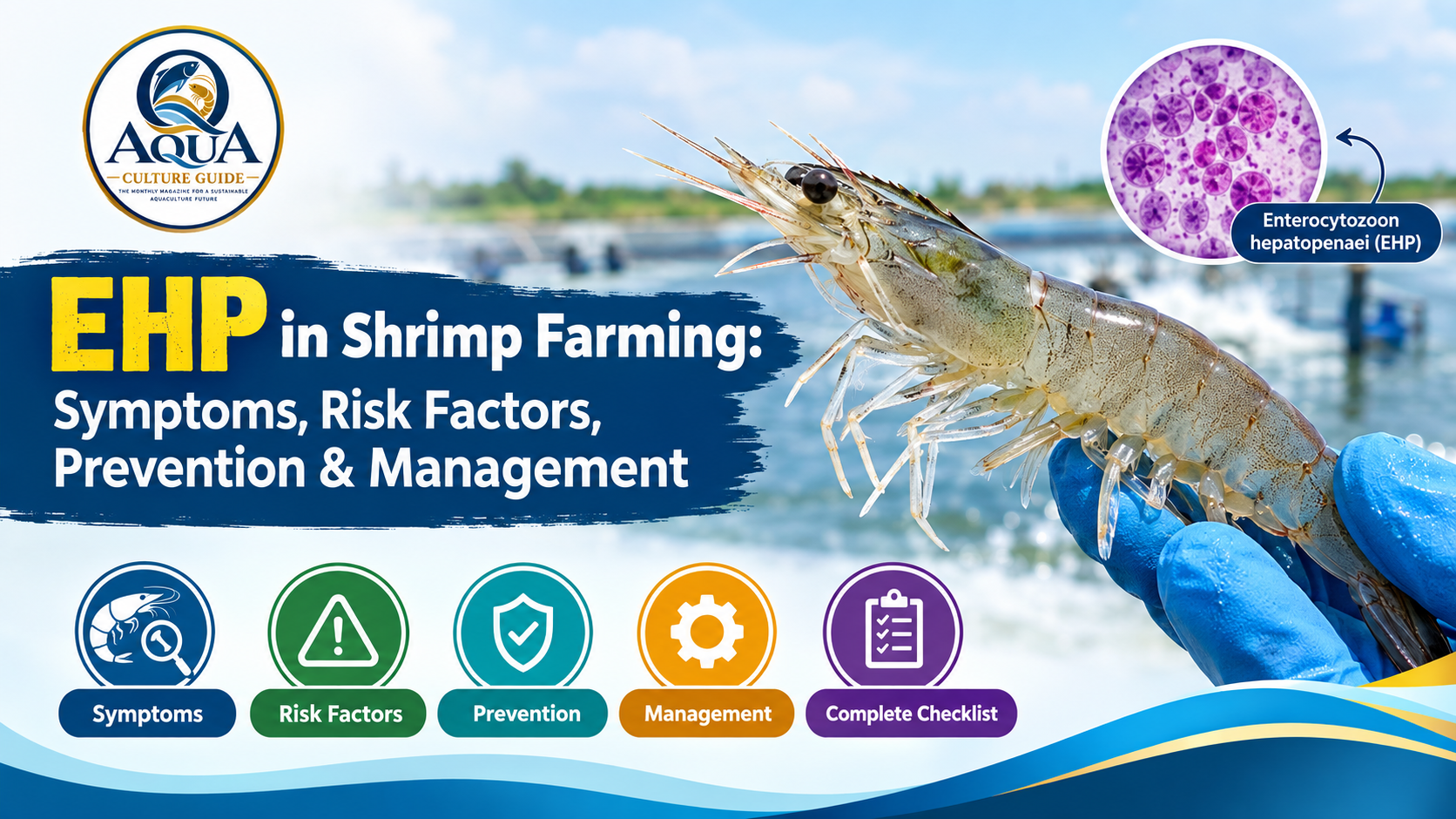
EHP in shrimp farming, including symptoms, transmission, risk factors, PCR diagnosis, prevention, pond preparation, biosecurity and management strategies for Penaeus vannamei.
EHP in Shrimp Farming: Complete Guide
Enterocytozoon hepatopenaei (EHP) is a microsporidian parasite associated primarily with severe growth retardation and uneven growth in cultured shrimp. Unlike several major shrimp diseases that can produce rapid mortality, EHP can remain relatively difficult to detect because infected shrimp may survive while showing poor growth and reduced production performance.
For shrimp farmers, the major concern is not simply mortality. Delayed growth, size variation, poor feed utilization and extended culture duration can significantly affect farm economics.
- What is EHP?
EHP stands for Enterocytozoon hepatopenaei, a microsporidian parasite that infects the hepatopancreas of shrimp.
The hepatopancreas plays an important role in digestion, nutrient absorption, metabolism and energy storage. EHP develops within hepatopancreatic cells and can interfere with normal physiological functions.
EHP is particularly important in intensive shrimp farming because infection can result in:
Slow growth
Severe size variation
Poor feed utilization
Delayed harvest
Increased production costs
Reduced final biomass
Lower profitability
Why is EHP a Serious Problem in Shrimp Farming?
One of the biggest challenges with EHP is that there may be no obvious clinical signs during the early stages.
A farmer may see:
“The shrimp are alive, feeding and the pond looks normal—but the shrimp are not growing uniformly.”
As the crop progresses, differences in shrimp size may become increasingly visible.
This can lead to:
EHP infection → hepatopancreas damage → impaired nutrient utilization → slow growth → size variation → prolonged culture → increased production cost
Main Symptoms of EHP in Shrimp
EHP does not have a single distinctive external symptom. Laboratory testing is important for confirmation.
Common signs associated with EHP include:
- Slow growth
Shrimp may initially appear normal but gradually show poor growth compared with healthy shrimp.
- Uneven size
One of the most important field observations is large size variation within the same pond.
You may find:
Large shrimp
Medium-sized shrimp
Very small shrimp
at the same time.
Reduced feed intake
Affected shrimp may show reduced feeding activity, although poor feeding can also have many other causes.
Delayed harvest
Because growth is slower, the farmer may need to extend the culture period to achieve the desired harvest size.
White feces
White fecal strings or floating white material can sometimes be observed in ponds associated with EHP, but white feces alone cannot be used to diagnose EHP. Other conditions can produce similar observations.
Hepatopancreas changes
Discoloration or abnormalities in the hepatopancreas may occur, but these signs are not sufficiently specific to confirm EHP.
Important:
Do not diagnose EHP based only on pond appearance or shrimp size variation.
EHP Transmission
EHP can spread through oral transmission.
Potential routes include:
Infected shrimp
Cannibalism
Contaminated water
Fecal material
Pond sediment
Infected or contaminated live feeds
Contaminated equipment
Movement of material between ponds
Major Risk Factors for EHP
Risk Factor 1: EHP-positive PL
Introducing infected post-larvae is one of the most important risks.
Always source PL from reliable hatcheries and request appropriate health screening.
NFDB recommends PCR testing of post-larvae before stocking and using EHP-free PL.
Risk Factor 2: Poor Pond Preparation
Previous crop residues, organic matter and contaminated sediment can contribute to disease risk.
Poorly cleaned pond bottoms are particularly concerning when a previous crop had suspected or confirmed EHP.
Risk Factor 3: Contaminated Water
Water can act as a vehicle for infectious material.
Untreated water entering a pond can introduce unwanted organisms and potential EHP sources.
Risk Factor 4: Cannibalism
Dead and weak shrimp can be consumed by healthy shrimp.
If infected shrimp are eaten, this may contribute to the recycling and spread of EHP spores within the pond.
Therefore:
Dead shrimp should be removed promptly.
Risk Factor 5: Contaminated Equipment
Equipment can potentially move infectious material from one pond to another.
Examples include:
Nets
Buckets
Sampling equipment
Boots
Harvesting equipment
Feeding equipment
Risk Factor 6: Infected Live Feed
Live feeds used in broodstock and hatchery operations can represent a biosecurity concern if they are contaminated.
Risk Factor 7: High Organic Load
Accumulated organic matter and sludge can complicate overall pond health management.
How is EHP Diagnosed?
Field observation can raise suspicion, but laboratory diagnosis is required for confirmation.
PCR Testing
PCR is widely used for detecting EHP.
Testing may include:
Conventional PCR
Nested PCR
Real-time PCR
Other diagnostic approaches can include:
Histopathology
In-situ hybridization
LAMP
When Should Farmers Test for EHP?
Testing should not be limited to situations where the pond is already showing severe problems.
Recommended monitoring points:
Before stocking
→ Test PL batches.
During nursery/rearing
→ Monitor growth and health.
During grow-out
→ Test when unexpected growth retardation or significant size variation develops.
When disease is suspected
→ Collect appropriate samples and send them to a qualified aquatic animal diagnostic laboratory.
EHP Sample Collection Checklist
For laboratory diagnosis, follow the laboratory's sample requirements.
The NFDB guidance indicates:
For PL:
100–200 live post-larvae
For juveniles:
3–5 live or moribund shrimp
Sample submission checklist
☐ Correct number of shrimp collected
☐ Samples are representative of the population
☐ Live samples maintained appropriately where required
☐ Sample properly labelled
☐ Pond number recorded
☐ Sampling date recorded
☐ Shrimp age recorded
☐ Average body weight recorded
☐ Growth history recorded
☐ Feed consumption recorded
☐ Previous disease history recorded
☐ Sample sent promptly to an appropriate laboratory
EHP Prevention: The Most Important Strategy
There is currently no established treatment that reliably eliminates an active EHP infection from shrimp during grow-out. Therefore, prevention and biosecurity are central to EHP management.
Think of EHP management as:
Clean Seed + Clean Water + Clean Pond + Clean Equipment + Strong Biosecurity + Continuous Monitoring
Step-by-Step EHP Prevention Program
Step 1: Select a Reliable Hatchery
Purchase PL only from reputable, registered hatcheries.
Ask for:
PL health records
Batch information
PCR screening information
Brood stock health status
Hatchery biosecurity practices
Do not select seed based only on price.
Step 2: PCR-Test the PL
Before stocking:
Collect representative PL samples → Send to diagnostic laboratory → Confirm EHP status → Stock only after satisfactory health verification.
NFDB specifically recommends PCR testing PL before stocking.
Step 3: Completely Drain the Previous Pond
After harvest:
Remove remaining water.
Drain the pond completely.
Remove accumulated sludge.
Clean pond corners.
Clean areas underneath aerators.
Remove dead organic material.
Clean drainage channels.
Step 4: Dry the Pond Bottom
Proper drying is an important part of pond preparation.
Sun-drying helps reduce residual organic matter and assists in preparing the soil for subsequent treatment.
For farms with a previous EHP history, pond preparation should be more rigorous.
Step 5: Treat Contaminated Pond Sediment Appropriately
For EHP-affected earthen ponds, Indian aquaculture guidance has recommended calcium oxide/quicklime treatment under controlled pond-preparation conditions.
NFDB guidance describes application of approximately 6 tonnes/ha, followed by incorporation into the upper 10–12 cm of soil, moistening to activate the lime, and allowing appropriate holding time before subsequent preparation
Important safety note
Lime treatment is not a universal “one-size-fits-all” prescription.
Application rates and procedures should be determined according to:
Pond soil condition
Previous crop history
Soil pH
Moisture condition
Pond type
Local aquaculture regulations
Technical advice
Do not apply large quantities of quicklime without proper technical guidance.
Step 6: Clean Farm Equipment
Create separate equipment wherever possible.
Equipment checklist
☐ Nets
☐ Buckets
☐ Sampling trays
☐ Boots
☐ Feed containers
☐ Water-testing equipment
☐ Harvesting equipment
☐ Aerator-related equipment
☐ Pumps and hoses
Step 7: Manage Water Carefully
Use the cleanest practical water source.
Where appropriate:
Use a reservoir system.
Filter incoming water.
Treat water according to the farm's biosecurity protocol.
Prevent entry of wild crustaceans.
Prevent cross-contamination between ponds.
Step 8: Control Wild Carriers
Prevent unwanted aquatic animals from entering culture ponds.
Examples include:
Wild shrimp
Other crustaceans
Unwanted aquatic animals
Use appropriate filtration and farm biosecurity measures.
Step 9: Avoid Cannibalism
Remove:
Dead shrimp
Moribund shrimp
Heavily affected animals where practical
This is important because cannibalism can contribute to oral transmission of EHP.
Step 10: Maintain Good Pond Bottom Conditions
Regularly monitor:
Sludge accumulation
Black soil
Organic matter
Water color
Hydrogen sulfide risk
Dissolved oxygen
Feed waste
Good pond-bottom management is part of broader disease prevention and can reduce conditions that worsen overall shrimp health.
**Step 11: Avoid Overfeeding
**
Overfeeding can increase:
Organic loading
Uneaten feed
Bottom sludge
Water-quality problems
Feed should be adjusted based on:
Shrimp biomass
Feeding response
Water quality
Weather
Dissolved oxygen
Shrimp health
CIBA guidance specifically recommends avoiding overfeeding when EHP is diagnosed.
Step 12: Monitor Growth Weekly
Don't rely only on feed consumption.
Record:
| Parameter | Frequency |
|---|---|
| Average body weight | Weekly |
| Size variation | Weekly |
| Feed consumption | Daily |
| Survival estimate | Regularly |
| FCR | Regularly |
| Dissolved oxygen | Daily |
| pH | Daily |
| Alkalinity | Regularly |
| Water colour | Daily |
| Bottom condition | Regularly |
| Shrimp health | Daily |
What to Do if EHP is Suspected During Culture?
Step 1 — Don't panic
Slow growth does not automatically mean EHP.
Other factors can cause poor growth, including:
Poor feed quality
Underfeeding
High stocking density
Low dissolved oxygen
Poor water quality
Poor pond bottom condition
Other pathogens
Environmental stress
Step 2 — Check growth data
Compare:
Current ABW
Previous ABW
Expected growth
Feed intake
FCR
Size distribution
Step 3 — Collect shrimp samples
Select representative shrimp and submit them to a qualified aquatic animal diagnostic laboratory.
Step 4 — Perform PCR testing
Use an appropriate laboratory diagnostic method.
Step 5 — Review farm management
Check:
☐ Seed source
☐ PL health testing
☐ Stocking density
☐ Feed quality
☐ Feed quantity
☐ Water quality
☐ Bottom condition
☐ Sludge accumulation
☐ Dead shrimp removal
☐ Equipment hygiene
☐ Water exchange practices
☐ Biosecurity
EHP Management During an Ongoing Crop
If EHP is confirmed, the objective should be containment and maintaining shrimp health, rather than searching for a quick cure.
Important management actions:
- Maintain adequate dissolved oxygen
Avoid oxygen stress because stressed shrimp are more vulnerable to additional health problems.
- Avoid overfeeding
Adjust feeding according to actual shrimp response.
- Maintain good water quality
Closely monitor:
DO
pH
Alkalinity
Ammonia
Nitrite
Temperature
Salinity
- Manage the pond bottom
Remove excessive sludge and organic matter wherever practical.
- Minimize cannibalism
Remove dead or moribund shrimp promptly.
- Monitor growth
Continue weekly sampling to understand whether the crop is progressing.
- Investigate secondary problems
EHP-affected shrimp may be more vulnerable to additional health problems, so do not assume every new symptom is caused by EHP.
Is There a Medicine for EHP?
This is one of the most common questions asked by shrimp farmers.
The practical answer:
There is no universally accepted curative treatment that reliably eliminates EHP from infected shrimp during grow-out.
Farmers should be cautious about products marketed as guaranteed “EHP cures.”
Before using any product, verify:
Active ingredients
Regulatory status
Manufacturer claims
Independent evidence
Recommended dosage
Withdrawal requirements, if applicable
Advice from a qualified aquatic animal health professional
Pond Preparation After an EHP-Affected Crop
After harvest:
Step 1
Completely drain the pond.
Step 2
Remove dead shrimp and organic material.
Step 3
Remove accumulated sludge, especially heavily contaminated areas.
Step 4
Clean pond infrastructure.
Step 5
Dry the pond thoroughly.
Step 6
Apply an appropriate pond disinfection/liming protocol.
Step 7
Plough/incorporate treatment into soil where applicable.
Step 8
Allow sufficient holding/drying time.
Step 9
Prepare and treat incoming water appropriately.
Step 10
Clean and disinfect equipment.
Step 11
Verify biosecurity before restocking.
CIBA and NFDB guidance emphasize pond preparation, drying, disinfection/liming and use of EHP-free seed as important components of EHP control.
Complete EHP Prevention Checklist for Shrimp Farmers
Before Stocking
☐ Pond completely drained
☐ Previous crop residues removed
☐ Sludge removed
☐ Pond bottom dried
☐ Appropriate pond treatment completed
☐ Pond equipment cleaned
☐ Nets disinfected
☐ Reservoir prepared
☐ Incoming water treated appropriately
☐ Wild carriers excluded
☐ Hatchery selected carefully
☐ PL health records checked
☐ PL tested for EHP
☐ Stocking density planned
☐ Farm biosecurity protocol established
**During Culture
**
☐ Daily shrimp behaviour observation
☐ Daily feeding observation
☐ Daily DO monitoring
☐ Regular pH monitoring
☐ Regular alkalinity monitoring
☐ Regular ammonia/nitrite monitoring
☐ Weekly growth sampling
☐ Size variation monitored
☐ Feed adjusted according to response
☐ Excess feed avoided
☐ Dead shrimp removed
☐ Pond bottom monitored
☐ Sludge accumulation monitored
☐ Equipment movement between ponds controlled
☐ Suspicious growth problems investigated
**If EHP is Suspected
**
☐ Check feeding history
☐ Check growth records
☐ Measure size variation
☐ Review water-quality records
☐ Check pond bottom
☐ Check seed history
☐ Collect representative samples
☐ Send samples for PCR
☐ Record laboratory result
☐ Review biosecurity
☐ Avoid unverified “EHP cure” claims
☐ Plan post-harvest pond remediation
EHP vs Other Shrimp Problems
| Observation | EHP | Other Possible Causes |
|---|---|---|
| Slow growth | Common | Poor nutrition, stress, density, other diseases |
| Size variation | Common | Uneven stocking, nutrition, other health problems |
| High sudden mortality | Not typical as a direct effect | Viral/bacterial diseases, environmental problems |
| Reduced feed intake | Can occur | Many possible causes |
| White feces | Can be associated | Multiple possible causes |
| Hepatopancreas abnormalities | Possible | Several diseases/conditions |
| PCR confirmation | Important | Depends on suspected pathogen |
Golden Rules for EHP Management
Rule 1
Start with clean seed.
Rule 2
Test PL before stocking.
Rule 3
Never ignore unusual size variation.
Rule 4
Maintain strong farm biosecurity.
Rule 5
Prevent cross-contamination between ponds.
Rule 6
Keep pond bottoms clean.
Rule 7
Remove dead shrimp quickly.
Rule 8
Avoid unnecessary overfeeding.
Rule 9
Use laboratory diagnosis instead of guessing.
Rule 10
Focus on prevention rather than searching for a cure after infection becomes established.
Conclusion:
EHP is a growth and production problem as much as it is a disease problem.
The most effective approach is to prevent the pathogen from entering the farm and to reduce opportunities for transmission.
The EHP management strategy can be summarized as:
EHP-Screened PL → Proper Pond Preparation → Clean Water → Strong Biosecurity → Controlled Stocking → Good Feeding → Clean Pond Bottom → Continuous Growth Monitoring → Early PCR Diagnosis
Questions & Answers
Q1.Can EHP kill shrimp?
EHP is primarily associated with growth retardation rather than direct mass mortality. However, infected shrimp may experience health and production problems, and additional infections or environmental stress can complicate the situation
Q2.Can EHP be detected by looking at shrimp?
Not reliably. There are no sufficiently specific external signs to confirm EHP. Laboratory testing such as PCR is important.
Q3.Can EHP be prevented?
Risk can be substantially reduced through EHP-screened seed, pond preparation, biosecurity, clean water, equipment hygiene, control of carriers and good farm management.
Q4.Can probiotics cure EHP?
Probiotics can be part of overall pond and water-quality management, but they should not be presented as a proven cure for EHP infection.
Q5.Is PCR testing important before stocking?
Yes. Pre-stocking health screening can identify EHP-positive PL before they are introduced into the grow-out pond.
Q6.What is the biggest warning sign?
Unexpected slow growth combined with increasing size variation should trigger investigation and, where appropriate, laboratory testing.
Related articles
భారతీయ రిజర్వాయర్లలో కేజ్ ఫిష్ ఫార్మింగ్: సాంకేతికత, అనుమతులు మరియు పెట్టుబడి వివరాలు
భారతదేశంలోని రిజర్వాయర్లలో కేజ్ ఫిష్ ఫార్మింగ్ ఎలా ప్రారంభించాలి? అవసరమైన సాంకేతికత, ప్రభుత్వ అనుమతులు, పెట్టుబడి, చేపల జాతులు, మేత నిర్వహణ మరియు లాభనష్టాల గురించి పూర్తి వివరాలు తెలుసుకోండి.
Freshwater Prawn Farming in IndiaFreshwater Prawn Farming in India: రైతులకు పూర్తి సాగు మార్గదర్శిని
భారతదేశంలో మంచినీటి రొయ్యల సాగు ఎలా ప్రారంభించాలి? జెయింట్ ఫ్రెష్వాటర్ ప్రాన్ సీడ్ ఎంపిక, చెరువు తయారీ, స్టాకింగ్, ఆహారం, నీటి నాణ్యత, పెట్టుబడి, మార్కెటింగ్ గురించి పూర్తి వివరాలు తెలుసుకోండి.
Tilapia farming in Indiaభారతదేశంలో తిలాపియా చేపల పెంపకం – మార్కెట్ అవకాశాలు, ప్రభుత్వ నిబంధనలు మరియు ఆధునిక సాగు పద్ధతులు
భారతదేశంలో తిలాపియా చేపల పెంపకం ఎలా చేయాలి? మార్కెట్ అవకాశాలు, ప్రభుత్వ అనుమతులు, చెరువు సాగు, బయోఫ్లాక్, RAS విధానాలు, పిల్లల ఎంపిక, మేత నిర్వహణ మరియు దిగుబడి గురించి పూర్తి సమాచారం.
PCR Testing in Shrimp Hatcheriesరొయ్యల హ్యాచరీల్లో PCR పరీక్షలు: ఫలితాలను రైతులు ఎలా అర్థం చేసుకోవాలి?
WSSV, EHP, AHPND వంటి వ్యాధికారకాలను గుర్తించడంలో PCR పరీక్షల పాత్ర, పరీక్షా నివేదికలను అర్థం చేసుకోవడం, నాణ్యమైన రొయ్య పిల్లలను ఎంపిక చేసుకోవడం గురించి రైతులు తెలుసుకోవాల్సిన పూర్తి సమాచారం.
Explore Aqua Culture Guide
Aqua companies directory
Feed, seed, probiotics & equipment suppliers
Aquaculture calculators
Feed, FCR, stocking & water quality tools
Telugu aqua magazine
Read the latest monthly issue online
All aqua news & articles
Farming, disease control and market updates
List your company free
Get found by farmers across India
Advertise with us
Magazine and website advertising options