Biofloc Fish Farming: How It Works and What Farmers Need to Know
13/10/2026
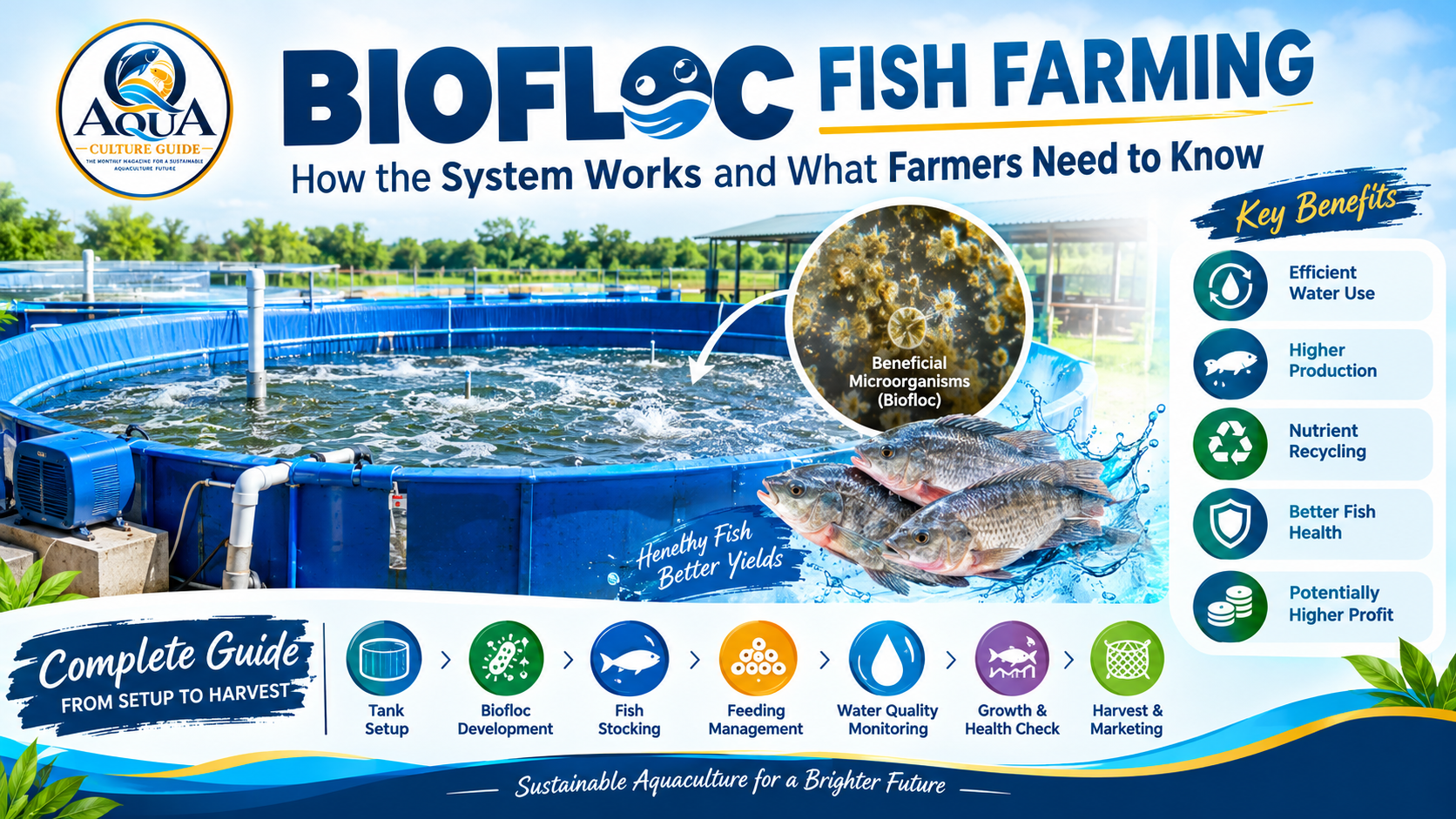
Learn how biofloc fish farming works, its benefits, tank setup, fish selection, water quality management, feeding, costs, and step-by-step practices for farmers in India.
Introduction
Biofloc fish farming is a modern aquaculture technique that allows farmers to raise fish in tanks by managing beneficial microorganisms and water quality. Unlike traditional fish farming, where a large pond is generally used, biofloc technology (BFT) can be operated in relatively small spaces with properly designed tanks, continuous aeration, and regular water-quality monitoring.
The main principle behind biofloc farming is to encourage beneficial microorganisms to convert nitrogenous waste, particularly waste associated with fish feed and excretion, into microbial biomass. These microorganisms form small suspended particles called bioflocs. Depending on the fish species and system conditions, fish may consume some of these particles as an additional source of nutrients.
Biofloc farming can help farmers use water and space efficiently and support intensive fish production. However, it is not a low-maintenance system. Successful farming requires reliable electricity, strong aeration, good-quality fish seed, appropriate feed, trained management, and daily monitoring.
What Is Biofloc Fish Farming?
Biofloc fish farming is an intensive aquaculture method in which beneficial microorganisms are encouraged to grow in the culture water and help recycle nutrients.
Fish release waste, and uneaten feed adds organic matter to the water. If this waste is not managed, ammonia and other harmful substances can accumulate. In a properly managed biofloc system, microorganisms use available nitrogen and organic carbon to form microbial aggregates. These aggregates remain suspended in the water with the help of continuous aeration and mixing.
The result is a culture system in which part of the waste nutrients is recycled rather than being removed immediately through frequent water exchange.
How Does the Biofloc System Work?
The biofloc system operates through a combination of fish production, microbial activity, aeration, and water-quality management.
1. Fish produce waste
Fish consume feed and release metabolic waste. Uneaten feed and faecal matter also contribute organic material to the tank.
- Microorganisms process nitrogenous waste
Beneficial microorganisms use available carbon and nitrogen to grow. With suitable management, this microbial activity can help reduce the accumulation of ammonia in the water.
- Bioflocs develop
Microorganisms combine with fine organic particles and other substances to form suspended flocs. These flocs contain a mixture of microbial biomass and organic matter.
4. Aeration supplies oxygen and keeps flocs suspended
Blowers, air diffusers, or suitable aeration equipment provide oxygen and maintain water movement. Adequate aeration is essential because fish and microorganisms both consume oxygen.
- Fish may consume some biofloc
Many suitable species can consume biofloc particles. This may contribute to their nutrition, but biofloc should not automatically be treated as a complete replacement for balanced commercial feed.
6. Farmers monitor and adjust the system
Farmers monitor dissolved oxygen, pH, temperature, ammonia, nitrite, alkalinity, solids, feeding, and fish behaviour. Corrective action is taken before poor water quality affects fish health.
Important: Biofloc is a managed biological system, not simply dirty or green water. Excessive solids, insufficient aeration, or unstable microbial activity can cause serious production problems.
Benefits of Biofloc Fish Farming
Efficient use of space
Biofloc tanks can be installed in a comparatively small area when suitable infrastructure and drainage are available. This can be useful for farmers who cannot construct large ponds.
Potentially lower water exchange
When the system is well established and properly managed, water exchange may be reduced compared with some conventional culture systems. Water still needs to be added to replace losses, and solids or poor-quality water may need to be removed.
Nutrient recycling
Microbial communities can convert part of the nitrogenous waste into microbial biomass, helping recycle nutrients within the production system.
Additional natural food
Fish that consume biofloc may obtain supplementary nutrients from microbial particles. The contribution varies with the fish species, floc composition, feed, and water conditions.
Production control
Tanks can make it easier to observe fish, measure feed consumption, sample growth, and manage individual culture units.
Potential for intensive production
Biofloc systems can support higher production per unit area than some traditional methods, but only when aeration, filtration or solids management, stocking density, and daily monitoring are appropriate.
Challenges Farmers Must Understand
Biofloc technology also has important limitations.
Electricity dependence: Aeration usually needs to operate continuously. Power failure can cause oxygen levels to fall rapidly.
Technical management: Farmers must understand water testing, microbial development, feeding, and solids control.
Initial investment: Tanks, blowers, diffusers, plumbing, electrical equipment, testing kits, and backup systems add costs.
Feed expenses: Commercial feed can remain a major operating cost.
Disease risks: Intensive stocking can increase the impact of disease and stress.
Solids accumulation: Excessive biofloc and sludge can reduce water quality and damage fish gills.
Market uncertainty: Selling price, survival, growth rate, and buyer demand determine profitability.
Best Fish Species for Biofloc Farming
Species selection is one of the most important decisions when planning a biofloc unit. Consider local market demand, seed availability, growth performance, tolerance of culture conditions, feed requirements, and applicable regulations.
1. Tilapia
Tilapia is commonly considered for intensive aquaculture because it grows relatively quickly under suitable conditions and can adapt to a range of culture systems. Farmers in India must follow the applicable government rules for tilapia species, seed sources, and culture practices.
Pangasius
Pangasius is commercially farmed in several regions and may be suitable for intensive production when stocking, aeration, feeding, and waste management are designed for the species and its expected size.
Magur and other air-breathing fish
Selected air-breathing fish, including suitable magur species, may be considered for tank culture. Confirm the exact species identity, seed quality, legal requirements, and appropriate stocking plan with a fisheries expert.
Common carp and other suitable freshwater species
Some freshwater species may be raised in biofloc under species-specific conditions. However, suitability should be verified before investment because not every fish performs equally well in a high-solids tank environment.
Farmer's tip: Do not select a fish species only because it is popular on social media. Speak with a fisheries department, aquaculture specialist, or experienced biofloc operator about local seed supply, buyer demand, water requirements, and a realistic production plan.
Step-by-Step Guide to Starting Biofloc Fish Farming
Step 1: Conduct a feasibility study
Before purchasing tanks, calculate the available space, water source, electricity requirements, seed availability, feed cost, labour, and expected selling price.
Contact potential buyers, wholesalers, retailers, or processors to understand the preferred fish size and likely demand.
Prepare a budget that includes both establishment costs and operating expenses for the entire production cycle.
Step 2: Select a suitable location
Choose a location that has:
Reliable electricity and a suitable backup power arrangement.
Access to clean water of appropriate quality.
Good drainage and wastewater management.
Protection from flooding, contamination, and extreme weather.
Space for feed storage, testing equipment, and routine maintenance.
Safe access for workers and harvesting.
Step 3: Choose the right tank
Biofloc systems may use suitable HDPE-lined, tarpaulin, fibreglass, or other engineered tanks. The material must be fish-safe, durable, and designed to withstand the pressure of the water.
Circular tanks are often useful for maintaining water circulation and directing settled waste towards a central drain when designed correctly.
Before filling the tank, check:
Tank stability and level foundation.
Liner condition and leak protection.
Drainage and sludge-removal arrangements.
Water inlet and overflow protection.
Aeration diffuser placement.
Safe access for sampling and harvesting.
Step 4: Install aeration and backup power
Aeration is one of the most critical parts of a biofloc unit. It provides oxygen for fish and microorganisms and helps keep bioflocs suspended.
Install an appropriately sized blower or aeration system with suitable diffusers. The required capacity depends on biomass, feed input, tank depth, water movement, and oxygen demand.
Before stocking:
Run the system and check every diffuser.
Confirm that aeration is distributed throughout the tank.
Check electrical wiring, connections, and protective equipment.
Test the backup power arrangement under realistic operating conditions.
Keep spare parts and emergency procedures ready.
Never stock fish until the aeration system and backup plan have been tested successfully.
Step 5: Prepare the tank and culture water
Clean the tank using a suitable method and rinse away residues. Fill it with water from a source that is safe for the selected fish species.
Test the source water before use. Check temperature, pH, alkalinity, hardness where relevant, and potential contaminants. If the water has been disinfected or treated, ensure that residual chemicals are no longer harmful before adding fish or establishing the microbial community.
Do not add unverified chemicals, fertilisers, soil, or homemade mixtures to the tank.
Step 6: Develop the biofloc
Biofloc development requires appropriate microbial activity, carbon availability, oxygen, mixing, and suitable water chemistry.
Farmers may establish biofloc using a validated protocol recommended by a fisheries institution or a qualified aquaculture specialist. The protocol should specify the carbon source, quantities, water conditions, inoculum if used, and monitoring schedule.
During development:
Maintain continuous aeration.
Monitor dissolved oxygen, pH, temperature, and nitrogenous waste.
Observe changes in water colour and suspended solids.
Measure floc volume with an Imhoff cone if this method is part of the management protocol.
Adjust carbon inputs only according to measured conditions and a validated plan.
Water color alone cannot confirm that a biofloc system is ready. Confirm that water quality is stable and the system is suitable for the intended fish before stocking.
Step 7: Purchase healthy fish seed
Buy healthy fingerlings or juveniles from a reputable hatchery or authorised supplier. Choose fish of reasonably uniform size and confirm that the species is correctly identified.
Check for active swimming, normal appearance, visible injuries, abnormal behaviour, and signs of disease. Ask the supplier about seed health, transport conditions, and any relevant health documentation.
Avoid mixing fish of widely different sizes if this may lead to competition, aggression, or uneven growth.
Step 8: Acclimatise and stock the fish
Acclimatise fish gradually to the tank water, following guidance appropriate to the species and transport conditions. Avoid sudden changes in temperature, pH, or other important water parameters.
Determine stocking density from the tank's actual water volume, fish size, expected harvest biomass, aeration capacity, water-quality management, and the species' requirements.
Start with a conservative, technically supported stocking plan if you are new to biofloc farming. Do not copy high stocking densities from a different farm without understanding its tank design, fish size, equipment, and management.
Record the stocking date, number of fish, average seed weight, supplier, and any initial mortality.
Step 9: Manage feeding correctly
Use a quality commercial feed formulated for the chosen species and life stage.
Good feeding practices include:
Follow the feed manufacturer's recommendations and adjust them according to fish size and actual consumption.
Feed at suitable intervals for the species and production stage.
Observe feeding behaviour and remove or reduce uneaten feed where appropriate.
Sample fish regularly to estimate average body weight.
Adjust the daily feed quantity as biomass changes.
Keep a daily record of feed supplied and any unusual feeding behaviour.
Step 10: Monitor water quality every day
Water quality must be monitored throughout the production cycle, not only during tank preparation.
Parameter
What farmers should do
Dissolved oxygen
Monitor frequently; maintain a safe level for the chosen species and production intensity.
Temperature
Measure regularly and keep within the species' suitable range.
pH
Monitor for sudden changes and maintain a stable, species-appropriate range.
Total ammonia nitrogen
Test regularly and interpret together with pH and temperature.
Nitrite
Monitor for accumulation and act before it reaches harmful levels.
Alkalinity
Check buffering capacity and follow a measured correction plan.
Biofloc volume and solids
Monitor using a consistent method; remove excess solids when required.
Fish behaviour
Watch for surface gasping, reduced feeding, unusual swimming, or sudden mortality.
Step 11: Control solids and remove accumulated sludge
Biofloc systems need solids management. Too much suspended material can stress fish, affect gill function, and increase oxygen demand.
Use the tank's designed drain or a suitable solids-removal arrangement to remove settled waste when necessary. Do not remove excessive beneficial floc indiscriminately.
Record floc readings and sludge removal so that changes in water quality can be linked to management actions.
Step 12: Monitor growth and fish health
Sample a representative group of fish at regular intervals using safe handling procedures.
Record:
Average body weight.
Size variation.
Feed consumption.
Estimated biomass.
Mortality and survival.
Water-quality readings.
Any disease signs or treatment.
Step 13: Plan the harvest
Harvest planning should begin before the fish reach market size.
Confirm buyer requirements, preferred fish size, harvest timing, transport arrangements, and current market prices. Estimate the quantity likely to be available and prepare equipment and labour in advance.
Handle fish carefully during harvesting and transport to minimise stress, injury, and quality loss. Clean and disinfect equipment using appropriate procedures before the next production cycle.
Step 14: Review the results before the next cycle
After harvest, compare actual performance with your original budget.
Review seed cost, feed cost, electricity, labour, survival, harvest biomass, average selling price, and other expenses. Identify the main causes of losses or better-than-expected results before changing stocking density or management in the next cycle.
Complete Biofloc Fish Farming Checklist
Before starting
Confirm local market demand and likely selling price.
Select a suitable fish species.
Check seed availability and supplier reliability.
Prepare a complete project budget.
Identify a suitable location and safe water source.
Confirm drainage and wastewater arrangements.
Check applicable permissions and species-specific regulations.
Consult a qualified fisheries or aquaculture specialist.
Tank and equipment preparation
Install a durable, fish-safe tank.
Check the foundation, liner, inlet, overflow, and drain.
Install correctly sized aeration equipment.
Test air distribution and water circulation.
Install and test backup power.
Keep spare aeration parts available.
Arrange safe storage for feed and testing supplies.
Water and biofloc preparation
Test source-water quality.
Prepare the tank using a suitable cleaning method.
Establish biofloc using a validated protocol.
Maintain aeration during biofloc development.
Measure dissolved oxygen, pH, temperature, and nitrogenous waste.
Monitor floc volume and solids where applicable.
Confirm that the system is stable before stocking.
Fish stocking
Purchase healthy, correctly identified seed.
Check fish condition on arrival.
Acclimatise fish gradually.
Calculate stocking density from system capacity.
Record stocking numbers, average weight, and date.
Keep a mortality and health log.
Daily and weekly management
Check aeration and backup power.
Observe fish behaviour and feeding response.
Test dissolved oxygen and other parameters according to the monitoring plan.
Feed the correct quantity and record feed use.
Check ammonia, nitrite, pH, and alkalinity at the planned frequency.
Monitor floc volume and remove excess solids as needed.
Sample fish growth at scheduled intervals.
Record mortality and investigate unusual changes.
Harvest and financial review
Confirm the target market size.
Contact buyers before harvest.
Arrange harvest equipment and transport.
Record total harvested biomass.
Calculate survival and feed conversion ratio.
Calculate total production cost and revenue.
Review the results before starting another cycle.
Cost of Biofloc Fish Farming
The cost of setting up a biofloc farm depends on the size and number of tanks, construction materials, blower capacity, backup electricity, water supply, testing equipment, seed, feed, labour, and local prices.
Main setup expenses
Tanks and supporting structures.
Blowers, diffusers, pipes, and fittings.
Electrical installation and backup power.
Water storage and drainage.
Water-testing equipment.
Nets, weighing equipment, and harvesting tools.
Main operating expenses
Fish seed.
Commercial feed.
Electricity or fuel.
Water and routine maintenance.
Labour.
Water-quality testing and approved farm inputs.
Health management and other operating costs.
Harvesting and transport.
How to Calculate Biofloc Fish Farming Profit
Profit depends on survival, average harvest weight, feed conversion ratio, feed price, electricity use, operating expenses, and the price received from buyers.
Use the following basic calculations:
Harvest biomass (kg)
Harvested fish number × average harvest weight in kg.
Survival rate (%)
(Number of fish harvested ÷ number of fish stocked) × 100.
Feed conversion ratio (FCR)
Total feed used (kg) ÷ net fish biomass gain (kg).
Gross revenue
Total saleable harvest weight (kg) × selling price per kg.
Operating profit estimate
Gross revenue − operating expenses.
For a full investment assessment, also account for tank and equipment depreciation, interest or financing costs, repairs, and other overheads. These simple calculations are planning tools, not a guarantee of profit.
Common Mistakes in Biofloc Fish Farming
- Stocking too many fish
Excessive stocking increases oxygen demand, waste production, and disease risk. Use a stocking plan that matches the equipment and the farmer's management ability.
- Ignoring backup power
A blower failure can rapidly create dangerous conditions. Test the backup system regularly and prepare an emergency response plan.
- Adding carbon without measurement
Carbon sources can help support microbial activity, but incorrect quantities may destabilise water quality and increase oxygen demand. Use a validated protocol and monitor the system.
- Feeding without tracking consumption
Excess feed increases waste and operating costs. Adjust feeding according to fish size, feeding response, and actual biomass.
- Failing to monitor ammonia and nitrite
Clear-looking water does not necessarily mean safe water. Use suitable testing methods and respond to results promptly.
- Neglecting solids management
Excessive floc and sludge can create poor conditions for fish. Monitor solids and remove accumulated waste appropriately.
- Expecting guaranteed returns
Production results vary with management, seed quality, mortality, market prices, and operating costs. Prepare conservative financial estimates and maintain records.
Is Biofloc Fish Farming Suitable for Beginners?
Biofloc farming may suit beginners who have access to technical training, reliable electricity, suitable water, a realistic budget, and a dependable market.
It may be unsuitable for farmers who cannot maintain aeration continuously, cannot test water regularly, or expect the system to run with little daily attention.
Before investing in a large commercial unit, consider practical training, a small pilot system, or supervised experience with an established farm. Scale up only after demonstrating stable water quality, good fish health, and a viable financial result.
Conclusion
Biofloc fish farming offers an opportunity to raise selected fish species in tanks while recycling part of the nutrients generated during production. Its success depends on more than tank installation: proper aeration, sound biofloc development, healthy seed, balanced feeding, water-quality monitoring, solids management, and market planning are all essential.
Farmers should begin with a technically sound design, receive practical training, and prepare a realistic budget before investing. By monitoring the system consistently and learning from each production cycle, farmers can make better decisions about whether biofloc farming is suitable for their business.
Aqua Culture Guide recommends: Consult a qualified aquaculture specialist or local fisheries institution before deciding stocking density, water-treatment inputs, or species-specific operating parameters.
Questions & Answers
Q1.What is biofloc fish farming?
Biofloc fish farming is an intensive aquaculture method that uses beneficial microorganisms to help recycle nitrogenous waste into microbial biomass while maintaining fish in aerated tanks.
Q2.Which fish are suitable for biofloc farming?
Selected species such as tilapia, pangasius, and certain air-breathing freshwater fish may be considered. Suitability depends on species-specific requirements, seed availability, local regulations, tank design, and market demand.
Q3.Does biofloc fish farming require daily attention?
Yes. Farmers need to monitor aeration, fish behaviour, feeding, water quality, and solids. A reliable emergency plan is especially important because the system depends heavily on aeration.
Q4.Is water exchange unnecessary in biofloc farming?
No. A well-managed system may reduce routine water exchange, but it still requires water replacement and, when necessary, removal of sludge or poor-quality water.
Q5.Can biofloc replace commercial fish feed?
Not in general. Biofloc may provide supplementary nutrition for suitable species, but a balanced diet remains essential for growth and health
Q6.What equipment is needed for biofloc fish farming?
A typical unit needs suitable tanks, a blower or aeration system, diffusers, pipes, a water supply and drainage arrangement, water-testing equipment, fish-handling tools, and a reliable backup power system.
Related articles
భారతీయ రిజర్వాయర్లలో కేజ్ ఫిష్ ఫార్మింగ్: సాంకేతికత, అనుమతులు మరియు పెట్టుబడి వివరాలు
భారతదేశంలోని రిజర్వాయర్లలో కేజ్ ఫిష్ ఫార్మింగ్ ఎలా ప్రారంభించాలి? అవసరమైన సాంకేతికత, ప్రభుత్వ అనుమతులు, పెట్టుబడి, చేపల జాతులు, మేత నిర్వహణ మరియు లాభనష్టాల గురించి పూర్తి వివరాలు తెలుసుకోండి.
Freshwater Prawn Farming in IndiaFreshwater Prawn Farming in India: రైతులకు పూర్తి సాగు మార్గదర్శిని
భారతదేశంలో మంచినీటి రొయ్యల సాగు ఎలా ప్రారంభించాలి? జెయింట్ ఫ్రెష్వాటర్ ప్రాన్ సీడ్ ఎంపిక, చెరువు తయారీ, స్టాకింగ్, ఆహారం, నీటి నాణ్యత, పెట్టుబడి, మార్కెటింగ్ గురించి పూర్తి వివరాలు తెలుసుకోండి.
Tilapia farming in Indiaభారతదేశంలో తిలాపియా చేపల పెంపకం – మార్కెట్ అవకాశాలు, ప్రభుత్వ నిబంధనలు మరియు ఆధునిక సాగు పద్ధతులు
భారతదేశంలో తిలాపియా చేపల పెంపకం ఎలా చేయాలి? మార్కెట్ అవకాశాలు, ప్రభుత్వ అనుమతులు, చెరువు సాగు, బయోఫ్లాక్, RAS విధానాలు, పిల్లల ఎంపిక, మేత నిర్వహణ మరియు దిగుబడి గురించి పూర్తి సమాచారం.
PCR Testing in Shrimp Hatcheriesరొయ్యల హ్యాచరీల్లో PCR పరీక్షలు: ఫలితాలను రైతులు ఎలా అర్థం చేసుకోవాలి?
WSSV, EHP, AHPND వంటి వ్యాధికారకాలను గుర్తించడంలో PCR పరీక్షల పాత్ర, పరీక్షా నివేదికలను అర్థం చేసుకోవడం, నాణ్యమైన రొయ్య పిల్లలను ఎంపిక చేసుకోవడం గురించి రైతులు తెలుసుకోవాల్సిన పూర్తి సమాచారం.
Explore Aqua Culture Guide
Aqua companies directory
Feed, seed, probiotics & equipment suppliers
Aquaculture calculators
Feed, FCR, stocking & water quality tools
Telugu aqua magazine
Read the latest monthly issue online
All aqua news & articles
Farming, disease control and market updates
List your company free
Get found by farmers across India
Advertise with us
Magazine and website advertising options