Aeration in Shrimp Farming: Paddlewheel vs Aspirator vs Other Systems
3/11/2026
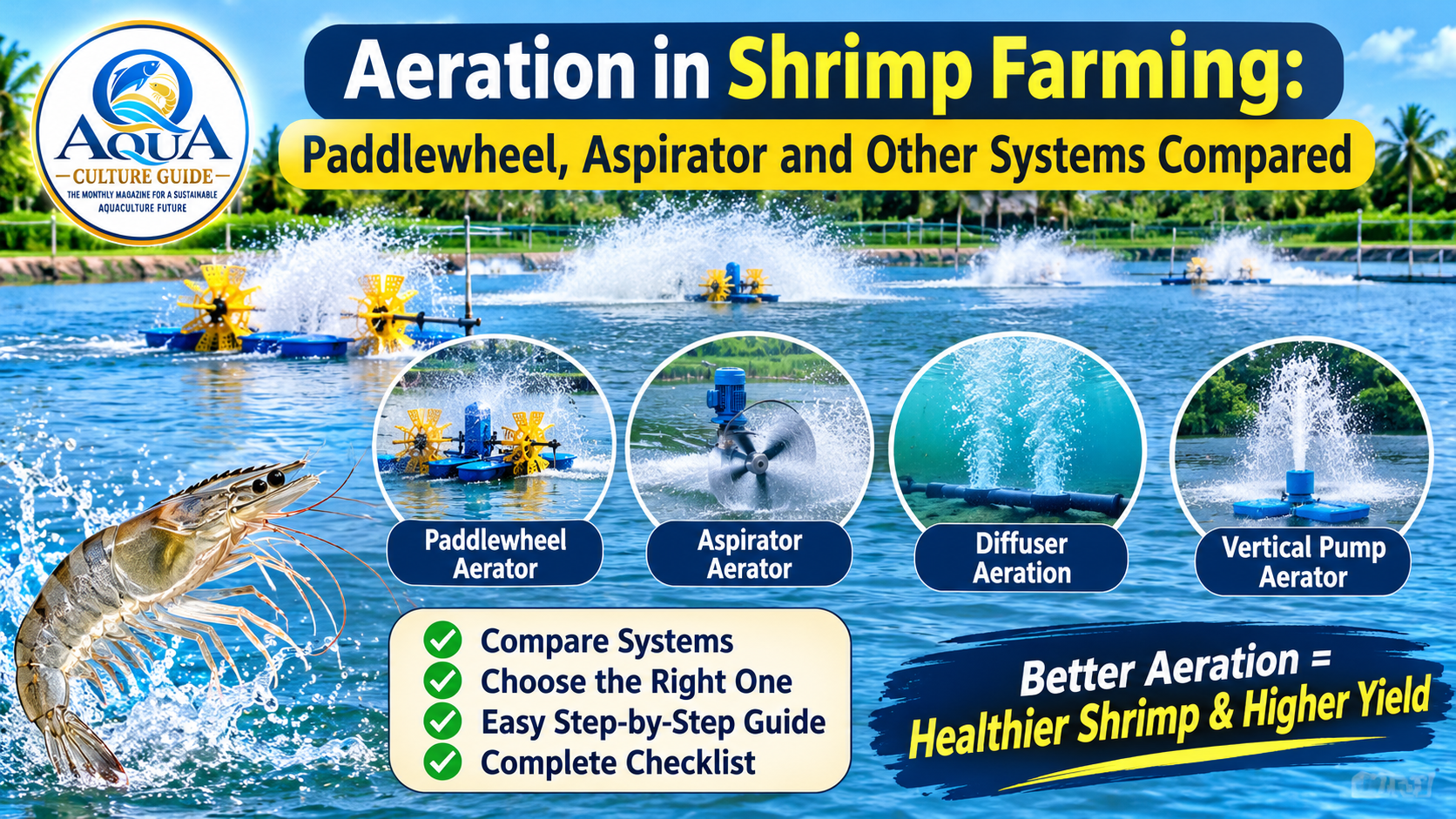
Learn about aeration systems in shrimp farming, including paddlewheel, aspirator, diffuser and vertical pump aerators. Compare their benefits, limitations, energy use and selection methods with a comp
Introduction
Aeration is one of the most important parts of successful shrimp farming. Shrimp need sufficient dissolved oxygen (DO) for respiration, feeding, digestion, growth and normal biological activities. When oxygen levels become low, shrimp may experience stress, reduced feeding, poor growth and, in severe cases, mortality.
As shrimp biomass increases, oxygen demand also increases. Uneaten feed, faecal matter, organic waste and microbial activity add to the oxygen demand in pond water. This makes proper aeration essential, particularly during nighttime and early morning when dissolved oxygen can fall.
Farmers use different aeration systems to maintain oxygen levels and improve water circulation. Common options include paddlewheel aerators, aspirator aerators, diffuser systems and vertical pump aerators. Each system has different working principles, energy requirements, advantages and limitations.
Choosing the right aerator depends on pond size, depth, stocking density, shrimp biomass, water quality, electricity availability and farm budget.
Why Is Aeration Important in Shrimp Farming?
Dissolved oxygen is essential for shrimp survival and pond ecosystem health.
The main benefits of proper aeration include:
Supports shrimp respiration and normal body functions.
Helps maintain feeding activity.
Supports growth and feed utilisation.
Helps maintain oxygen for beneficial aerobic microorganisms.
Supports the breakdown of organic matter under aerobic conditions.
Improves water circulation and reduces stagnant areas when properly positioned.
Helps reduce the risk of sudden oxygen shortages.
Aeration does not solve every water-quality problem. Farmers must also manage feeding, organic waste, pond-bottom conditions and water quality.
Understanding Dissolved Oxygen in Shrimp Ponds
Dissolved oxygen is the amount of oxygen available in water for aquatic animals and microorganisms.
It is usually measured in milligrams per litre (mg/L) or parts per million (ppm).
Shrimp ponds experience changes in dissolved oxygen throughout the day.
Daytime
During daylight, phytoplankton and aquatic plants produce oxygen through photosynthesis. Dissolved oxygen may increase, especially in ponds with active plankton populations.
Nighttime
At night, photosynthesis stops, but shrimp, plankton, bacteria and other organisms continue consuming oxygen through respiration.
As a result, dissolved oxygen gradually decreases.
Early Morning
Dissolved oxygen is often at its lowest level just before sunrise. This is one of the most important times for farmers to monitor pond oxygen.
Important DO Management Points
Monitor dissolved oxygen at different times of the day.
Pay special attention to late night and early morning.
Maintain suitable oxygen levels for the cultured shrimp and farm conditions.
Investigate sudden changes in oxygen readings.
Do not wait for shrimp to come to the surface before starting aeration.
As a general management target, many shrimp farms aim to maintain dissolved oxygen around 5 mg/L or higher where practical. The appropriate operating target depends on species, stocking density, culture conditions and farm management. Low oxygen requires immediate attention.
Types of Aeration Systems Used in Shrimp Farming
Different aerators transfer oxygen into water using different methods.
The most commonly used systems are:
Paddlewheel aerators.
Aspirator aerators.
Diffuser aeration systems.
Vertical pump aerators.
Propeller-aspirator systems.
Venturi aeration systems.
Let's understand each system.
Paddlewheel Aerator
Paddlewheel aerators are among the most commonly used aeration systems in commercial shrimp ponds.
How Does a Paddlewheel Aerator Work?
A paddlewheel aerator uses rotating blades or paddles to splash water into the air.
This increases contact between water and air, helping oxygen transfer into the pond.
The movement also creates water circulation and can help move water and suspended materials around the pond.
Advantages of Paddlewheel Aerators
Commonly used in commercial shrimp farms.
Provide both aeration and water circulation.
Help create water movement.
Available in different motor capacities and configurations.
Relatively straightforward to install and operate.
Can be arranged to create circulation patterns in suitable ponds.
Limitations of Paddlewheel Aerators
Consume electricity.
Require regular maintenance of motors, gearboxes and bearings.
Incorrect placement can create stagnant zones.
Excessive water movement may disturb pond-bottom sediment.
Performance depends on equipment design, water depth and operating conditions.
Best Suitable Applications
Paddlewheel aerators are commonly used in:
Commercial shrimp ponds.
High-biomass culture systems.
Ponds requiring strong surface aeration.
Farms where water circulation is an important management requirement.
Aspirator Aerator
Aspirator aerators use a motor-driven propeller to draw air into water and disperse it through the surrounding water.
How Does an Aspirator Aerator Work?
The rotating propeller creates water movement and draws atmospheric air into the water stream.
The air-water mixture improves contact between air and water, supporting oxygen transfer.
Advantages of Aspirator Aerators
Provide aeration and water movement.
Can create strong local circulation.
Useful in selected pond layouts.
Available in different designs and capacities.
May help direct water movement in specific pond areas.
Limitations of Aspirator Aerators
Performance depends on design and installation depth.
Can require significant electricity.
May create strong local water movement.
Require regular inspection and maintenance.
Oxygen transfer efficiency varies between models.
Best Suitable Applications
Aspirator aerators may be considered for:
Shrimp ponds requiring localised circulation.
Ponds with suitable depth and layout.
Farms where the equipment's performance has been verified under operating conditions.
Diffuser Aeration System
Diffuser systems release air through small openings in submerged diffusers, producing bubbles in the water.
They are generally connected to an air blower or compressor through pipes and air distribution lines.
How Does Diffuser Aeration Work?
Air is pumped through pipes to diffusers placed underwater.
The diffusers release bubbles, allowing oxygen transfer as the bubbles rise through the water.
Smaller bubbles generally provide more surface area for gas transfer, but actual performance also depends on diffuser design, water depth, airflow and maintenance.
Advantages of Diffuser Aeration
Can distribute air across selected pond areas.
Useful in deeper water and designed tank systems.
Can provide bottom-up water movement.
Allows air distribution through a pipe network.
Can be integrated into suitable recirculating systems.
Limitations of Diffuser Aeration
Requires an air blower or compressor.
Diffusers can become clogged.
Pipe systems need regular inspection.
Performance depends on water depth and diffuser specifications.
Shallow earthen ponds may require careful design to achieve suitable oxygen transfer and circulation.
Best Suitable Applications
Selected deep ponds.
Hatcheries and nursery systems.
Tanks and recirculating aquaculture systems.
Systems where distributed air supply is required.
Vertical Pump Aerator
Vertical pump aerators use a motor-driven pump or impeller to move water vertically and expose it to the atmosphere.
How Does It Work?
The equipment draws water and throws or sprays it into the air. This increases water-air contact and supports oxygen transfer.
Advantages
Creates surface water movement.
Supports localised aeration.
Can be useful in suitable pond layouts.
Relatively simple operating principle.
Limitations
Oxygen transfer depends on the design and installation.
May not provide uniform pond circulation.
Requires electrical power and maintenance.
Incorrect positioning may leave some areas poorly aerated.
- Propeller-Aspirator Aerator
Propeller-aspirator systems combine water movement with air intake.
A motor-driven propeller moves water while drawing air into the water stream.
Advantages
Provides water movement and air mixing.
Can help improve circulation in selected pond areas.
Useful in systems where localised aeration is required.
Limitations
Actual oxygen transfer depends on the model.
Requires proper positioning.
Needs regular motor and mechanical maintenance.
Performance may vary with water depth and operating conditions.
Venturi Aeration System
A venturi system uses flowing water through a specially designed nozzle to create a pressure drop that draws air into the water.
Advantages
Can introduce air without a separate air blower in some configurations.
Can be integrated into suitable water-pumping systems.
Useful for localised aeration and water mixing.
Limitations
Requires suitable water flow and pump pressure.
May increase pumping energy requirements.
Performance depends on nozzle design and installation.
May not provide sufficient aeration as a standalone system in high-biomass shrimp ponds.
Comparison of Different Aeration Systems
Paddlewheel Aerator
Main function: Surface aeration and water circulation.
Strength: Commonly used in commercial shrimp ponds.
Limitation: Requires correct placement and regular mechanical maintenance.
Suitable use: Commercial earthen shrimp ponds.
Aspirator Aerator
Main function: Air intake and water movement.
Strength: Can create localised circulation.
Limitation: Performance varies by model and installation.
Suitable use: Ponds where localised aeration is required.
Diffuser Aeration
Main function: Air distribution through submerged bubbles.
Strength: Can supply air to selected areas and depths.
Limitation: Diffusers and pipelines require maintenance.
Suitable use: Tanks, hatcheries, biofilters and suitably designed ponds.
Vertical Pump Aerator
Main function: Water spraying and surface aeration.
Strength: Provides localised water movement.
Limitation: May not provide uniform circulation.
Suitable use: Selected pond layouts and smaller systems.
Venturi Aerator
Main function: Air intake through flowing water.
Strength: Can be integrated into water circulation systems.
Limitation: Depends on suitable pump flow and pressure.
Suitable use: Localised aeration and water-mixing applications.
Important: No aerator is automatically the best or most energy-efficient choice for every farm. Compare actual oxygen transfer performance, power consumption, installation costs and operating conditions before purchasing.
How to Choose the Right Aeration System for Your Shrimp Pond
Before buying an aerator, farmers should consider the following factors.
A. Pond Size
The pond area and shape influence aerator placement and the number of units required.
B. Pond Depth
Different aerators perform differently at different water depths.
C. Stocking Density
Higher stocking densities generally increase oxygen demand.
D. Shrimp Biomass
As shrimp grow, oxygen consumption increases. Aeration planning should consider expected peak biomass, not only initial stocking density.
E. Feeding Rate
Higher feeding rates can increase oxygen demand through shrimp respiration and the decomposition of waste.
F. Electricity Availability
Check whether the farm has a reliable power supply and enough electrical capacity to operate all aerators.
G. Energy Consumption
Compare motor power, operating hours and expected electricity costs.
H. Maintenance Requirements
Consider spare parts, motor servicing, gearbox maintenance and diffuser cleaning.
I. Pond Circulation
Choose equipment and positioning that support suitable water movement without unnecessarily disturbing pond-bottom sediment.
Complete Checklist Before Buying Aerators
Use this checklist before selecting an aeration system.
Pond Assessment Checklist
Measure pond area.
Check average water depth.
Understand pond shape.
Identify shallow and deeper areas.
Check existing water circulation.
Review pond-bottom conditions.
Check stocking density.
Estimate expected peak shrimp biomass.
Review daily feeding requirements.
Identify areas where oxygen may become low.
Equipment Selection Checklist
Select the suitable type of aerator.
Check motor capacity.
Review actual oxygen transfer performance.
Check power consumption.
Check equipment construction and material quality.
Review installation requirements.
Confirm availability of spare parts.
Check manufacturer warranty.
Compare purchase and operating costs.
Confirm suitability for the pond's depth and layout.
Electrical Safety Checklist
Use suitable electrical protection.
Ensure proper earthing.
Protect electrical connections from water.
Use appropriate circuit breakers.
Check cables and connections regularly.
Use qualified electricians for installation.
Keep emergency electrical arrangements ready.
Operation and Maintenance Checklist
Check aerator operation daily.
Inspect motor temperature and unusual noise.
Check paddles, propellers and bearings.
Inspect pipes and diffusers where applicable.
Monitor electricity consumption.
Keep spare parts available.
Maintain a backup aeration plan.
Record equipment maintenance.
Step-by-Step Guide to Planning and Installing Aeration in Shrimp Ponds
Step 1: Assess the Pond
Measure the pond area, depth and shape.
Understand the existing water movement and identify areas where circulation is weak.
Step 2: Estimate Shrimp Biomass
Estimate the expected shrimp biomass throughout the culture cycle.
Remember that oxygen demand increases as shrimp grow and feed consumption rises.
Step 3: Check Dissolved Oxygen
Measure dissolved oxygen at different times, especially late at night and early in the morning.
Use the readings to understand the pond's oxygen requirements.
Step 4: Select the Suitable Aerator
Choose between paddlewheel, aspirator, diffuser, vertical pump or other systems based on pond conditions.
For many commercial earthen shrimp ponds, paddlewheel aerators are a common choice. Other systems may be useful in specific designs.
Step 5: Calculate Aeration Requirements
Aeration requirements should be based on expected peak biomass, oxygen demand, pond conditions and actual equipment performance.Do not select the number of aerators using pond area alone.
Consult an aquaculture engineer or experienced technical professional when designing a high-density system.
Step 6: Plan Aerator Placement
Position aerators to create suitable pond circulation.
Avoid leaving large stagnant areas and avoid creating excessive water movement that disturbs bottom sediment.
The correct arrangement depends on pond shape, aerator type and local conditions.
Step 7: Install Equipment Safely
Install aerators according to the manufacturer's instructions.
Ensure that:
The equipment is securely fixed.
Electrical connections are protected.
Proper earthing is provided.
Cables are safely routed.
Moving parts are protected where necessary.
Step 8: Test the Aeration System
Run the equipment and check its operation.
Observe:
Water movement.
Splashing or air distribution.
Unusual vibration.
Motor noise.
Electrical safety.
Water circulation patterns.
Step 9: Monitor Dissolved Oxygen
Measure dissolved oxygen at different pond locations and depths.
Check late-night and early-morning oxygen levels to determine whether aeration is adequate.
Step 10: Adjust Aerator Operation
Adjust the number of operating units and operating hours according to dissolved oxygen readings, shrimp biomass, feeding rate and weather conditions.
Do not depend only on a fixed timer when pond oxygen demand changes.
Step 11: Prepare Backup Arrangements
Maintain a backup plan for power failures and equipment breakdowns.
Possible arrangements include:
Standby aerators.
Backup generators.
Emergency power connections.
Regular equipment inspection.
A clear emergency response procedure.
Step 12: Maintain Daily Records
Record:
Dissolved oxygen readings.
Aerator operating hours.
Electricity consumption.
Number of aerators running.
Equipment problems.
Maintenance activities.
Shrimp feeding response.
Weather conditions.
These records help farmers improve aeration planning and control operating costs.
Common Aeration Mistakes in Shrimp Farming
Installing aerators without calculating oxygen requirements.
Depending only on pond area when selecting equipment.
Ignoring early-morning dissolved oxygen readings.
Installing all aerators in one area.
Creating excessive water movement near the pond bottom.
Ignoring electricity consumption.
Not maintaining motors and mechanical components.
Operating aerators without checking actual DO levels.
Having no backup during power failures.
Increasing stocking density without reviewing aeration capacity.
How to Reduce Aeration Electricity Costs
Electricity is a major operating expense in many shrimp farms.
Farmers can improve energy management through the following practices:
Select properly sized and efficient equipment.
Compare oxygen transfer performance per unit of power.
Maintain motors, bearings and gearboxes.
Clean diffusers when required.
Position aerators to avoid unnecessary water movement.
Monitor dissolved oxygen before adjusting operating hours.
Use automatic DO monitoring and control where practical.
Avoid unnecessary operation while maintaining safe oxygen levels.
Maintain a suitable stocking density.
Keep records of energy consumption and shrimp biomass.
Never reduce aeration simply to save electricity if dissolved oxygen is already low or shrimp are under stress.
Emergency Aeration Management During Low Oxygen
Low dissolved oxygen can become a serious problem, especially at night and early morning.
Watch for warning signs such as:
Shrimp gathering near pond edges.
Shrimp moving towards water inlets.
Reduced feeding activity.
Unusual swimming behaviour.
Shrimp showing signs of stress.
If low oxygen is suspected:
Measure dissolved oxygen immediately.
Start available aerators.
Activate backup power if necessary.
Check oxygen levels at different pond locations.
Stop or reduce feeding temporarily if advised by the farm's emergency management plan.
Investigate the cause of oxygen depletion.
Monitor shrimp behaviour and DO continuously.
Seek technical support if the problem continues.
Do not wait for visible stress signs before responding to a low-oxygen reading.
Conclusion
Aeration plays a major role in successful shrimp farming. Paddlewheel, aspirator, diffuser, vertical pump and venturi systems all provide different ways to transfer oxygen and move water.
Paddlewheel aerators are widely used in commercial shrimp ponds because they combine surface aeration with water circulation. Aspirator and vertical pump systems can provide useful localized water movement, while diffuser systems are valuable in selected tanks, biofilters and suitably designed ponds.
There is no single aeration system that is best for every farm. Farmers should consider pond size depth, shrimp biomass, oxygen demand, energy consumption, equipment performance and maintenance requirements before making a decision.
Good aeration management means maintaining suitable dissolved oxygen, proper water circulation, reliable equipment and a backup plan for emergencies.
Questions & Answers
Q1.Why is aeration important in shrimp farming?
Aeration helps maintain dissolved oxygen, supports shrimp respiration, improves water circulation and supports aerobic biological processes in the pond.
Q2.Which aerator is best for shrimp farming?
Paddlewheel aerators are commonly used in commercial shrimp ponds. However, the best choice depends on pond design, depth, stocking density, biomass, energy costs and equipment performance.
Q3.What is the difference between paddlewheel and aspirator aerators?
Paddlewheel aerators use rotating paddles to splash water and improve surface oxygen transfer. Aspirator aerators draw air into water using a propeller-based system and create localised water movement.
Q4.What is a diffuser aeration system?
A diffuser system uses a blower or compressor to push air through submerged diffusers, producing bubbles that support oxygen transfer.
Q5.When is dissolved oxygen lowest in shrimp ponds?
Dissolved oxygen is often lowest just before sunrise because photosynthesis stops at night while shrimp, plankton and microorganisms continue consuming oxygen.
Q6.What dissolved oxygen level should shrimp farmers maintain?
Many farms aim for around 5 mg/L or higher where practical. The appropriate target depends on the species, stocking density, culture conditions and farm management.
Q7.How many paddlewheel aerators are required per acre?
There is no universal number for every pond. Requirements depend on peak shrimp biomass, pond depth, oxygen demand, equipment capacity and actual oxygen transfer performance.
Related articles
భారతీయ రిజర్వాయర్లలో కేజ్ ఫిష్ ఫార్మింగ్: సాంకేతికత, అనుమతులు మరియు పెట్టుబడి వివరాలు
భారతదేశంలోని రిజర్వాయర్లలో కేజ్ ఫిష్ ఫార్మింగ్ ఎలా ప్రారంభించాలి? అవసరమైన సాంకేతికత, ప్రభుత్వ అనుమతులు, పెట్టుబడి, చేపల జాతులు, మేత నిర్వహణ మరియు లాభనష్టాల గురించి పూర్తి వివరాలు తెలుసుకోండి.
Freshwater Prawn Farming in IndiaFreshwater Prawn Farming in India: రైతులకు పూర్తి సాగు మార్గదర్శిని
భారతదేశంలో మంచినీటి రొయ్యల సాగు ఎలా ప్రారంభించాలి? జెయింట్ ఫ్రెష్వాటర్ ప్రాన్ సీడ్ ఎంపిక, చెరువు తయారీ, స్టాకింగ్, ఆహారం, నీటి నాణ్యత, పెట్టుబడి, మార్కెటింగ్ గురించి పూర్తి వివరాలు తెలుసుకోండి.
Tilapia farming in Indiaభారతదేశంలో తిలాపియా చేపల పెంపకం – మార్కెట్ అవకాశాలు, ప్రభుత్వ నిబంధనలు మరియు ఆధునిక సాగు పద్ధతులు
భారతదేశంలో తిలాపియా చేపల పెంపకం ఎలా చేయాలి? మార్కెట్ అవకాశాలు, ప్రభుత్వ అనుమతులు, చెరువు సాగు, బయోఫ్లాక్, RAS విధానాలు, పిల్లల ఎంపిక, మేత నిర్వహణ మరియు దిగుబడి గురించి పూర్తి సమాచారం.
PCR Testing in Shrimp Hatcheriesరొయ్యల హ్యాచరీల్లో PCR పరీక్షలు: ఫలితాలను రైతులు ఎలా అర్థం చేసుకోవాలి?
WSSV, EHP, AHPND వంటి వ్యాధికారకాలను గుర్తించడంలో PCR పరీక్షల పాత్ర, పరీక్షా నివేదికలను అర్థం చేసుకోవడం, నాణ్యమైన రొయ్య పిల్లలను ఎంపిక చేసుకోవడం గురించి రైతులు తెలుసుకోవాల్సిన పూర్తి సమాచారం.
Explore Aqua Culture Guide
Aqua companies directory
Feed, seed, probiotics & equipment suppliers
Aquaculture calculators
Feed, FCR, stocking & water quality tools
Telugu aqua magazine
Read the latest monthly issue online
All aqua news & articles
Farming, disease control and market updates
List your company free
Get found by farmers across India
Advertise with us
Magazine and website advertising options