Aeration in Shrimp Farming: Paddlewheel vs Aspirator and Other Systems
25/10/2026
Compare paddlewheel, aspirator, diffuser and other aeration systems for shrimp farming. Learn how to choose, install, operate and maintain pond aerators.
Introduction
Aeration is one of the most important parts of successful shrimp farming. Shrimp need sufficient dissolved oxygen (DO) for respiration, feeding, growth, and normal activity. When oxygen levels fall, shrimp may reduce feeding, become stressed, grow poorly, or die in severe cases.
As shrimp biomass increases, the pond's oxygen demand also rises. Feed waste, organic matter, plankton respiration, and microbial activity can further increase oxygen consumption, especially at night and during periods of cloudy weather.
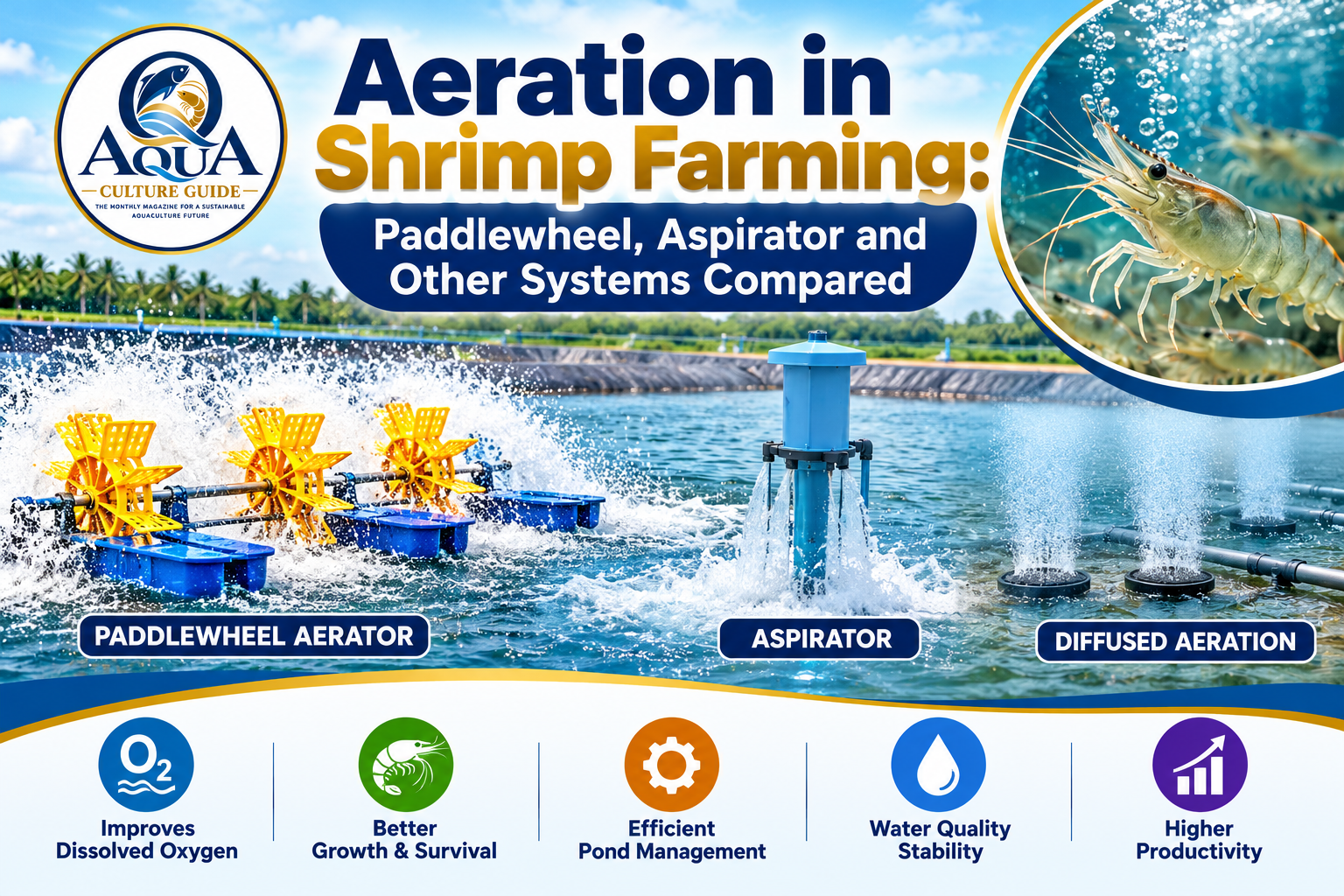
Different aeration systems are available for shrimp ponds, including paddlewheel aerators, aspirator aerators, diffused-air systems, and propeller-aspirator pumps. Each system works differently and has its own advantages, operating costs, and limitations.
Choosing the right aerator is not simply about buying the most powerful machine. Farmers should consider pond size and depth, stocking density, biomass, water circulation, oxygen demand, electricity availability, maintenance requirements, and the cost of operation
Why Is Aeration Important in Shrimp Farming?
Aeration does more than add oxygen. It also helps circulate pond water and distribute oxygen throughout the culture area. In shrimp ponds, circulation is important because shrimp spend much of their time near the bottom, where oxygen can become depleted as organic matter accumulates.
The main purposes of aeration are:
- Maintain dissolved oxygen: Supply oxygen when natural processes cannot meet shrimp and microbial demand.
- Improve water circulation: Reduce stagnant areas and help distribute oxygenated water.
- Support feeding and growth: Help maintain suitable conditions for normal feeding and metabolism.
- Manage intensive production: Support the higher oxygen demand associated with greater shrimp biomass and feed inputs.
- Reduce oxygen-related stress: Help prevent dangerous oxygen depletion when correctly sized and operated.
Types of Aeration Systems Used in Shrimp Farming
- Paddlewheel aerator
Rotating paddles splash and move pond water, increasing contact between water and air. Paddlewheels are widely used in shrimp ponds because they provide both oxygen transfer and water circulation.
- Aspirator aerator
A motor-driven propeller or jet draws air into moving water and disperses it into the pond. The exact performance depends on the design, installation depth, water conditions, and circulation pattern.
- Diffused-air system
A blower or compressor pushes air through pipes and submerged diffusers. Rising bubbles transfer some oxygen and create water movement. This system may be useful as part of a combined aeration strategy.
- Vertical pump or spray aerator
A pump lifts water and sprays it into the air. The resulting droplets increase contact with air and return to the pond. Suitability depends on the pond layout and the unit's oxygen-transfer performance.
- Propeller-aspirator pump
A propeller moves water while drawing in air. These units can be useful in certain pond layouts, but farmers should check actual oxygen-transfer performance and water circulation rather than relying only on motor power.
Paddlewheel vs Aspirator vs Other Systems: Comparison
Feature Paddlewheel Aspirator Diffused air Vertical pump/spray
Main action Splashes and moves water Draws air into moving water Releases air bubbles underwater Sprays water into air
Water circulation Generally strong when positioned correctly Depends on model and placement Usually gentler; depends on diffuser layout Depends on pump design
Typical pond use Common in semi-intensive and intensive ponds Supplementary or system-specific aeration Often used in combined systems or suitable pond designs Depends on pond size and configuration
Installation Floats or long-arm assembly Mounted or floating, depending on model Requires blower, pipes, and diffusers Requires pump and suitable mounting
Maintenance Paddles, bearings, gearbox, motor Impeller, air intake, motor, and seals Blower, filters, pipes, and diffusers Pump, impeller, and motor
Main consideration Positioning, current, and energy use Verify real-world efficiency and circulation Bubble size and pond depth affect oxygen transfer Confirm oxygen transfer and circulation
Best choice? Often a strong starting point for pond circulation Depends on the particular model and objective Can complement surface aeration Useful in suitable designs
Advantages and Limitations of Each System
Paddlewheel aerators
Advantages
- Widely used and familiar to shrimp farmers.
- Can generate strong horizontal circulation.
- Helps move oxygenated water across the pond.
- Available in different motor sizes and configurations.
Limitations
- Can consume significant electricity during long operating periods.
- Incorrect positioning may create excessive currents or leave dead zones.
- Moving parts require regular inspection.
- Strong currents can disturb the pond bottom if equipment is poorly positioned.
Aspirator aerators
Advantages
- Can introduce air while moving water.
- May suit particular pond shapes or supplementary aeration needs.
- Some designs are compact and straightforward to install.
Limitations
- Performance varies considerably by design.
- Some units may provide less oxygen transfer or circulation than expected.
- Actual performance in farm water may differ from laboratory ratings.
Diffused-air systems
Advantages
- Air can be delivered to selected parts of the pond.
- May complement surface aerators and help manage local oxygen conditions.
- Can be useful in suitable low-water-exchange or specialised systems.
Limitations
- Requires a blower, air lines, diffusers, and regular maintenance.
- Diffuser blockage and air leaks can reduce performance.
- In shallow shrimp ponds, bubbles may rise too quickly for the system to achieve the expected oxygen-transfer efficiency.
Vertical pump and spray aerators
Advantages
- Create water droplets and increase contact with air.
- Can suit certain pond layouts and smaller systems.
- May be useful for specific circulation or supplementary aeration requirements.
Limitations
- Performance depends on the pump and spray design.
- Splashing may be less effective under some conditions.
- Water movement may not reach all areas of a large pond.
A combined system can be effective when each component has a clear purpose. For example, research in closed-cycle shrimp farms found that combining paddlewheels with a diffused-air system was useful for maintaining oxygen conditions while reducing some problems associated with excessive paddlewheel-driven bottom erosion.
How to Choose the Right Aeration System for Your Shrimp Pond
Before purchasing an aerator, evaluate the following factors.
- Pond area and depth: The pond's shape, water depth, and layout affect how oxygen and water circulate.
- Shrimp biomass: Oxygen demand generally increases as shrimp grow and total biomass rises.
3. Feeding rate: Higher feed inputs can increase oxygen demand from shrimp and microbial decomposition.
- Dissolved oxygen readings: Measure oxygen at different locations and times, especially before sunrise.
- Pond-bottom condition: Areas with accumulated sludge may need better circulation and improved waste management.
- Electricity and operating costs: Compare power consumption, expected operating hours, maintenance costs, and equipment efficiency.
- Emergency backup: Consider backup power and a standby aerator for power failures or sudden oxygen depletion.
- Manufacturer specifications: Check rated oxygen-transfer performance, energy consumption, warranty, and local service support.
Step-by-Step Guide to Planning and Managing Pond Aeration
Step- 1: Assess your pond and production target
Record pond area, average depth, stocking density, expected harvest biomass, feeding rate, and pond-bottom condition. These details help estimate the pond's oxygen demand.
Step-2: Measure dissolved oxygen
Use a calibrated DO meter. Take readings at several locations and depths, particularly in the early morning when oxygen may be lowest. Repeat measurements as biomass and feed inputs increase.
Step-3: Estimate aeration requirements
Work with an aquaculture technician to estimate oxygen demand and select suitable equipment. Consider actual oxygen-transfer performance, water circulation, pond conditions, and a contingency margin for high-demand periods.
Step-4: Select the aerator type
Choose paddlewheel, aspirator, diffused air, spray aeration, or a combination based on the pond's requirements. Compare energy use and manufacturer performance data under relevant conditions.
Step-5: Position equipment for useful circulation
Arrange paddlewheels to create a planned circulation pattern without excessive current or bottom erosion. Place other units according to their design and the areas needing oxygen delivery. Check for stagnant zones and uneven DO.
Step-6: Set an operating schedule
Use DO readings, feeding rate, biomass, weather, and previous oxygen trends to plan operation. Oxygen often declines overnight, so early morning deserves special attention. Avoid switching off essential aeration simply to save electricity when oxygen demand remains high.
Step-7: Prepare an emergency response plan
Keep backup power or a standby aerator ready where feasible. If DO falls dangerously, start available aeration immediately, verify readings, and reduce or suspend feeding temporarily as appropriate. Investigate the cause and follow farm emergency procedures.
Step-8: Maintain and review performance
Inspect motors, electrical connections, bearings, paddles, impellers, air pipes, and diffusers as applicable. Record DO, running hours, energy consumption, maintenance, and shrimp performance. Adjust the plan as biomass increases.
Dissolved Oxygen: What Should Shrimp Farmers Monitor?
Dissolved oxygen is one of the most useful indicators for managing aeration.
The Marine Products Export Development Authority (MPEDA) provides a general DO reference range of 4–6 mg/L for shrimp farming. The appropriate operating target depends on the species, production system, temperature, salinity, and farm conditions.
Monitoring item Why it matters
Early-morning DO Helps identify overnight oxygen depletion
Afternoon DO Helps assess daily variation and possible excessive photosynthesis
DO at different pond locations Reveals uneven circulation or low-oxygen zones
Shrimp feeding response Reduced feeding can indicate stress or other problems
Weather and water colour Cloudy weather or sudden plankton changes may alter oxygen conditions
Aerator running hours Helps track energy use and operating needs
Shrimp biomass and feed input Helps anticipate increasing oxygen demand
Practical note: If oxygen falls below your farm's safe operating target, act promptly rather than waiting for shrimp to show visible distress. If shrimp gather near the surface or aerators, investigate oxygen depletion and other possible causes immediately.
Complete Aeration Management Checklist
Use this checklist before stocking and throughout the culture cycle.
Before stocking
[ ] Pond area and water depth are recorded.
[ ] Aerator capacity has been reviewed for the production target.
[ ] Equipment is securely installed and tested.
[ ] Electrical connections and safety protection are checked.
[ ] Backup aeration or power arrangements are planned.
Daily monitoring
[ ] Early-morning dissolved oxygen is measured.
[ ] DO is checked at relevant pond locations.
[ ] Feeding behaviour and shrimp activity are observed.
[ ] Weather, water colour, and sudden changes are recorded.
[ ] Aeration hours are adjusted to actual oxygen demand.
Equipment maintenance
[ ] Motors, bearings, and gearboxes are inspected.
[ ] Paddles, impellers, and floats are checked.
[ ] Air pipes and diffusers are checked for leaks or blockages.
[ ] Electrical safety and backup equipment are checked.
[ ] Running hours and maintenance are recorded.
Ongoing production management
[ ] Aeration requirements are reviewed as biomass increases.
[ ] Feed input and oxygen demand are considered together.
[ ] Stagnant areas and excessive currents are investigated.
[ ] Energy consumption is reviewed without compromising oxygen safety.
[ ] An emergency low-oxygen response plan is available to farm staff.
Common Aeration Mistakes to Avoid
- Installing too few aerators: Oxygen demand may increase substantially as shrimp biomass and feeding rates rise.
- Choosing by horsepower alone: Motor power does not tell you the actual oxygen-transfer rate or circulation pattern.
- Ignoring early-morning readings: Afternoon DO can be high while oxygen drops overnight.
- Creating excessive currents: Poor positioning can increase shrimp energy expenditure and disturb the pond bottom.
- Ignoring maintenance: Worn paddles, damaged impellers, clogged diffusers, and air leaks reduce performance.
- Operating without monitoring: A fixed schedule may not match changing oxygen demand or weather conditions.
- Having no backup plan: Power failures can create a serious oxygen emergency in intensive ponds.
- Focusing only on aeration: Excess feeding, accumulated sludge, and poor water quality also need attention.
Conclusion
Aeration is essential for maintaining dissolved oxygen and suitable water circulation in many shrimp farming systems. Paddlewheel aerators are popular because they perform both functions, while aspirator, diffused-air, and spray systems may provide benefits in specific situations or as part of a combined setup.
The most effective approach is to select equipment based on pond conditions and oxygen demand, monitor dissolved oxygen regularly, position aerators carefully, maintain equipment, and prepare for emergencies.
Remember: the best aeration system is not necessarily the most powerful one—it is the system that reliably meets your pond's oxygen needs with appropriate circulation and operating costs.
Questions & Answers
Q1.Which aerator is best for shrimp farming?
Paddlewheel aerators are widely used because they provide both oxygen transfer and water circulation. Aspirators, diffused-air systems, and other aerators may suit specific situations. The best choice depends on pond design, oxygen demand, energy efficiency, and actual performance.
Q2.What is the difference between a paddlewheel and an aspirator aerator?
A paddlewheel splashes and moves pond water to promote oxygen transfer and circulation. An aspirator draws air into moving water. Their oxygen-transfer rates and circulation patterns vary by model and operating conditions.
Q3.Are diffused-air systems suitable for shrimp ponds?
They can be suitable in certain systems, particularly as part of a combined aeration arrangement. However, shallow ponds may limit oxygen-transfer efficiency because bubbles have less time to remain in contact with water.
Q4.When should aerators be operated?
Operation should be based on measured DO, shrimp biomass, feeding rate, weather, and oxygen trends. Night-time and early morning are important monitoring periods because oxygen can decline when photosynthesis stops.
Q5.How much dissolved oxygen do shrimp need?
A general reference range used in Indian shrimp-farming guidance is 4–6 mg/L. Farms should establish suitable operating targets for their particular production system and respond promptly when DO approaches unsafe levels.
Q6.Can more aerators improve shrimp growth?
Adequate aeration supports suitable culture conditions, but adding more equipment does not automatically improve growth. Aeration must be sized and positioned correctly while maintaining appropriate feeding, water quality, and stocking density.
Q7.Does aeration help manage pond-bottom problems?
Proper circulation can help move oxygenated water across the pond, but excessive currents may erode the bottom or redistribute sludge. Aeration should be combined with suitable sludge and organic matter management.
Related articles
భారతీయ రిజర్వాయర్లలో కేజ్ ఫిష్ ఫార్మింగ్: సాంకేతికత, అనుమతులు మరియు పెట్టుబడి వివరాలు
భారతదేశంలోని రిజర్వాయర్లలో కేజ్ ఫిష్ ఫార్మింగ్ ఎలా ప్రారంభించాలి? అవసరమైన సాంకేతికత, ప్రభుత్వ అనుమతులు, పెట్టుబడి, చేపల జాతులు, మేత నిర్వహణ మరియు లాభనష్టాల గురించి పూర్తి వివరాలు తెలుసుకోండి.
Freshwater Prawn Farming in IndiaFreshwater Prawn Farming in India: రైతులకు పూర్తి సాగు మార్గదర్శిని
భారతదేశంలో మంచినీటి రొయ్యల సాగు ఎలా ప్రారంభించాలి? జెయింట్ ఫ్రెష్వాటర్ ప్రాన్ సీడ్ ఎంపిక, చెరువు తయారీ, స్టాకింగ్, ఆహారం, నీటి నాణ్యత, పెట్టుబడి, మార్కెటింగ్ గురించి పూర్తి వివరాలు తెలుసుకోండి.
Tilapia farming in Indiaభారతదేశంలో తిలాపియా చేపల పెంపకం – మార్కెట్ అవకాశాలు, ప్రభుత్వ నిబంధనలు మరియు ఆధునిక సాగు పద్ధతులు
భారతదేశంలో తిలాపియా చేపల పెంపకం ఎలా చేయాలి? మార్కెట్ అవకాశాలు, ప్రభుత్వ అనుమతులు, చెరువు సాగు, బయోఫ్లాక్, RAS విధానాలు, పిల్లల ఎంపిక, మేత నిర్వహణ మరియు దిగుబడి గురించి పూర్తి సమాచారం.
PCR Testing in Shrimp Hatcheriesరొయ్యల హ్యాచరీల్లో PCR పరీక్షలు: ఫలితాలను రైతులు ఎలా అర్థం చేసుకోవాలి?
WSSV, EHP, AHPND వంటి వ్యాధికారకాలను గుర్తించడంలో PCR పరీక్షల పాత్ర, పరీక్షా నివేదికలను అర్థం చేసుకోవడం, నాణ్యమైన రొయ్య పిల్లలను ఎంపిక చేసుకోవడం గురించి రైతులు తెలుసుకోవాల్సిన పూర్తి సమాచారం.
Explore Aqua Culture Guide
Aqua companies directory
Feed, seed, probiotics & equipment suppliers
Aquaculture calculators
Feed, FCR, stocking & water quality tools
Telugu aqua magazine
Read the latest monthly issue online
All aqua news & articles
Farming, disease control and market updates
List your company free
Get found by farmers across India
Advertise with us
Magazine and website advertising options